Best Cat Carriers for Vet Visits: A Buyer’s Guide (2026)

A buyer's guide built from specifications, warranties and return policies, not hands-on testing. Facts and prices checked October 13, 2026. We may earn a commission if you buy through links on this page. It never changes what we recommend. As an Amazon Associate we earn from qualifying purchases. How we research
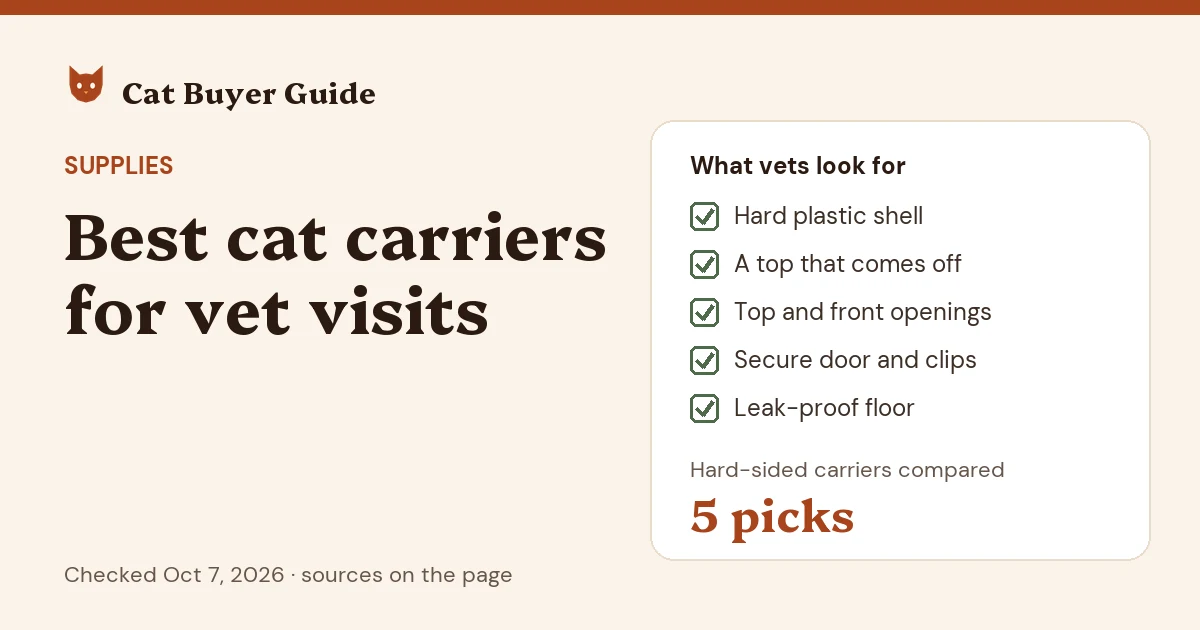
The best cat carrier for vet visits is a hard plastic one that opens from the top as well as the front, with a top half that comes off. The vet can then lift the top away and examine your cat while it stays in the bottom half, where many cats feel safer and less anxious. That is the advice of the Feline Veterinary Medical Association (FelineVMA, formerly the American Association of Feline Practitioners) and International Cat Care. A good carrier should also lock securely, clean easily and fit your cat.
This is a buyer’s guide built from the makers’ published specifications, warranties and return policies, checked on Oct 7, 2026 (the key specs and Amazon listings were re-checked on Oct 13, 2026). It is not a hands-on test: we didn’t buy, handle or try any of these carriers.
The short answer
- Best overall: Petmate Two Door Top Load Kennel (top and front doors; the top comes off).
- Best for large cats: Ferplast Atlas 30 Open (snap-off top; pets up to 12 kg, about 26 lb).
- Widest top opening: Catit Cabrio (opens to both sides; cats up to 25 lb).
- Front-loading pick: Petmate Vari Kennel, 24-inch (10 to 20 lb).
- Budget pick: Petmate Top Load Cat Kennel (one top door; up to 10 lb).
What vets recommend in a cat carrier
FelineVMA’s owner guide is direct: “A hard plastic carrier is the safest and easiest to clean.” It advises choosing one with a top that comes off, so your cat can stay in the bottom of the carrier during the checkup (FelineVMA). Its Cat Friendly Homes site adds that a carrier should open at both the top and the front, or have a very large round opening, so you can lower in a cat that won’t walk in (Cat Friendly Homes).
International Cat Care (iCatCare) favors solid plastic carriers: easy to clean, with quick-release clips, a secure door, ventilation slats and a removable top half for the vet (iCatCare). Its guide for owners warns that soft fabric carriers can collapse and are hard to keep clean, that backpack carriers swing your cat around, and that carriers with no removable top or top opening make the exam harder (iCatCare guide).
Vets’ own guidelines agree. The 2022 AAFP/ISFM Cat Friendly Veterinary Interaction Guidelines tell the clinic team to let a cat come out on its own and, if it won’t, to take off the top half and examine it in the bottom. If a carrier’s top can’t be opened or removed, they suggest encouraging the owner to replace it (Rodan et al., 2022). The earlier AAFP/ISFM handling guidelines, endorsed by the American Animal Hospital Association (AAHA), add that a carrier should be sturdy, secure, stable, easy to carry and quiet to open, so the noise doesn’t startle the cat (2011 guidelines).
The criteria at a glance
| What to look for | Why it matters | Sources |
|---|---|---|
| Hard plastic shell | Safest and easiest to clean; soft carriers can collapse | FelineVMA, iCatCare |
| A top that comes off | The vet can examine your cat in the bottom half | FelineVMA, AAFP/ISFM 2022 |
| Top and front openings | Lower a nervous cat in; let a calm one walk out | Cat Friendly Homes, iCatCare |
| Secure door and clips | Your cat can’t get loose on the way | iCatCare, FelineVMA |
| Leak-proof floor | Cats may urinate, vomit or drool on the trip | Cat Friendly Homes, iCatCare |
| Vents and a cover | Fresh air, plus a towel over it to hide under | iCatCare, FelineVMA 2025 |
| The right size | Room to move comfortably, not to slide around | FelineVMA, iCatCare |
| Quiet to open | A noisy opening can startle your cat | AAFP/ISFM 2011 |
| One carrier per cat | Travel stress can make even friendly cats clash | FelineVMA, iCatCare |
Five carriers that meet the criteria
Every spec below comes from the maker’s own page (we converted Ferplast’s metric sizes). Treat a weight limit as a ceiling.
| Carrier | Openings | How the top comes off | Pet weight limit |
|---|---|---|---|
| Petmate Two Door | Top and front | Wing nuts | 10 lb (19-inch), 15 lb (24-inch) |
| Ferplast Atlas Open | Top and front | Push-fit side hooks | 8 kg (Atlas 20), 12 kg (Atlas 30) |
| Catit Cabrio | Top (both sides) and front | Not stated by Catit | 25 lb |
| Petmate Vari Kennel | Front | Wing nuts | 10 to 20 lb (24-inch) |
| Petmate Top Load | Top | Screws and nuts (screwdriver) | 10 lb |
1. Best overall: Petmate Two Door Top Load Kennel
Petmate’s two-door kennel has the features vets ask for most: a heavy-duty plastic and steel wire build, a door on top and another in front, and two halves joined by screws and wing nuts. Petmate lists this kennel among those its wing-nut hardware fits, so the top comes off once you undo the wing nuts.
- 19-inch: 19.4 x 12.8 x 10 inches outside (16.75 x 11 x 9.25 inside), for pets up to 10 lb. The kennel weighs 3.8 lb.
- 24-inch: 24 x 16.8 x 14.5 inches outside (21 x 14.5 x 13.5 inside), for pets up to 15 lb. It weighs 6.43 lb.
- Material: Petmate’s EcoTEC plastic, at least 90% pre-consumer recycled, made in the USA; other parts are imported.
- Warranty: one-year limited.
Best for: kittens and most adult cats: a top door for a reluctant cat, a front door for one that walks in.
Watch out for: wing nuts are slower to undo than clips. Petmate’s FAQ says its warranty covers only purchases from Petmate or an authorized dealer, so check who is selling before you buy.
See the Petmate Two Door Top Load Kennel (19-inch) on Amazon · See the Petmate Two Door Top Load Kennel (24-inch) on Amazon
2. Best for large cats: Ferplast Atlas 30 Open
Ferplast, an Italian maker, gives its Atlas Open carriers a plastic shell, a plastic-coated iron front door that clips shut from the outside, and a metal grid on top that opens as a second door, which Ferplast says helps with uncooperative cats. The halves snap together with side hooks: Ferplast’s assembly sheet shows four push-fit hooks, which you open to lift the top off. A bowl and a washable cotton cushion come with it.
- Atlas 30 Open: 60 x 40 x 38 cm (about 23.6 x 15.7 x 15 inches), for pets up to 12 kg (about 26.5 lb). Ferplast designed this size for large cats and small dogs.
- Atlas 20 Open: 58 x 37 x 32 cm (about 22.8 x 14.6 x 12.6 inches), for pets up to 8 kg (about 17.6 lb).
- Warranty: none stated for US buyers. Ferplast’s own online store sells only in Europe, so returns and claims go through the seller.
Best for: large cats (the Atlas 30), and anyone who wants a top that unclips instead of unscrewing.
Watch out for: the Amazon listings don’t use the Atlas name, so check that the one you open lists the size above and a double (top and front) opening.
See the Ferplast Atlas 30 Open on Amazon · See the Ferplast Atlas 20 Open on Amazon
3. Widest top opening: Catit Cabrio
The Cabrio’s top opens to both sides, so you can lower your cat straight in with the front door shut, or open one side and slide it in from the flank. The clear front door locks with one hand. Catit also lists vents in the front, top and bottom, an anti-slip floor with a gutter that catches urine or spilled food, and a feeding door with slide-out bowls.
- Size: 20 x 13 x 13.75 inches, for cats up to 25 lb and up to 13.75 inches tall from head to front paws.
- Build: Catit’s page describes it as hard-sided, but doesn’t name the material, list a warranty or say whether the top lifts off completely.
Best for: large or long cats that won’t walk into a carrier.
Watch out for: Catit says you can loop a seat belt through the handle. FelineVMA advises belting only crash-test-certified carriers, which Catit doesn’t claim, so let it ride on the floor behind a front seat.
See the Catit Cabrio on Amazon · Catit’s own Cabrio page
4. Front-loading pick: Petmate Vari Kennel (24-inch)
Petmate’s classic Vari Kennel has a single front door, but its halves are held by wing nuts and bolts that need no tools, so the vet can still lift the top off. Petmate lists a squeeze-latch door, vents all around and an interior moat that keeps pets dry.
- Size: 24.1 x 16.7 x 14.5 inches outside (21.5 x 15 x 13.5 inside), for pets of 10 to 20 lb. It weighs 5 lb.
- Material: EcoTEC plastic, made in the USA; other parts are imported.
- Warranty: one-year limited, with the same authorized-dealer rule as above.
Best for: bigger cats that walk into a carrier on their own.
Watch out for: with no top door, a reluctant cat has to go in through the front or with the top off.
See the Petmate Vari Kennel (24-inch) on Amazon
5. Budget pick: Petmate Top Load Cat Kennel
The simplest carrier here is a hard plastic kennel with one big door in the roof, which Petmate says is twice the size of a front-entry door. It was also the lowest-priced of the four hard carriers in our new kitten checklist price check.
- Size: 19.4 x 12.8 x 10 inches, for pets up to 10 lb. It weighs 2.9 lb.
- Build: durable plastic held together with screws and hex nuts, with vents all around.
- Warranty: none listed on Petmate’s page.
Best for: kittens and small cats, on a tight budget.
Watch out for: there is no front door, so your cat can’t walk out on its own, and taking the top off needs a screwdriver. The vet can still lift your cat out through the wide top door.
See the Petmate Top Load Cat Kennel on Amazon
How we chose, and what we left out
- We started from the vet criteria, then read each maker’s product, warranty and FAQ pages on Oct 7, 2026, keeping only hard-sided carriers whose makers publish the size, a pet weight limit and how the carrier opens.
- We left out MidWest’s Spree top-door carrier (no weight limit published), IRIS USA’s two-door carriers (unavailable on IRIS’s own store), Catit’s smaller Cat Carrier (only a small petting door on top), and soft or backpack carriers, which FelineVMA and iCatCare advise against for vet trips.
- Petmate’s own store takes returns within 30 days. For an Amazon order, the seller’s return policy applies.
- Prices change daily, so we don’t show any here. For what a carrier and the other first supplies cost, see our new kitten checklist.
Getting your cat used to the carrier
Vet guidelines call reward-based carrier training the gold standard and say it shortens exams (Rodan et al., 2022). Our guide on how to get a cat used to a carrier goes step by step; here is the short version.
Leave the carrier out where your cat likes to be, with familiar bedding and a few treats or toys inside, so it becomes furniture, not a sign of the vet (FelineVMA; iCatCare). Then work through FelineVMA’s six steps, moving on only when your cat is relaxed:
- Encourage your cat to lie on a security blanket.
- Put the blanket in the bottom half of the carrier.
- Add the top, and help your cat stay calm.
- Encourage your cat to stay inside with the door closed.
- Slowly increase the time in the closed carrier.
- Lift the carrier from underneath, never by the handle alone, until your cat is comfortable being carried.
On visit day:
- Spray a synthetic feline pheromone on the bedding or a towel 15 minutes to 4 hours before you leave, while your cat isn’t nearby (FelineVMA).
- If your cat isn’t trained yet, bring it and the carrier into a small room with few hiding places, and don’t chase it (AAFP/ISFM 2011). If it panics, iCatCare suggests wrapping it in a familiar towel and lowering it in through a top opening.
- Cover the carrier with a towel, put it on the floor behind a front seat, keep the car quiet and comfortable, and never open the carrier on the way (FelineVMA).
- With a kitten, try occasional short car rides early on (AAFP/ISFM 2011). The AAHA/AAFP life stage guidelines note that teaching a cat to come for a treat helps with carrier training.
Talk to your vet
- If your cat stays very frightened, or drools or vomits in the car despite training, ask your vet about medicine before visits; never give one your vet hasn’t prescribed.
- Ask whether you can offer treats in the carrier on visit day.
- Tell the clinic if your cat urinates, defecates or vomits in the carrier; it can mean your cat is frightened or feeling sick (iCatCare).
Cat carrier FAQ
Are top-loading cat carriers better for vet visits?
For most cats, yes. A top door lets you lower a nervous cat in and the vet lift it out gently. Best of all is a top that comes off, so the exam can happen in the bottom half (Cat Friendly Homes; FelineVMA).
Is a soft-sided carrier OK for the vet?
Vet groups prefer hard plastic, and iCatCare says soft carriers can collapse and are hard to clean. If you use one, FelineVMA says it should open wide at the top, have one or ideally two doors, and have a door opening that doesn’t collapse. Skip backpacks: FelineVMA and iCatCare say they are cramped or swing too much.
Should I seat-belt the carrier in the car?
Only if it is crash-test certified. FelineVMA’s 2025 position statement says to put carriers on the floor behind the driver’s or passenger’s seat, and to use seat belts only with carriers certified by the Center for Pet Safety, because a belt can crush a carrier that isn’t. None of the five makers here claims that certification.
What size carrier does my cat need?
One your cat can move around in comfortably, but not so big that it slides about (FelineVMA; iCatCare). Go by the maker’s weight limit: a 19-inch carrier rated to 10 lb suits kittens and small cats, while a large adult needs a model rated for its full weight. Each cat needs its own carrier.
What’s the best cat carrier for anxious cats?
A top that comes off matters even more, so your cat can stay hidden in the bottom half; add a towel over the carrier and training at home. For some cats, FelineVMA says, medicine from the vet before the trip helps, so ask yours.
Sources
- FelineVMA: Visiting Your Veterinarian, Getting Your Cat to the Veterinary Practice (client brochure, 2024), checked Oct 13, 2026
- Cat Friendly Homes (FelineVMA): Choosing the Perfect Cat Carrier, checked Oct 13, 2026
- FelineVMA: 2025 Transportation of Cats in Motor Vehicles (position statement), checked Oct 7, 2026
- Rodan et al.: 2022 AAFP/ISFM Cat Friendly Veterinary Interaction Guidelines (JFMS), checked Oct 7, 2026
- Rodan et al.: AAFP and ISFM Feline-Friendly Handling Guidelines (2011, endorsed by AAHA), checked Oct 7, 2026
- AAHA and AAFP: 2021 Feline Life Stage Guidelines (Quimby et al.), checked Oct 7, 2026
- International Cat Care: Travelling with your cat (updated Sept. 26, 2025), checked Oct 7, 2026
- International Cat Care: Taking your cat to the vet (updated Sept. 26, 2025), checked Oct 7, 2026
- International Cat Care: Taking your cat to the veterinary clinic, a guide for cat carers (2022), checked Oct 7, 2026
- Center for Pet Safety: CPS Certified products, checked Oct 7, 2026
- Petmate: E-Z Load Two Door Dog and Cat Kennel (specs and warranty), checked Oct 13, 2026
- Petmate: Tri Wing 0.75-inch hardware for kennels (fits the 2 Door Top Load Kennels), checked Oct 13, 2026
- Petmate: E-Z Load Top Load Cat Kennel, checked Oct 7, 2026
- Petmate: Vari Kennel (specs and warranty), checked Oct 7, 2026
- Petmate: FAQs (warranties and authorized dealers), checked Oct 7, 2026
- Petmate: Refund policy, checked Oct 7, 2026
- Ferplast: Atlas Open carrier (sizes 10, 20 and 30), checked Oct 7, 2026
- Ferplast: Atlas 10-20 Open assembly and disassembly sheet, checked Oct 7, 2026
- Ferplast blog: Atlas, the right carrier for your pet, checked Oct 7, 2026
- Ferplast: Shipping (countries its online store serves), checked Oct 7, 2026
- Catit: Cabrio Carrier, checked Oct 13, 2026