How to Find a Good Cat Breeder (and Avoid a Bad One)

Built from dated data and expert sources, not hands-on pet testing. Facts and prices checked October 7, 2026. No affiliate links on this page. How we research
To find a good cat breeder, start with the CFA and TICA breeder lists, breed clubs and cat shows. Then check the breeder yourself. A good one tests the parents for the breed’s inherited diseases, shows you the mother and kittens in person or on live video, keeps kittens until about 12 to 16 weeks, and sells with a written contract. A registry listing is a place to start, not a seal of approval.
The short answer
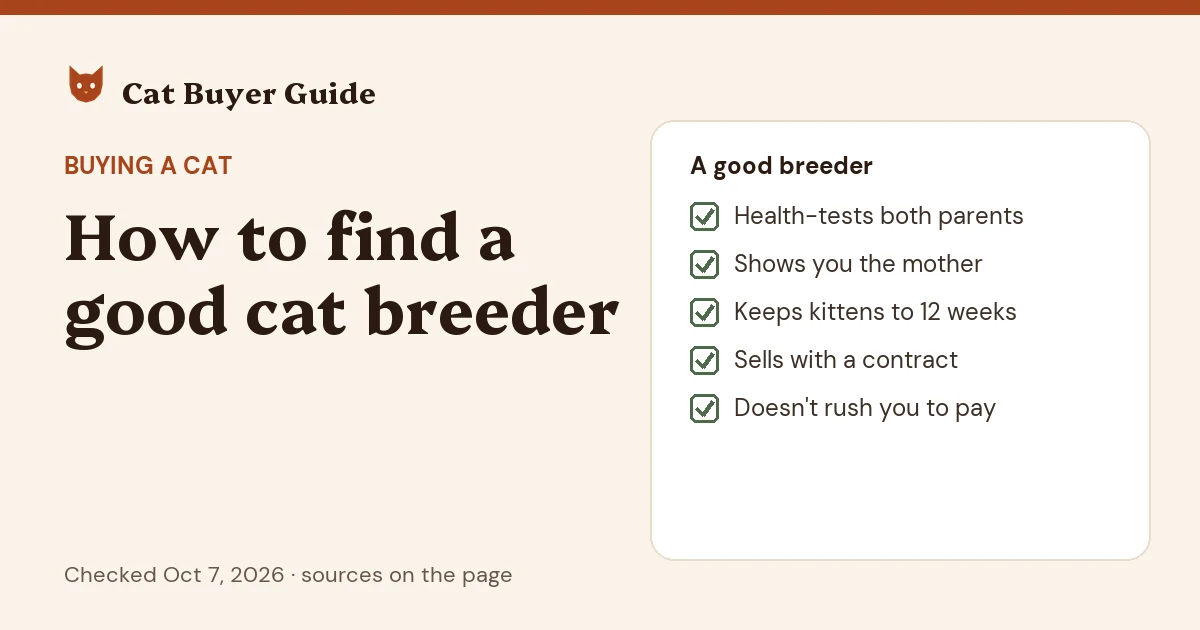
A reputable cat breeder:
- Tests both parents for the breed’s known inherited diseases, and shows you the reports.
- Lets you see the mother and kittens, at home or on a live video call.
- Keeps kittens until 12 weeks or older, after at least two vaccinations.
- Sells with a written contract covering a health guarantee, spay/neuter, the papers and what happens if you can’t keep the cat.
- Answers every question, asks you plenty, and doesn’t rush you to pay.
We checked the registries’ codes, listings and disclaimers, the UC Davis genetic tests and veterinary guidance on Oct 7, 2026.
We don’t list catteries
Cat Buyer Guide doesn’t list, rank or endorse catteries. If an old link brought you here looking for this domain’s “approved catteries” pages, the site changed hands in 2026 and doesn’t publish them.
On this page
- How to find a reputable cat breeder
- What listings and “approved cattery” badges mean
- What good breeders do: the CFA and TICA codes
- Health tests to ask about, by breed
- The visit: in person or on live video
- The contract: what it should cover
- Questions to ask a cat breeder
- Warning signs: when to walk away
- Cat breeder FAQ
How to find a reputable cat breeder
Registry lists. CFA’s Find a Breeder and TICA’s breeder listings list breeders by breed and location. CFA’s list includes only catteries that opt in: when we checked, it had 211 listings in all and none for 11 breeds. Its Cattery Name Index has every registered cattery name.
Breed clubs. TICA’s buyer guide suggests checking whether a breeder belongs to a reputable club for the breed. Some clubs list breeders who agree to the club’s code of ethics. Treat those lists as a place to start, too.
Cat shows. TICA’s leaflet and CFA’s magazine suggest a cat show to meet breeders and see their cats; check the CFA and TICA calendars. Exhibitors are busy around judging, so ask when they have a minute, and don’t touch a cat without permission (CFA; TICA). A kitten offered for sale at a CFA show must be at least 4 months old and CFA-registered (rule 10.24).
Referrals. A responsible breeder will put you in touch with past buyers (World Cat Congress), and reputable breeders with no kittens due are happy to refer you to others (CFA’s magazine). You can also ask for the breeder’s vet as a reference, though some clinics won’t give one (CFA’s magazine). For an adult cat, try breed rescue: there are rescues for specific breeds (FTC), and many breed clubs have welfare groups that rehome their breed (International Cat Care).
Where not to look. CFA’s magazine says reliable breeders aren’t on Craigslist or other sites that aren’t just for cats, and CFA says reputable breeders don’t sell through pet stores. International Cat Care says to avoid dealers.
What listings and “approved cattery” badges mean
A listing means a cattery is on a registry’s records, not that anyone inspected it. CFA makes no representations about the breeding or business practices of breeders it lists. TICA says its registered breeders meet its standards for responsible breeding, but its disclaimer says it doesn’t endorse listed breeders unless noted and won’t settle disputes between buyers and sellers.
Badges vary, and only some involve an inspection:
| Label | What it means | Keep in mind |
|---|---|---|
| CFA cattery name | A registered name, $100 for five years | It identifies the breeder; it isn’t an inspection |
| TICA Outstanding Cattery | A signed voluntary code, and a vet scored the cattery at least 75 of 88 | Renewed yearly; suspended after 3 formal complaints in 12 months |
| CFA Distinction | CFA’s Cattery of Distinction: bred at least 10 grand champions or grand premiers | A show record, not a health or welfare check |
| ACFA Distinction | ACFA’s Cattery of Distinction: passed a facility inspection by a vet or government inspector | Valid one year; ACFA itself doesn’t inspect |
| CFA Approved Cattery | An older voluntary CFA vet-inspection program, with “Approved Cattery” and “Cattery of Excellence” tiers (2024 page, FAQ) | Each award lasted one year; we found no current page for it on CFA’s site in October 2026 |
If a breeder shows a badge, ask who issued it, what it required and when it expires.
How to check a registration
- Look the cattery up in CFA’s Cattery Name Index or TICA’s listings; if it isn’t there, ask the registry.
- Contact the breeder through the details the registry lists, not just the ad. Our kitten scam guide explains why.
- Ask which registry the litter is registered with, and for the parents’ registered names and numbers. CFA’s registration rules put the breeder’s cattery name, if any, at the start of each kitten’s registered name, so it should match the breeder you’re dealing with.
What good breeders do: the CFA and TICA codes
CFA’s Breeder Code of Ethics is a pledge by breeders who use CFA’s services. TICA’s Outstanding Cattery code is voluntary, for breeders seeking that status.
| Topic | CFA code | TICA Outstanding Cattery code |
|---|---|---|
| Kittens leave | Not before “a proper level of immunity” | After at least two vaccinations for panleukopenia, rhinotracheitis and calicivirus |
| Health | No sale of a sick or exposed kitten without telling you | Health guaranteed at sale; you’re urged to see your own vet within a few days |
| Contract | Not covered (beyond honest dealing) | A written agreement with all the terms, which the breeder keeps to |
| Spay/neuter | Not covered | Before the kitten leaves if possible, or by 12 months; papers after a vet’s proof |
| Care | Housing above CFA’s minimum standard; vet care as needed | A vet inspects the cattery every year |
| After the sale | Direct placement, or staying in touch to advise | Prompt answers to buyers’ questions |
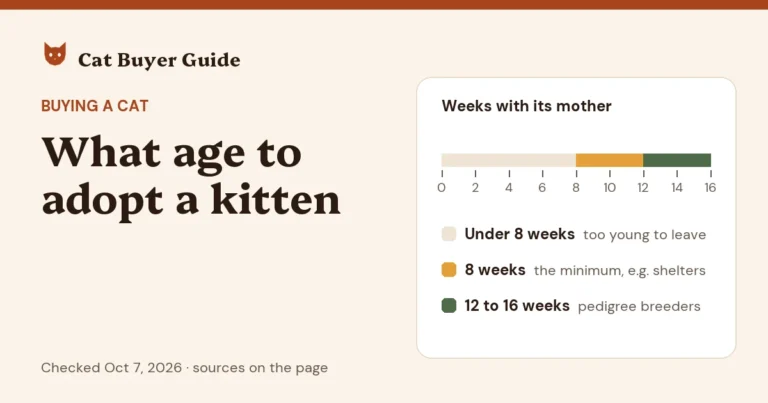
Neither code sets a number of weeks or promises to take a cat back. TICA’s leaflet says most responsible breeders let kittens go at 14 weeks or older, and CFA’s magazine says 12 to 16 weeks, depending on the breed; see what age to adopt a kitten. For take-backs, International Cat Care says a good breeder should be willing to take a kitten back if serious problems arise, and RSPCA Australia says a responsible breeder should accept a cat returned for an inherited disorder at any time.
Health tests to ask about, by breed
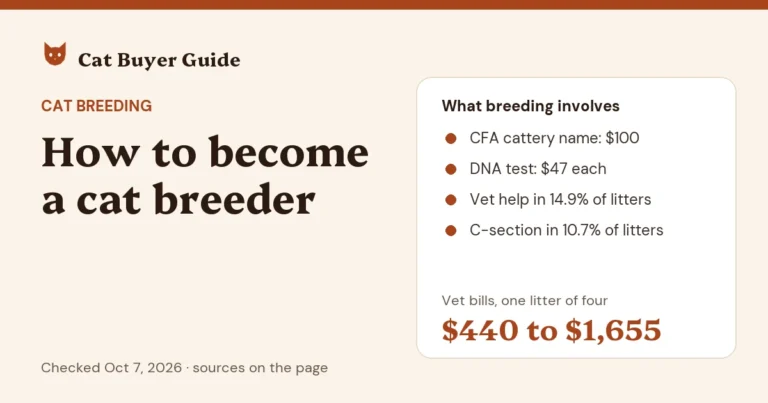
Inherited diseases are more common in pedigree cats (International Cat Care), and several have a cheek-swab DNA test. At the UC Davis Veterinary Genetics Laboratory, one test costs $47 per cat (checked Oct 7, 2026). Ask which tests both parents have had, and ask to see the reports. Examples:
| Breed | Ask about | Tests |
|---|---|---|
| Persian, Exotic | Polycystic kidney disease (PKD) | PKD1 DNA test; it also matters for Himalayans, British Shorthairs, Scottish Folds and other breeds with Persian ancestry |
| Maine Coon | HCM (a heart disease), spinal muscular atrophy | HCM and SMA DNA tests, plus heart scans |
| Ragdoll, RagaMuffin | HCM | Ragdoll HCM DNA test, plus heart scans |
| Abyssinian, Somali | PK deficiency (anemia), PRA (blindness) | PK deficiency and PRA rdAc DNA tests |
| Bengal | PK deficiency, PRA, HCM | PK deficiency and PRA-b DNA tests; ask about heart scans |
| Burmese | Hypokalemia (muscle weakness), GM2 gangliosidosis | Hypokalemia and GM2 DNA tests |
| Sphynx, Devon Rex | Congenital myasthenic syndrome (muscle weakness); HCM in Sphynx | CMS DNA test; ask about heart scans for Sphynx |
What the results mean, according to UC Davis:
- Clear (N/N): the cat doesn’t have the variant and can’t pass it on.
- Carrier of a recessive disease (PK deficiency, PRA, SMA): healthy, but two carriers are expected to produce about one affected kitten in four. Ask for both parents’ results.
- PKD is dominant: one copy means the cat has the disease and passes it to about half its kittens. Both parents should test negative.
HCM needs more than a swab. Each UC Davis HCM test finds one mutation, and the Maine Coon one isn’t the only cause of HCM in the breed, UC Davis notes. Cornell calls a heart ultrasound (echocardiogram) the gold standard for diagnosing HCM, and International Cat Care advises that breeding Maine Coons and Ragdolls get both tests, with a scan every year while breeding. Cornell also lists British Shorthair, Sphynx and Bengal among the breeds where HCM is more common.
Ask whether a vet took the sample and whether the report shows the cat’s microchip number, as International Cat Care recommends.
One problem no test fixes: in Scottish Folds, the gene that folds the ears also affects cartilage and bone, and even one copy can cause problems (UC Davis).
Talk to your vet
Before you choose a breeder, ask your vet which tests matter for the breed; International Cat Care says vets can talk you through them. A clear result covers only the variant tested. Once your kitten is home, have your own vet check it within a few days, and keep it apart from your other cats until then (Cornell).
The visit: in person or on live video
Ask questions first: what the kittens met in their first 8 weeks, such as people, visitors and household noise, and what the mother is like with people (International Cat Care). CFA’s magazine suggests an open question, “How do you socialize your kittens?”, then listening.
Many breeders now limit home visits for safety, CFA’s magazine says, but they should offer photos and live video instead. TICA’s checklist says to visit if you can and to see the parents in person or on video. A seller who offers neither is a warning sign; our scam guide shows how to test a video call.
What to look at:
- The mother: healthy, relaxed and confident with people. Kittens copy her, and friendliness is partly inherited (International Cat Care).
- The litter: ask to see all the kittens; they should look healthy too.
- The home: clean, not smelly or crowded. Look elsewhere if there are litters of many ages, several breeds or rooms full of cats (International Cat Care). If cats live in pens, CFA’s minimum standard calls for litter cleaned daily, no wire-mesh floors and at least 30 cubic feet for a single cat of 4 pounds or more.
- The kitten’s health: bright, clear eyes; a clean nose and ears; a clean coat with no bald patches or flaky skin; a clean bottom; not thin or pot-bellied (Cornell; TICA; International Cat Care).
- Temperament: after a little caution, the kitten should play with a feather or ribbon and let you hold it briefly (TICA). Be wary of one that keeps hiding or seems lethargic (Cornell).
Be ready to walk away. International Cat Care warns against buying out of pity, and CFA’s magazine says not to take a kitten that looks ill. When the day comes, pick the kitten up in person if you can.
The contract: what it should cover
TICA’s leaflet says a responsible breeder sells only with a written contract that includes a health guarantee. Read it before you pay a deposit, and keep a copy signed by both of you. It should cover:
- Deposit: a small one is normal; ask when it’s refunded. A large nonrefundable deposit is a warning sign (CFA’s magazine).
- Health guarantee: what it covers, including inherited conditions, how long it lasts, and the remedy, such as a refund or replacement (CFA; CFA’s magazine).
- Vet check: time for your own vet to examine the kitten within a few days (TICA), and what happens if the vet finds a problem.
- Records: vaccinations, deworming and the microchip registration, if chipped (CFA’s magazine; TICA).
- Spay/neuter and papers: the deadline, and when you get the registration papers. Holding papers until you send a vet’s proof is common (CFA).
- Registration details: the registry, date of birth, the parents’ registration numbers, and whether the kitten is sold with or without breeding rights. If a breeder never sends the papers, CFA asks for a signed sales agreement with these details that says CFA papers will be provided.
- If it doesn’t work out: whether the breeder takes cats back or has a right of first refusal (CFA’s magazine; International Cat Care).
Watch out for: relying on state law. As of 2023, 22 states had “puppy lemon laws” giving buyers a remedy for a sick pet, and many cover cats, but they typically apply only to pet stores (Animal Legal & Historical Center). With a breeder, the contract is usually your main protection.
Questions to ask a cat breeder
A short list, drawn from TICA, CFA and International Cat Care:
- Can I see the kittens and their mother, in person or on live video?
- Which health tests have both parents had, and can I see the reports?
- Have the parents tested negative for feline leukemia virus (FeLV)?
- How are the kittens raised, and have they met children, visitors or dogs?
- When do your kittens go home, and which vaccines will mine have had?
- What does your health guarantee cover, and for how long?
- What happens if I can’t keep the cat?
- Can I talk to past buyers, and to your vet?
Expect questions back: TICA says reputable breeders ask many about you and your family. A breeder who gets annoyed by your questions, or can’t answer them, is one to skip (CFA’s magazine).
Warning signs: when to walk away
- No visit and no live video, or no chance to see the mother (CFA; TICA).
- Kittens offered before 12 weeks or without vaccinations (CFA; TICA).
- Many kittens ready now, several breeds, or rooms full of cats (CFA’s magazine; International Cat Care).
- No health tests for the breed’s known problems, and no vet records (TICA; RSPCA Australia).
- No written contract, pressure to decide fast, or full payment before you choose a kitten (TICA).
- A demand for payment by wire transfer or gift card (TICA).
- Kittens sold through pet stores, dealers or general classified sites (CFA; International Cat Care).
- A price far below the breed’s usual range (TICA).
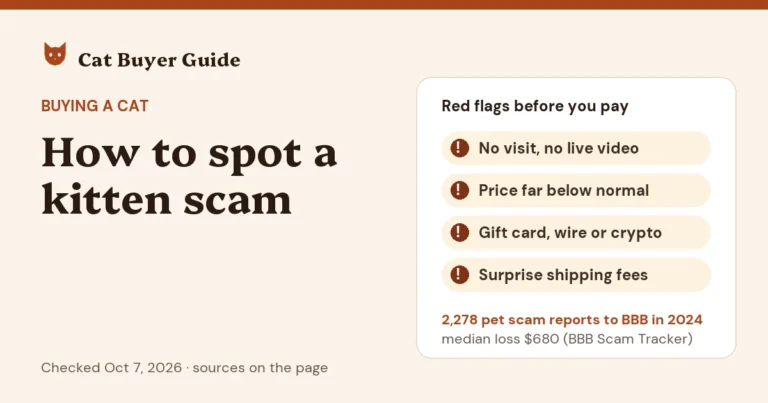
Our cat breeder red flags guide explains each sign. Fake sellers often use photos stolen from real breeders (CFA’s magazine), so run the checks in how to spot a kitten scam before you pay anyone.
Cat breeder FAQ
How do I find a cat breeder near me?
Search CFA’s Find a Breeder by breed and state and TICA’s listings by breed and country, visit a cat show nearby, and ask breed clubs. Then check each breeder: health tests, a visit or live video, and a written contract.
Does a CFA or TICA listing mean a breeder is legitimate?
Not on its own. It means the breeder is on the registry’s records; neither registry vouches for listed breeders’ practices. A legitimate breeder also shows you the mother and kittens, shares the parents’ test results and gives you a written contract.
What makes a cat breeder ethical?
Putting the cats’ health first: health-tested breeding cats, not too many of them, kittens raised with lots of handling and placed after their vaccinations, and support after the sale (International Cat Care; CFA; TICA). As International Cat Care puts it, “‘Breeder’ is not a professional qualification,” so judge breeders by what they do.
Is it normal to wait for a kitten?
Yes. Most reputable breeders don’t have many kittens at once, and many have one or two litters a year, so you’ll often wait (CFA’s magazine). A website full of kittens ready to go is a warning sign.
Sources
- CFA: Find a Breeder, checked Oct 7, 2026
- CFA: Register a Cattery Name and Cattery Name Index, checked Oct 7, 2026
- CFA: Breeder Code of Ethics, checked Oct 7, 2026
- CFA: Cattery Standard Minimum Requirements, checked Oct 7, 2026
- CFA: Cattery of Distinction Award, checked Oct 7, 2026
- CFA: Approved Cattery Program (archived copy, May 2024), checked Oct 7, 2026
- CFA: Cattery FAQs (archived copy, May 2024), checked Oct 7, 2026
- CFA: Registration Overview, checked Oct 7, 2026
- CFA: Show Rules, 2026-2027 show season (rule 10.24), checked Oct 7, 2026
- CFA: Cat Show Spectator Guide, checked Oct 7, 2026
- CFA: Shows and Events calendar, checked Oct 7, 2026
- CFA: Finding the Purr-fect Pedigreed Kitten, checked Oct 7, 2026
- CFA Cat Talk: Could This Kitten Be A Scam? (Hoos, 2025), checked Oct 7, 2026
- CFA Cat Talk: So You Want to Get a New Pedigreed Cat (Coughlan, 2025), checked Oct 7, 2026
- CFA Cat Talk: Kitten Socialization, Part 1 (Drury, 2025), checked Oct 7, 2026
- CFA: Registration Rules (cattery name prefix), checked Oct 7, 2026
- TICA: Find a Cat Breeder, checked Oct 7, 2026
- TICA: Disclaimers, checked Oct 7, 2026
- TICA: Pet Buyer’s Guide, checked Oct 7, 2026
- TICA: Finding the Purr-fect Pedigreed Kitten (buyer leaflet), checked Oct 7, 2026
- TICA: Outstanding Cattery Code of Ethics (revised August 2021), checked Oct 7, 2026
- TICA: Cattery Evaluation Form (revised August 2021), checked Oct 7, 2026
- TICA: Cat Shows for Visitors, checked Oct 7, 2026
- TICA: Show Calendar, checked Oct 7, 2026
- ACFA: Breeders’ Listings (notice to buyers), checked Oct 7, 2026
- ACFA: Cattery of Distinction, Facility Inspection Program, checked Oct 7, 2026
- World Cat Congress: Advice about Purchasing a Kitten, checked Oct 7, 2026
- UC Davis Veterinary Genetics Laboratory: Polycystic Kidney Disease (PKD1), checked Oct 7, 2026
- UC Davis Veterinary Genetics Laboratory: Hypertrophic Cardiomyopathy (HCM) in Maine Coons, checked Oct 7, 2026
- UC Davis Veterinary Genetics Laboratory: Spinal Muscular Atrophy (SMA) in Maine Coon Cats, checked Oct 7, 2026
- UC Davis Veterinary Genetics Laboratory: Hypertrophic Cardiomyopathy (HCM) in Ragdolls, checked Oct 7, 2026
- UC Davis Veterinary Genetics Laboratory: Erythrocyte Pyruvate Kinase Deficiency (PK Deficiency), checked Oct 7, 2026
- UC Davis Veterinary Genetics Laboratory: Progressive Retinal Atrophy (PRA rdAc), checked Oct 7, 2026
- UC Davis Veterinary Genetics Laboratory: Progressive Retinal Atrophy (PRA-b) in Bengals, checked Oct 7, 2026
- UC Davis Veterinary Genetics Laboratory: Burmese Hypokalemia, checked Oct 7, 2026
- UC Davis Veterinary Genetics Laboratory: GM2 Gangliosidosis in Burmese, checked Oct 7, 2026
- UC Davis Veterinary Genetics Laboratory: Sphynx and Devon Rex Congenital Myasthenic Syndrome (CMS), checked Oct 7, 2026
- UC Davis Veterinary Genetics Laboratory: Scottish Fold, checked Oct 7, 2026
- Cornell Feline Health Center: Hypertrophic Cardiomyopathy (updated May 2025), checked Oct 7, 2026
- Cornell Feline Health Center: Choosing and Caring for Your New Cat, checked Oct 7, 2026
- International Cat Care: Inherited disorders in cats, checked Oct 7, 2026
- International Cat Care: Cardiomyopathy (heart disease) in cats, checked Oct 7, 2026
- International Cat Care: Choosing a kitten, checked Oct 7, 2026
- International Cat Care: Where to get a cat or kitten, checked Oct 7, 2026
- RSPCA Australia: How do I find a responsible dog or cat breeder?, checked Oct 7, 2026
- FTC: Get the dog or cat instead of the scam (consumer alert, 2023), checked Oct 7, 2026
- Animal Legal & Historical Center (Michigan State University): Table of Pet Purchaser Protection Acts (2023), checked Oct 7, 2026