Buying a Pedigree Cat: What You Get, What It Costs, and What to Check

Built from dated data and expert sources, not hands-on pet testing. Facts and prices checked October 23, 2026. No affiliate links on this page. How we research
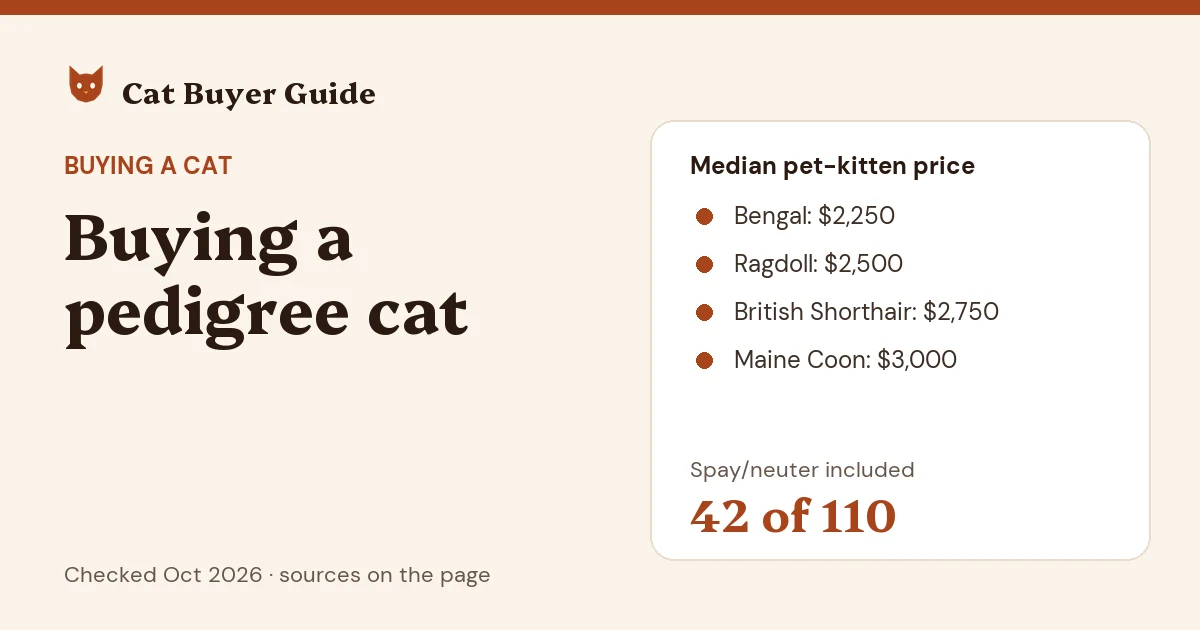
Buying a pedigree cat means buying a kitten whose parents are known and registered, bred to match a written breed standard, so its looks and temperament are fairly predictable (CFA). From a US cattery that posts prices, expect about $2,250 to $3,000 for a pet kitten: those were the median prices for Bengals, Ragdolls, British Shorthairs and Maine Coons at the 110 catteries we checked in October 2026. A pedigree doesn’t make a cat healthier, so the parents’ health tests, the contract and the breeder matter more than the papers.
This guide covers what you’re paying for and what you take home. For finding the breeder, see how to choose a cat breeder and the questions to ask.
The short answer
- What it is: a cat from registered parents of one breed, bred to a written standard. Pedigreed cats are only about 3 to 5% of North America’s cats (CFA).
- What it costs: median pet-kitten prices of $2,250 (Bengal), $2,500 (Ragdoll), $2,750 (British Shorthair) and $3,000 (Maine Coon) in our October 2026 data.
- What it doesn’t promise: better health. Inherited disorders are more common in pedigree cats (International Cat Care).
- What to check: the parents’ health tests, the written contract, the spay/neuter terms and when you get the papers, and the kitten’s age (CFA: around 16 weeks).
On this page
What “pedigree” means, and what it doesn’t
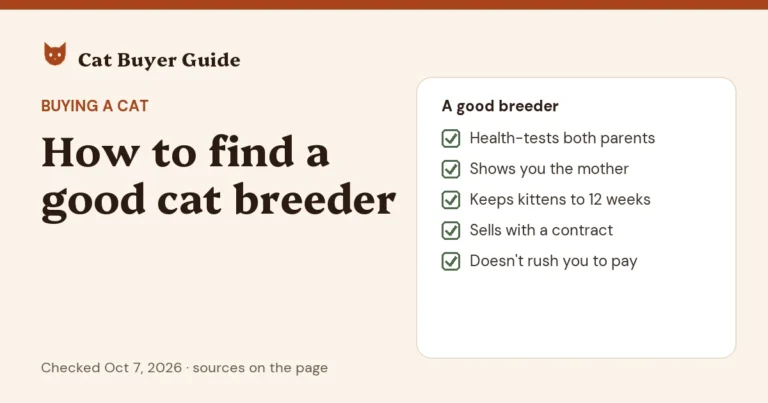
A pedigreed kitten is bred from known pedigreed parents to conform to a written standard of what the ideal cat of that breed looks like, says the Cat Fanciers’ Association (CFA). A mixed-breed cat, often called a domestic shorthair or longhair, usually comes from an unplanned mating of two cats of unknown background. There are over 40 breeds across the North American registries, such as CFA and TICA (The International Cat Association).
What you gain is predictability, and a family history. The CFA points out that, unlike with most random-bred cats, you’ll know something of the cat’s family health and perhaps its parents’ genetic test results.
What you don’t gain is a healthier or “better” cat. “Pedigree is not better than non-pedigree (moggie), it is just different,” says International Cat Care (iCatCare). Breeds are kept within small gene pools, which lets inherited diseases such as polycystic kidney disease (PKD) and hypertrophic cardiomyopathy (HCM) spread.
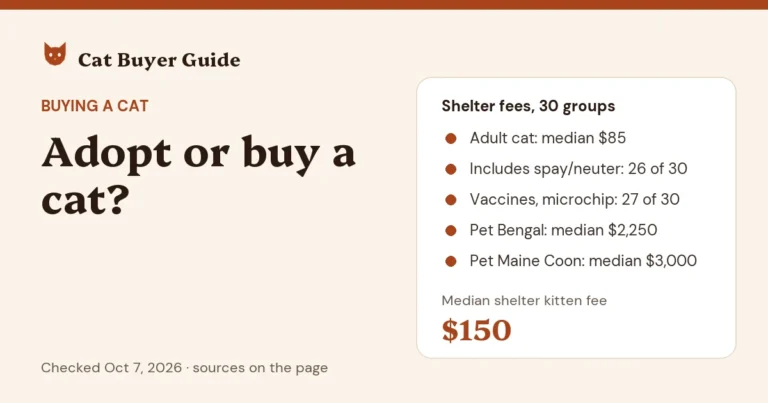
Registration papers record a cat’s ancestry, not its health or how well it was raised. If cost is your main concern, adopting is far cheaper.
What pedigree kittens cost: four breeds, 110 catteries
We collected the posted pet-kitten prices of US catteries in four popular breeds, from the catteries’ own websites, in October 2026. Each study has its own page with the full method and an anonymized table.
| Breed | Catteries | Median pet price | Middle half | Checked |
|---|---|---|---|---|
| Bengal | 30 in 24 states | $2,250 | $1,800 to $2,500 | Oct 7, 2026 |
| Ragdoll | 31 in 17 states | $2,500 | $1,975 to $3,050 | Oct 17, 2026 |
| British Shorthair | 24 in 14 states | $2,750 | $2,500 to $3,300 | Oct 20, 2026 |
| Maine Coon | 25 in 21 states | $3,000 | $2,750 to $3,250 | Oct 7, 2026 |
Details: Bengal, Ragdoll, British Shorthair, Maine Coon.
How much is a pedigree Ragdoll cat? The median was $2,500 at 31 catteries, and $2,900 at the 15 that spay or neuter the kitten before it goes home.
Older guides quote much less. The CFA’s undated buyer’s page still says to expect $300 to $1,500 for a pedigreed cat; 102 of the 110 catteries in our data started above $1,500.
A price far below these is a reason for caution, not a bargain: see how to spot a kitten scam.
What the price buys: pet, breeding or show
Most kittens are sold as pets, to be spayed or neutered. A kitten sold with breeding rights costs more. Nine of our 30 Bengal catteries posted a breeding price: a median of $4,000, or $2,000 more than the same cattery’s pet price. Several sell breeding rights only to registered or experienced breeders.
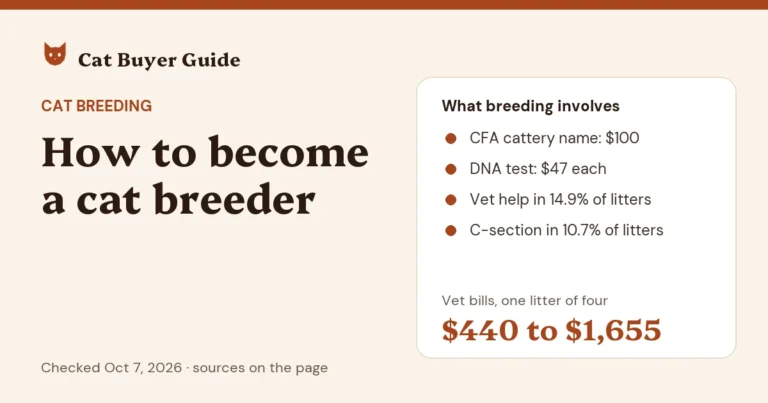
If you’re thinking of breeding later, read what it takes to become a cat breeder first; a pet kitten won’t come with the rights.
Papers, spay/neuter terms and the contract
Nearly every pedigree breeder will ask you to sign a purchase agreement that addresses spaying or neutering (CFA). In practice, breeders handle it in one of two ways:
- Spayed or neutered before pickup. Many breeders do this, so the kitten doesn’t face a move and surgery close together (CFA). In our data, 42 of the 110 catteries (38%) said they include it: 16 Bengal, 15 Ragdoll, 6 Maine Coon and 5 British Shorthair catteries.
- Done by you, under the contract. The registration papers may be held back until you send proof of the surgery (CFA). Several Maine Coon and British Shorthair catteries in our data work this way, and some set a deadline.
If the surgery isn’t included, budget for it: clinics in our new kitten checklist charged $89 to $369.
Before you pay, ask to read the contract. According to the CFA, it may include:
- a genetic health guarantee: some breeders state the cat is free of known genetic conditions and may compensate you if one appears;
- a rehoming guarantee or right of first refusal: if you can’t keep the cat, you return it to the breeder or let the breeder decide first;
- the spay/neuter terms and when the papers come.
Take the kitten to your own vet soon after you bring it home (CFA). Our questions guide covers what to ask about each clause.
Health: what a pedigree can carry
Inherited disorders are passed from parents to kittens, and they’re more common in pedigree cats, says iCatCare. Some are obvious at birth; others appear later in life. That doesn’t mean some breeds are simply “unhealthy”: more problems are found in breeds that are tested more.
DNA tests can control some of them. iCatCare’s example is PKD in Persians and related breeds: up to half or more of Persians may once have had it, and with an accurate DNA test from blood or a cheek swab, it’s now much rarer in many countries. Some breeds are also screened for heart disease (cardiomyopathy) and pyruvate kinase deficiency (CFA). iCatCare advises that the test result be tied to the cat’s microchip number, with a vet collecting the sample. So ask for reports with the parents’ names or microchip numbers on them, not a “tested” line on a website. Breed-by-breed tests are in our breeder guide.
Some breed traits are the problem. iCatCare names breeds whose defining look comes from a harmful gene or trait: the Manx, the Scottish Fold and extreme flat-faced Persians. It also says that harmful extreme traits, such as severe flat faces, hairlessness and short legs, shouldn’t be bred on. iCatCare also opposes crossing wild cat species with domestic cats to make hybrids. If you’re drawn to one of these breeds, ask your vet about its health first.
Talk to your vet
- Before you choose a breed, ask your vet which inherited conditions it’s known for, and which tests matter.
- Book a vet check soon after the kitten comes home, and bring the breeder’s health and vaccine records.
- Ask what lifelong care the breed may need.
Age, waiting lists and where to look
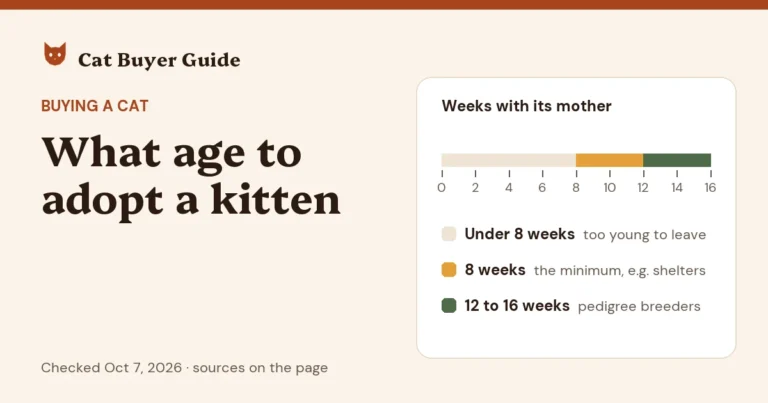
Age. The CFA says most pedigree kittens should go home around 16 weeks, and to shy away from one younger than 14 weeks, barring very special circumstances. See what age to adopt a kitten.
Waiting lists. Many breeders have only one or two litters a year, and some breed only when people are on their waiting list (CFA). Expect to wait, and expect a deposit: 25 of our 30 Bengal catteries stated one, from $250 to $1,000 (median $500), and 20 of them said it wasn’t refundable.
Where to look:
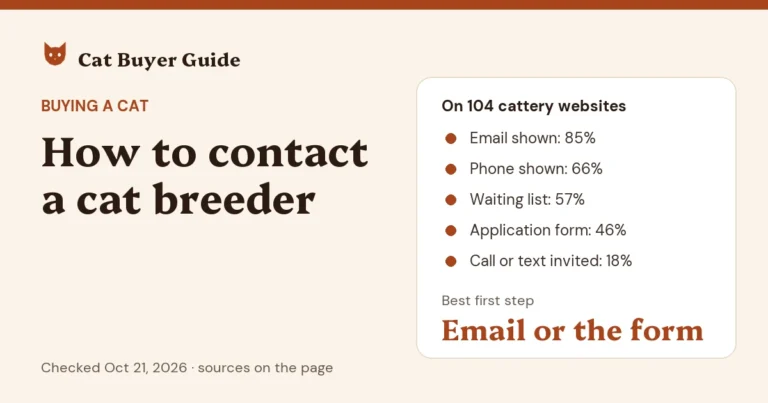
- Cattery websites and registry listings (CFA, TICA). A listing isn’t an endorsement: see how to find a good breeder, and how to contact a cat breeder.
- Cat shows, to meet breeders and see the breed. At most shows, kittens offered for sale are at least 4 months old (CFA).
- Breed rescue. Many breed clubs have welfare groups that rehome adult cats of their breed, says iCatCare.
- Not pet stores. Reputable breeders don’t sell through them, and pet-store kittens may come from kitten mills, the CFA warns.
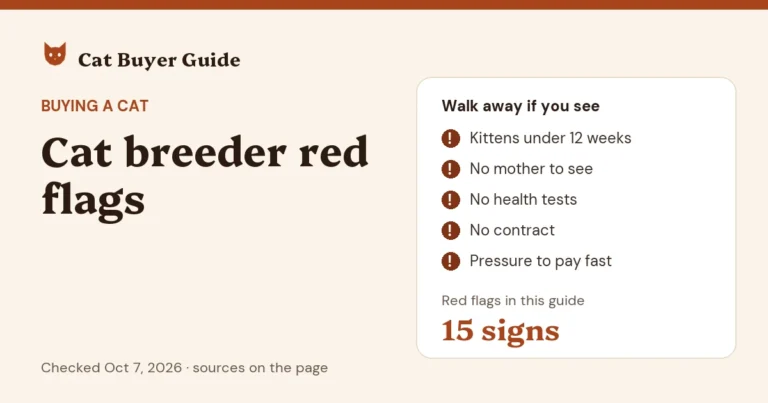
Many breeders no longer let visitors into their cattery (CFA), so a live video call may be what you get. Whatever the route, walk away if what you see or hear worries you (iCatCare). Our red flags list and backyard breeder guide show what to watch for.
The first year: more than the kitten
The price is only the start. Our new kitten checklist puts must-have supplies at $131 to $349 and first vet care at $308 to $1,158 (checked Oct 7, 2026), less whatever the breeder has already done. If you want insurance, see what cat insurance costs.
FAQ
Is a pedigree cat worth the money?
It is if a breed’s look, coat or temperament matters to you and you buy from a breeder who tests the parents and puts the terms in writing. It isn’t if you only want a healthy, friendly cat: iCatCare doesn’t consider pedigree cats better, and a shelter cat costs a fraction of the price.
What’s the difference between pedigree and purebred?
Very little: the CFA uses “pure bred” and “pedigreed” for the same thing, a cat bred from known pedigreed parents. The difference is proof. Without registration papers, a seller’s “purebred” is only a claim.
Can I buy a pedigree cat without papers?
Some catteries sell pet kittens and send the papers only after proof of spay or neuter (CFA). A seller who says the kitten is pedigree but can’t name the registry or the parents is a different matter: ask for them before you pay any deposit.
Do pedigree cats have more health problems?
Inherited disorders are more common in pedigree cats, according to iCatCare, but the risk depends on the breed, the line and the breeder’s testing. Ask for the parents’ test reports and ask your vet about the breed.
Sources
- CFA: Finding the Purr-fect Pedigreed Kitten, checked Oct 23, 2026
- CFA Cat Talk: So You Want to Get a New Pedigreed Cat (April 3, 2025), checked Oct 23, 2026
- International Cat Care: Position Statement on the Breeding of Pedigree Cats, checked Oct 23, 2026
- International Cat Care: Inherited disorders in cats (updated Dec 18, 2025), checked Oct 23, 2026
- International Cat Care: Where to get a cat or kitten (updated Sept 26, 2025), checked Oct 23, 2026
- Our price data: 110 US catteries in four breeds (Bengal and Maine Coon checked Oct 7, Ragdoll Oct 17, British Shorthair Oct 20, 2026)