How to Contact a Cat Breeder (With a Sample Kitten Inquiry)

Built from dated data and expert sources, not hands-on pet testing. Facts and prices checked October 21, 2026. No affiliate links on this page. How we research
To contact a cat breeder, find them through a registry’s breeder list, read their website first, then send a short email or use their contact form. Say who you are, which kitten or litter you’re asking about, and a little about your home. Most breeders list an email address, and many want an application before they talk about a kitten. Expect a wait, and expect questions back.
The short answer
- Find breeders through CFA or TICA breeder lists or at a cat show, not on general ad sites.
- Read the breeder’s website first: price, waiting list, application and how they want to be contacted.
- Use the method the breeder asks for. Email or the site’s form is the usual first step.
- Keep the first message short: who you are, which kitten or litter, your home, your timing.
- Answer the breeder’s questions openly, and ask yours by phone or video call.
- Pay nothing until you’ve talked to the breeder and read the contract.
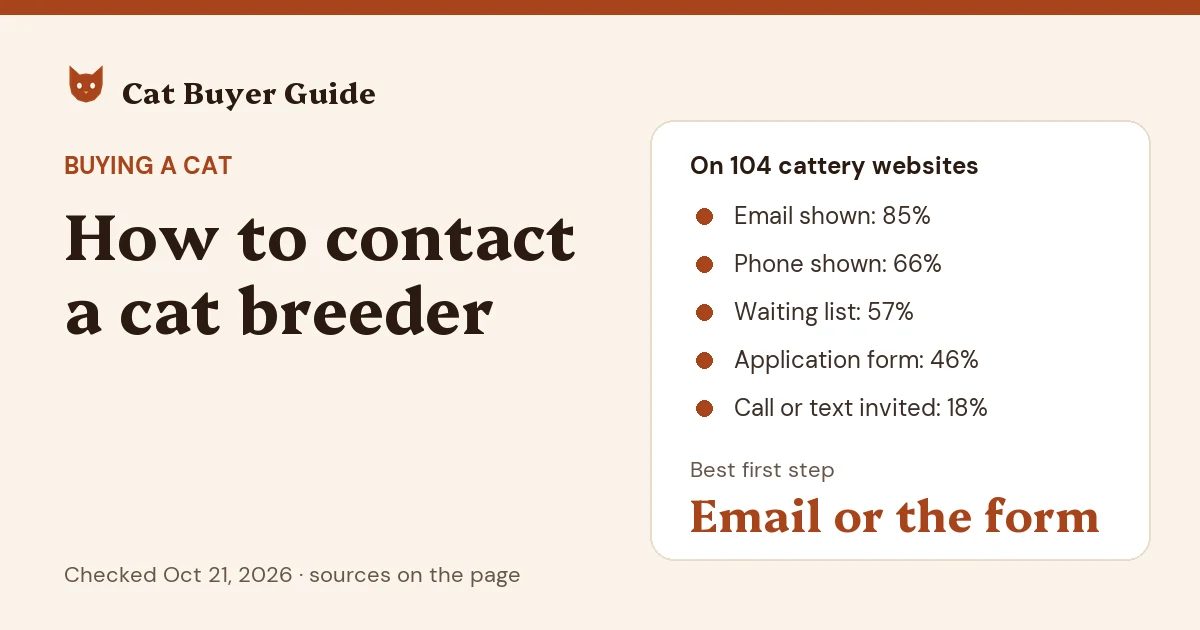
We read the websites of 110 US catteries on Oct 21, 2026: every cattery in our Bengal, Maine Coon, Ragdoll and British Shorthair price samples. Of the 104 sites we could read, here is how they ask to be contacted. The advice comes from the Cat Fanciers’ Association (CFA). The sample message is ours.
On this page
- What breeders ask for: our check of 104 cattery websites
- Where to find a breeder’s contact details
- Email, form, call or text?
- What to put in your first message
- A sample kitten inquiry you can copy
- What happens after you reach out
- Breeder etiquette: what helps and what hurts
- Warning signs in the reply
- How to contact a cat breeder: FAQ
What breeders ask for: our check of 104 cattery websites
| Of 104 cattery websites | Count | Share |
|---|---|---|
| Show an email address or email link | 88 | 85% |
| Show a phone number | 69 | 66% |
| Have a kitten application or questionnaire | 48 | 46% |
| Say they keep a waiting list | 59 | 57% |
| Say to call or text, or to text them | 19 | 18% |
How we counted. We fetched each cattery’s listed page and up to six of its own pages about contact, applications, waiting lists, kittens, prices, policies or FAQs (472 pages), searched the text and read every match by hand. No site appears twice. Six sites were built in a way our check couldn’t read and are left out. Forms that load by script can hide from a check like ours, so treat each share as “at least”. The raw file is in our data folder: `breeder-contact-methods-2026-10-21.csv`.
What this means for you:
- Email is the safe default. Five in six sites show an email address. Only about one in five invites a call or text in so many words.
- Look for the application before you write. Nearly half have one. When there’s a form, the breeder usually wants it first. Writing without it can just get you a link back to it.
- Waiting lists are normal. Over half say they keep one. Some lists are free to join. Others cost money: for example, a $100 fee or deposit at two catteries, $250 at another and a $500 nonrefundable deposit at a fourth. Five sites said they keep no list, or not a traditional one.
Where to find a breeder’s contact details
Start with the registries. CFA’s Cat Talk magazine advises using each registry’s breeder listings by breed, and warns that reliable breeders aren’t found on Craigslist or other sites that aren’t about cats (CFA, Hoos, 2025). CFA’s Find a Breeder lets you search catteries by breed and location, and TICA has a breeder directory too. A cat show is another good way in: CFA suggests meeting breeders there and seeing their cats (Coughlan, 2025).
Then open the breeder’s own website. CFA says a breeder’s site should give contact information and show the adult cats and where the cats live. A site full of kittens for sale is a warning sign, since most breeders don’t have many kittens at once. A listing alone doesn’t prove a breeder is good: our guide to choosing a cat breeder explains what to check.
Email, form, call or text?
CFA lists the usual ways to reach a breeder: telephone, email, texting, websites and social media (Coughlan). Which one to use is the breeder’s call, and most websites tell you.
- Email or the contact form suits a first message. It gives the breeder your details in writing, and our check found an email address on 85% of sites.
- The application comes first where there is one. Many breeders use it to join their waiting list or to be told about the next litter.
- A call or text is right when the site says so. Some breeders ask you to text before calling, so they don’t take you for a spam call. One asks for no calls after 10 p.m. Eastern.
- Social media messages work for some breeders, but keep the important things, such as price, deposit and contract, in writing.
CFA notes that many are at cat shows on weekends, so a reply may not come until the week. A few sites post a reply time, from “within 24 hours” to about three days.
What to put in your first message
Keep it short and specific. A breeder reading it wants to know four things: who you are, which kitten you mean, whether your home suits the cat, and when you’re hoping to bring one home.
- Your name and where you live (city and state is enough at first).
- Which kitten, litter or breed you’re asking about, and pet or show.
- Your household: adults, children and their ages, other pets.
- Your experience with cats, or with this breed.
- Your timing, and that you’re happy to wait for the right kitten.
- One or two questions, not twenty. The rest is for the phone call.
CFA says good breeders will likely ask about your work or study, how much time you have for a kitten, your experience, other pets and children, whether your home allows pets, whether a vet is nearby, and whether you want a pet, a breeding cat or a show cat (Preston and Giddings, 2024). Answering some of that up front saves a round of emails. On the breeders’ sites we read, 12 asked buyers in so many words to tell them about their home, family, pets or lifestyle.
A sample kitten inquiry you can copy
Change the parts in brackets. Keep it about this length.
Sample message to a cat breeder
Subject: Inquiry about a pet [breed] kitten, [your city, state]
Hello [breeder’s name],
I found [cattery name] on [CFA’s breeder list / your website] and I’m interested in a pet [breed] kitten, from [the litter born in (month) / a future litter].
About us: we’re [two adults and a 9-year-old] in [city, state], in a [house / pet-friendly apartment]. We have [one older, neutered cat / no other pets]. [I’ve had cats before / This would be our first cat], and our vet is [name or “nearby”].
We’re hoping to bring a kitten home around [month], but we’re happy to wait. I’ve read your page on [prices / the waiting list / your health guarantee]. Could you tell me whether you expect kittens around then, and how your application or waiting list works?
I’d be glad to fill out your application or talk by phone or video call.
Thank you, [Name], [phone, if you’re happy to share it]
What it leaves out on purpose: no deposit offer and no “Is it still available?” one-liner. A short, real introduction shows the breeder you’ve read their site and thought about the cat.
What happens after you reach out
- A reply, a form or a list. A breeder with an application or a waiting list will usually point you to it. Most reputable breeders don’t have kittens ready all the time; CFA’s magazine says you’ll usually wait (Hoos). Many breed only one or two litters a year.
- Questions back. Expect questions about your home, as above. That’s a good sign, not a test.
- A call or video call. “You can learn a lot in a phone call,” writes CFA’s Laurie Coughlan. This is when to ask the full questions to ask a cat breeder.
- Photos or video instead of a visit. Many breeders no longer let visitors into their cattery, CFA says, partly for safety. They should still offer photos and a FaceTime or Zoom call. If they won’t, CFA calls it a big red flag.
- A deposit, later. Once you’re approved and a kitten is matched to you, many breeders ask for a deposit. CFA warns that scams are more likely when a large nonrefundable deposit is asked; a small, reasonable one is normal, and most breeders have conditions for refunding it. Ask what they are, and read the contract first.
If a breeder doesn’t expect kittens soon, ask who they’d recommend. CFA says reputable breeders are happy to give referrals.
Breeder etiquette: what helps and what hurts
- Do read the website before asking what it already answers, such as the price or the waiting list.
- Do ask anything you need to know. “No question is too silly to ask,” CFA’s Kathi Hoos writes, and a good breeder will make you comfortable asking.
- Do say so if you’re talking to more than one breeder. It’s normal.
- Do reply when a breeder offers you a kitten, even to say no. Some breeders give each family a set time to answer, such as 48 hours.
- Don’t send the same one-line message to twenty catteries.
- Don’t push to take a kitten home early. CFA advocates 16 weeks, or at least 12 (why age matters).
- Don’t send money to hold a kitten you haven’t seen on a live call.
Warning signs in the reply
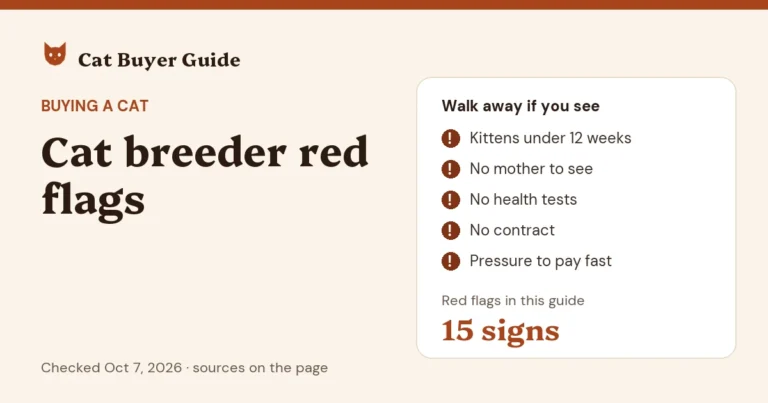
Most breeders answer like the ones above. Walk away if you see these, which CFA lists as red flags:
- The breeder is annoyed by your questions or can’t answer them.
- They have many kittens ready now, in a breed that’s usually rare.
- They won’t do a video call or send new photos.
- They want a large nonrefundable deposit before you’ve talked or seen a contract.
- The price looks too good to be true.
Our guides to kitten scams and breeder red flags cover the rest, including payment methods to refuse. If the breeder seems to have litters all year with no health testing, read about backyard cat breeders.
How to contact a cat breeder: FAQ
Should I email or call a cat breeder first?
Use what the breeder’s website asks for. On the 104 sites we read, 85% showed an email address and only 18% invited a call or text in so many words, so email or the contact form is the usual first step. Save the long conversation for a phone or video call once the breeder has replied.
How long do breeders take to reply?
It varies. A few breeders post a reply time, from 24 hours to about three days, and CFA notes that many are at cat shows on weekends. If you’ve heard nothing after a week, one polite follow-up is fine. Check your spam folder too.
Do I need to fill out an application to get a kitten?
Often, yes. Nearly half the cattery websites we read had a kitten application or questionnaire, and some only add names to their waiting list once it’s in. It usually asks about your home, family, other pets and the kind of kitten you want.
Is it OK to contact several breeders at once?
Yes. Talking to a few breeders is how you compare them. Write to each one personally, be open that you’re looking at more than one, and tell the others once you’ve chosen.
Should I pay to join a waiting list?
Some breeders charge for their list; others let you join for free. The list fees and deposits we saw included $100, $250 and $500. Before paying, ask whether the money comes off the kitten’s price, and when it’s refunded. Get the terms in writing.
Sources
- CFA Cat Talk: Could This Kitten Be A Scam? (Hoos, 2025), checked Oct 21, 2026
- CFA Cat Talk: So You Want to Get a New Pedigreed Cat (Coughlan, 2025), checked Oct 21, 2026
- CFA Cat Talk: Good Things Come To Those Who Wait (Preston and Giddings, 2024), checked Oct 21, 2026
- CFA: Find a Breeder, checked Oct 21, 2026
- Our contact study: the websites of 110 US catteries from our Bengal, Maine Coon, Ragdoll and British Shorthair price samples, read Oct 21, 2026, checked Oct 21, 2026