Questions to Ask a Cat Breeder Before You Buy a Kitten

Built from dated data and expert sources, not hands-on pet testing. Facts and prices checked October 7, 2026. No affiliate links on this page. How we research
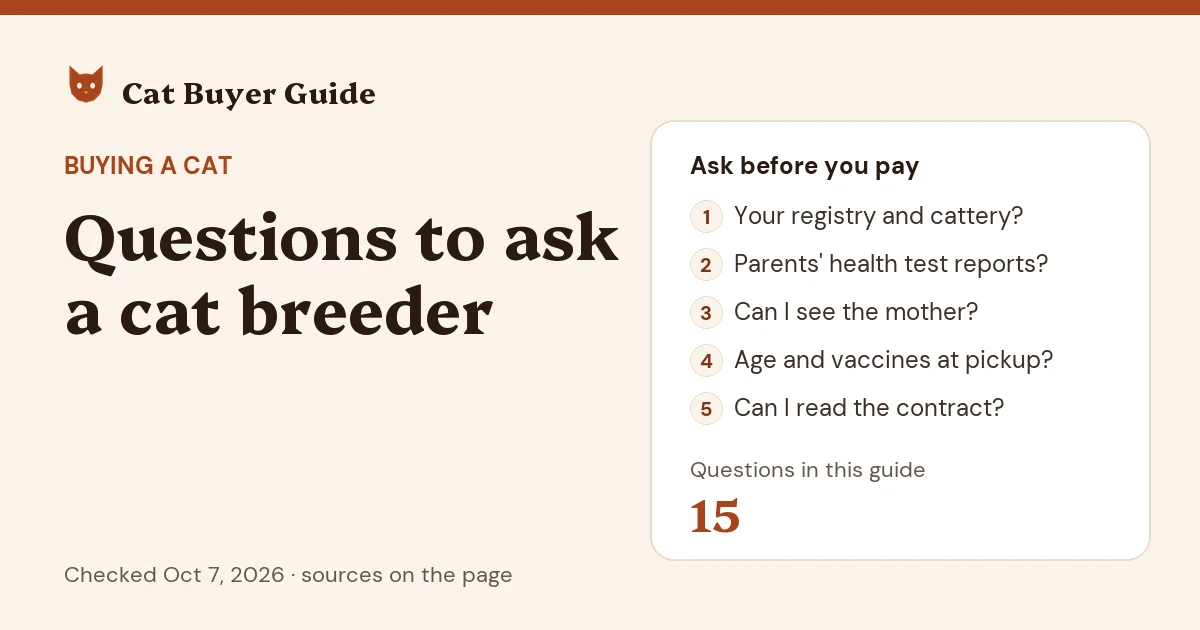
The best questions to ask a cat breeder cover the registration, the parents’ health tests, the kitten, the contract, the money and the help you’ll get afterward. Ask them by phone or video call before you pay anything. A good breeder answers plainly, shows you the paperwork and asks you questions, too. Vague answers or pressure to pay are your cue to walk away.
The short answer
The eight questions that matter most:
- Which registry are you with, and what’s your cattery name?
- Which health tests have both parents had, and can I see the reports?
- Can I see the kitten with its mother, in person or on a live video call?
- When will the kitten come home, and which vaccines will it have had?
- How do you raise and socialize your kittens?
- Can I read the contract and health guarantee before I pay?
- What does the price include, and when is the deposit refunded?
- What happens if I can’t keep the cat?
We built this list from CFA, TICA and the World Cat Congress, a group of major cat registries, plus International Cat Care, Cornell, UC Davis, the FTC, BBB and our own price checks, all on Oct 7, 2026. Most are good questions to ask when buying a kitten from anyone, not just a pedigree breeder.
On this page
- Questions about the breeder and registration
- Questions about the parents’ health tests
- Questions about the kitten
- Questions about the contract
- Questions about price, deposit and payment
- Questions about support after pickup
- Questions a good breeder will ask you
- How to ask, and when to walk away
- Printable checklist: questions to ask a cat breeder
- Questions to ask a cat breeder: FAQ
Questions about the breeder and registration
Which registry are you with, and what’s your cattery name?
Both let you check the breeder yourself. CFA’s Cattery Name Index lists every current CFA cattery name, and CFA and TICA list breeders by breed. Under CFA’s rules, the breeder’s cattery name, if any, starts each kitten’s registered name. A listing isn’t an endorsement: CFA makes no representations about the breeding or business practices of breeders it lists.
- Good answer: a named registry, a cattery name you can find there, and the parents’ registered names and numbers.
- Warning sign: no registry, or a name you can’t find. Contact breeders through details you found yourself, as our scam guide explains.
How long have you bred this breed, and can I talk to past buyers?
CFA’s magazine suggests asking whether a breeder has been at it long enough to build a record. A responsible breeder will happily put you in touch with past buyers, says the World Cat Congress. TICA’s red flags include a lack of breed knowledge and no verifiable references.
- Good answer: years with this breed, contacts for past buyers, and a frank talk about the breed’s needs and health problems.
- Warning sign: vague answers, no references you can reach, or a website only weeks old (see our scam guide).
Questions about the parents’ health tests
Which health tests have both parents had, and can I see the reports?
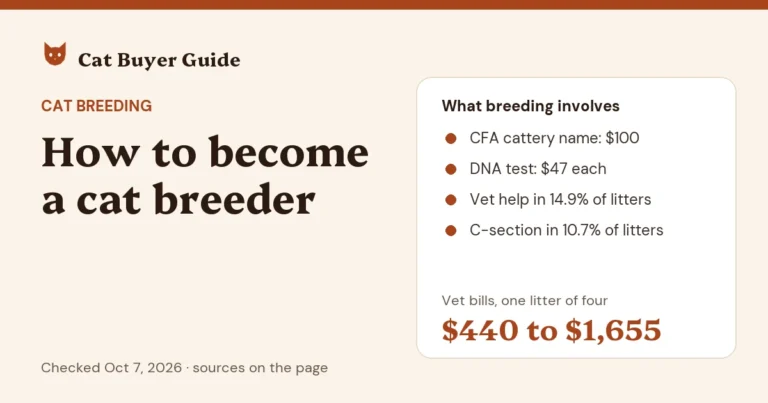
Inherited diseases are more common in pedigree cats, and there are DNA tests for several of them (International Cat Care). Ask about testing for your breed’s known problems, CFA’s magazine advises; our breeder guide lists tests by breed. TICA says to ask for both parents’ health and genetic records. For scale, the UC Davis Veterinary Genetics Laboratory charges $47 per cat for a single DNA test, such as its PKD1 test. CFA’s own list of questions for breeders adds the health of the mother and litter, and whether both parents tested negative for feline leukemia virus (FeLV).
- Good answer: the breed’s main tests on both parents, with lab reports. International Cat Care advises that a vet take the sample and that each result show the cat’s microchip number.
- Warning sign: vague claims of healthy bloodlines instead of named tests, or reports you never see.
Have the parents had heart scans?
Ask if HCM, a heart disease, is common in the breed: Cornell lists it as more common in Maine Coon, Ragdoll, British Shorthair, American Shorthair, Sphynx, Bengal, Chartreux, Norwegian Forest, Siberian and Persian cats. Many cats with HCM don’t look ill, and a heart ultrasound (echocardiogram) is the gold standard for diagnosing it. Gene tests can show a raised risk, Cornell adds, but not every cat with a mutation develops HCM. For Maine Coons and Ragdolls, International Cat Care says screening means both tests, with a scan every year during a cat’s breeding years.
- Good answer: a recent echocardiogram report for each parent.
- Warning sign: a gene test offered in place of a heart scan.
Talk to your vet
Ask your vet which tests matter for your breed; International Cat Care says vets can discuss them. After pickup, have your own vet examine the kitten within a few days (World Cat Congress), and keep it apart from your other cats until then (Cornell).
Questions about the kitten
Can I see the kitten with its mother, in person or on a live video call?
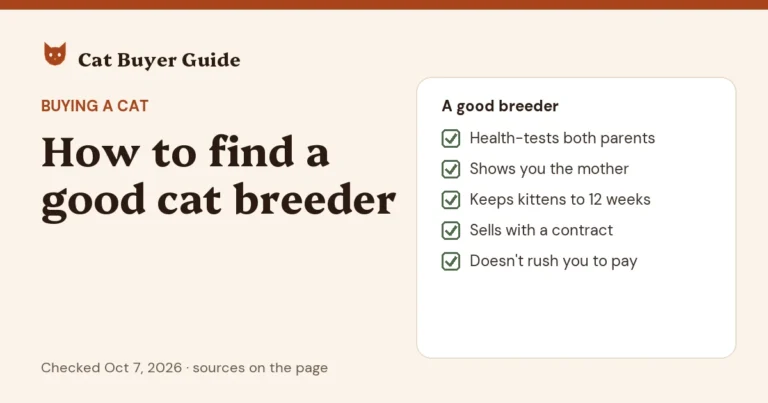
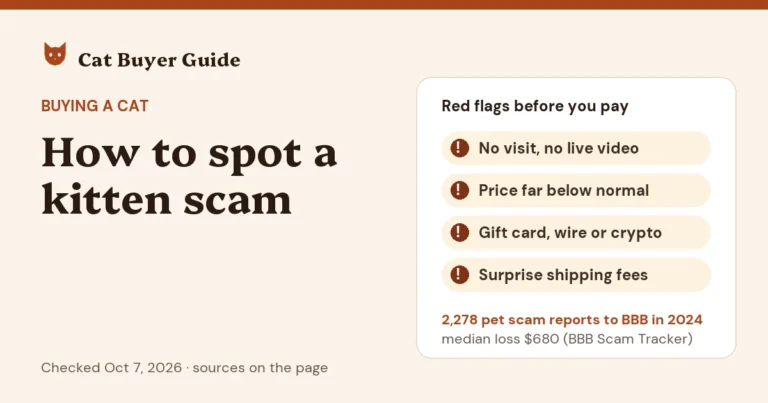
Many breeders no longer welcome visitors at home, but they should offer photos and FaceTime or Zoom calls; CFA’s magazine calls a breeder who can’t a big red flag. Legitimate breeders encourage a visit or video call, says the FTC, and BBB lists a seller who refuses both among its pet scam red flags.
- Good answer: a visit, or a live video call at a time you pick, showing the kitten with its mother and littermates (International Cat Care).
- Warning sign: only photos, or a new excuse each time. Our scam guide shows how to test a video call.
When will the kitten come home, and how old will it be?
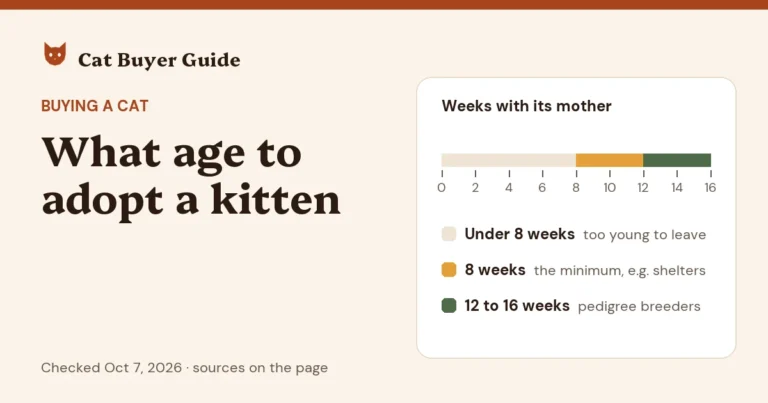
Most breeders let kittens go at 12 to 16 weeks, depending on the breed, CFA’s magazine says. The World Cat Congress says most responsible breeders wait until 12 weeks or older, when a kitten is weaned, litter trained and vaccinated at least twice. In scams, kittens are often sold at 6 to 8 weeks (CFA). See what age to adopt a kitten.
- Good answer: 12 weeks or older.
- Warning sign: a kitten offered at 6 to 8 weeks.
Which vaccines, deworming and vet checks will it have had?
Ask which vaccines the kitten will have had, and whether it’s been wormed and vet checked (CFA’s magazine). CFA’s list adds the next vaccine date and a stool test; International Cat Care adds flea treatment. You should get the health and vaccination record (World Cat Congress) and any microchip registration (CFA’s magazine).
- Good answer: dated records of each vaccine, deworming and vet check, and word of any illness or exposure, which CFA’s breeder code commits breeders to disclose before a sale.
- Warning sign: no written records.
How do you raise and socialize your kittens?
Kittens learn to accept people mainly between 2 and 7 weeks of age, weeks before a pedigree kitten goes home, and those handled by four or five different people before 7 weeks grow up more sociable (International Cat Care). Ask an open question and listen before getting specific, as CFA’s magazine suggests. Then ask which kitten would suit your home: a breeder can play matchmaker (CFA’s magazine).
- Good answer: kittens raised in the home, handled daily from about 2 weeks by several people, and used to household noise and visitors.
- Warning sign: kittens kept in outside pens with little handling, or litters of several ages at once (International Cat Care).
Questions about the contract
Can I read the contract before I pay?
A responsible breeder sells only with a written contract, which usually includes a health guarantee (World Cat Congress). Ask in advance which papers you’ll get (CFA’s magazine), and read the contract: TICA says to get the health guarantee and return policy in writing.
- Good answer: a copy before any deposit, covering the price, deposit, health guarantee, spay/neuter, papers and returns.
- Warning sign: no written contract, or one you first see on pickup day.
What does the health guarantee cover, and for how long?
No breeder can guarantee a kitten’s health completely, CFA’s magazine notes, so ask how problems are handled: a refund, a replacement or something else. Ask what’s covered and for how long (CFA), and who is responsible for illnesses that arise (World Cat Congress). In our price check of 30 Bengal catteries, 25 described a guarantee, but only 5 mentioned HCM, covering it for 1 to 5 years. Some catteries in our checks made the guarantee depend on a vet visit within 48 to 72 hours of pickup.
- Good answer: written terms: what’s covered, for how long, the remedy, and any vet-check deadline.
- Warning sign: a guarantee that’s only a verbal promise.
What are the spay/neuter terms, and when do I get the papers?
Many breeders spay or neuter kittens before they leave, or hold back the registration papers until you send a vet’s proof (CFA’s magazine), which CFA calls a fairly common practice. Ask whether the kitten is sold as a pet or with breeding rights: unless the breeder writes the litter’s PIN on the registration form, CFA registers a kitten as not for breeding. If you’ll pay for the surgery yourself, see what spaying a cat costs. Planning to breed? See should you become a cat breeder.
- Good answer: a clear deadline, and a contract naming the registry, birth date, parents’ registration numbers and breeding rights, the details CFA asks for if papers never arrive.
- Warning sign: a contract that doesn’t mention the papers.
Questions about price, deposit and payment
What does the price include?
TICA says to know the average price range for the breed, since unusually high or low prices could indicate a scam. In our October 2026 checks, the median pet kitten price was $2,250 at 30 Bengal catteries and $3,000 at 25 Maine Coon catteries. What’s included varies: every Bengal cattery included vaccines, but only half mentioned a microchip, and 16 of 30 included spay or neuter.
- Good answer: a written price listing what’s included (vaccines, microchip, spay/neuter, registration) and any extras, like delivery or sales tax.
- Warning sign: a price far below the breed’s usual range.
How much is the deposit, and when would I get it back?
A small deposit to reserve a kitten is reasonable, and most breeders have conditions for refunding it, says CFA’s magazine; scams are more likely when large, nonrefundable deposits are required. In our price checks, the median deposit was $500 at both Bengal and Maine Coon catteries, most called it nonrefundable, and a few let buyers move it to a later kitten. So ask what happens if no kitten is born for you, if the kitten fails a vet check, or if you change your mind.
- Good answer: a modest deposit, with written terms and a receipt.
- Warning sign: a large nonrefundable deposit, or full payment before you’ve chosen a kitten (TICA).
How should I pay?
Nobody legitimate will require gift cards, wire transfers or cryptocurrency, the FTC says; payment apps like Venmo make money hard to get back, and a credit card gives you the most protection. Never pay anyone who insists on those or a payment app, and remember that honest businesses give you time to decide (FTC). In the pet scams BBB studies, money often changes hands through services like Zelle or Venmo. Keep every receipt: if papers never arrive, CFA asks for proof of full payment.
- Good answer: a credit card, or another method with a receipt, after you’ve checked the breeder and read the contract.
- Warning sign: a demand for gift cards, a wire transfer, crypto or a payment app, or pressure to pay today.
Questions about support after pickup
What help will I get, and what if I can’t keep the cat?
Expect written care instructions (CFA’s magazine), and ask what food and litter the kitten is used to, so you can keep them or change them gradually (International Cat Care). A responsible breeder encourages you to call whenever you have questions (World Cat Congress). If a cat can’t stay, many breeders offer a rehoming guarantee or a right of first refusal, and would much rather hear from you than have the cat passed on (CFA’s magazine). A good breeder should be willing to take a kitten back if serious problems arise (International Cat Care).
- Good answer: written care notes, an open line for questions, and a take-back or first-refusal clause in the contract.
- Warning sign: no return policy in writing, or a seller who only communicates by text or email (TICA).
Questions a good breeder will ask you
Expect questions back: reputable breeders ask a lot about you and your family (TICA), to be sure you and the kitten are a good match (FTC). “Don’t be offended if the breeder asks you questions,” says the World Cat Congress. You may be asked about (CFA’s magazine; CFA’s buyer page):
- your work or study, and the hours someone is home;
- your experience with kittens or with the breed;
- children, other pets, your housing and your vet;
- keeping the cat indoors, and declawing;
- whether you want a pet, a show cat or a breeding cat;
- whether the kitten is a gift: many breeders won’t sell one unless the person who’ll care for it meets it first.
How to ask, and when to walk away
Call or video-call first: you can learn a lot in a phone call (CFA’s magazine), and if a seller won’t let you visit, video chat or even talk by phone, move on (FTC). TICA warns against breeders who only use email or text, and against being rushed. Get the answers, documents and contract before any deposit, and talk to more than one breeder (CFA).
“No question is too silly to ask,” says CFA’s magazine, and if a breeder gets annoyed or can’t answer, move on. International Cat Care says to be ready to walk away if you’re not happy with the answers. Our guides to cat breeder red flags and kitten scams explain what evasive answers can mean.
Printable checklist: questions to ask a cat breeder
Print it and note each answer:
- Registry and cattery name (check them yourself)
- Years with the breed; references from past buyers
- Both parents’ DNA test reports and FeLV results; heart scans if HCM is common in the breed
- Health of the mother and litter
- Visit or live video call: kitten, mother, littermates
- Age at pickup (12 weeks or older); dated vaccine, deworming and vet records
- How the kittens are raised; which kitten suits your home
- A contract to read before you pay
- Health guarantee: coverage, length, remedy, vet-check deadline
- Spay/neuter terms, papers, breeding rights, take-back clause
- Price and inclusions; deposit refund terms in writing
- Payment by credit card, with a receipt
- Care instructions, and support after pickup
Then get your home ready with our new kitten checklist.
Questions to ask a cat breeder: FAQ
Is it rude to ask a breeder for health test results?
No. TICA says to ask for both parents’ health and genetic records, and CFA’s magazine says a good breeder should be happy to answer all your questions.
What paperwork comes with a kitten?
The health and vaccination record, a written sales agreement and a pedigree (World Cat Congress), plus any microchip registration and written care instructions (CFA’s magazine). For a pet kitten, registration papers often come later, once you send the breeder a vet’s proof of spay or neuter.
Sources
- CFA Cat Talk: Could This Kitten Be A Scam? (Hoos, 2025), checked Oct 15, 2026
- CFA Cat Talk: So You Want to Get a New Pedigreed Cat (Coughlan, 2025), checked Oct 7, 2026
- CFA Cat Talk: Kitten Socialization, Part 1 (Drury, 2025), checked Oct 7, 2026
- CFA Cat Talk: Good Things Come To Those Who Wait (Preston and Giddings, 2024), checked Oct 7, 2026
- CFA: Finding the Purr-fect Pedigreed Kitten (Ten Questions To Ask The Breeder), checked Oct 7, 2026
- CFA: Find a Breeder, checked Oct 7, 2026
- CFA: Register a Cattery Name and Cattery Name Index, checked Oct 7, 2026
- CFA: Registration Overview, checked Oct 7, 2026
- CFA: Registration Rules (cattery name prefix), checked Oct 7, 2026
- CFA: Breeder Code of Ethics, checked Oct 7, 2026
- TICA: Pet Buyer’s Guide, checked Oct 7, 2026
- TICA: Find a Cat Breeder, checked Oct 7, 2026
- World Cat Congress: Advice about Purchasing a Kitten, checked Oct 7, 2026
- World Cat Congress: Members, checked Oct 7, 2026
- International Cat Care: Where to get a cat or kitten, checked Oct 7, 2026
- International Cat Care: Choosing a kitten, checked Oct 7, 2026
- International Cat Care: Bringing up a litter of kittens, behavioural considerations, checked Oct 7, 2026
- International Cat Care: Inherited disorders in cats, checked Oct 7, 2026
- International Cat Care: Cardiomyopathy (heart disease) in cats, checked Oct 7, 2026
- Cornell Feline Health Center: Hypertrophic Cardiomyopathy (updated May 2025), checked Oct 7, 2026
- Cornell Feline Health Center: Choosing and Caring for Your New Cat, checked Oct 7, 2026
- UC Davis Veterinary Genetics Laboratory: Polycystic Kidney Disease (PKD1) test, checked Oct 15, 2026
- FTC: Get the dog or cat instead of the scam (consumer alert, 2023), checked Oct 15, 2026
- FTC: How To Avoid a Scam (2023), checked Oct 7, 2026
- BBB: Puppy Scams 2025 Study Update, checked Oct 7, 2026
- Our price data: posted prices, deposits and terms at 30 US Bengal and 25 US Maine Coon catteries, collected Oct 7, 2026, checked Oct 7, 2026