How to Stop a Cat Scratching Furniture (Couch, Carpet and Doors)

A buyer's guide built from specifications, warranties and return policies, not hands-on testing. Facts and prices checked November 1, 2026. We may earn a commission if you buy through links on this page. It never changes what we recommend. As an Amazon Associate we earn from qualifying purchases. How we research
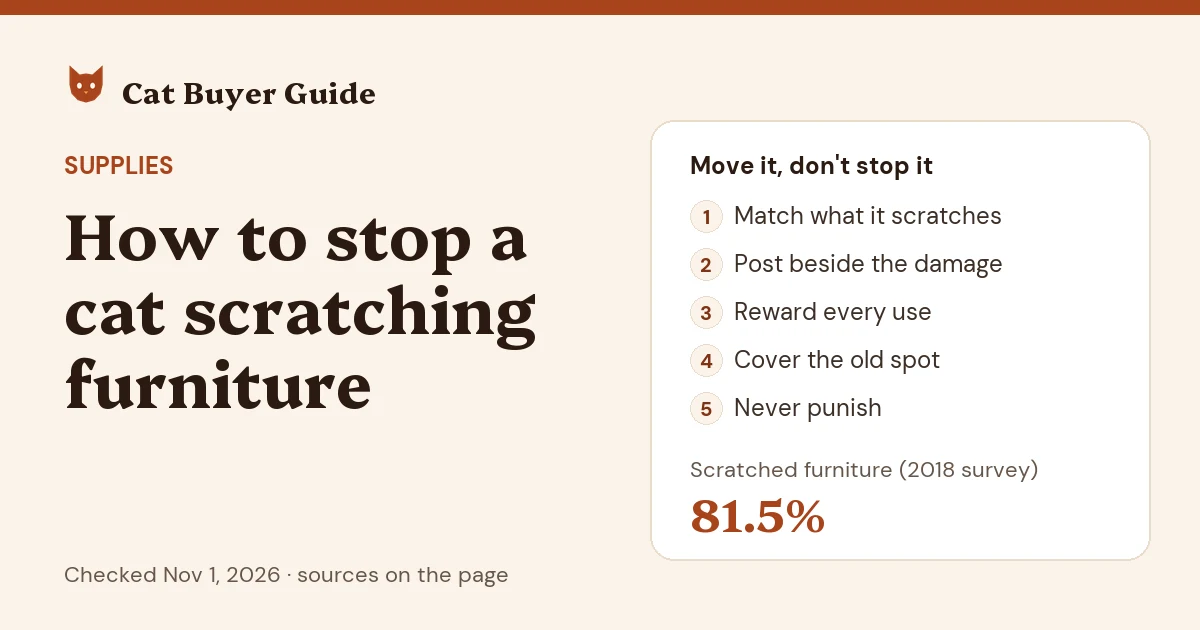
You can’t stop a cat from scratching, and International Cat Care and the ASPCA both say you shouldn’t try. What works is moving the scratching somewhere you can live with. Find out what your cat scratches and how (upright or flat, fabric or carpet). Put a sturdy post or pad that matches it right beside the damaged spot. Reward every use. Then make the old spot less inviting with a cover such as a heavy blanket or double-sided tape, and never punish your cat for scratching.
We built this guide from the advice of International Cat Care, the ASPCA, Cornell’s Feline Health Center, the San Francisco SPCA and the Feline Veterinary Medical Association (FelineVMA), plus two published studies, all checked on November 1, 2026. We don’t own a cat and haven’t tested any of this at home. For which post to buy, see our scratching post buyer’s guide.
Why cats scratch your furniture
Scratching is normal cat behavior with real jobs to do. International Cat Care (iCatCare) lists three: keeping the claws healthy, exercising the muscles of the front legs and spine, and marking. Dragging the claws down a surface pulls off the worn outer layer of each claw. Glands between the paw pads leave a scent message at the same time, and the marks themselves are a visual signal to other cats.
Cornell’s Feline Health Center calls scratching largely a marking behavior and an innate one, like grooming or burying waste, which is why it is hard to stop. The good news, Cornell adds, is that cats can be taught to scratch more suitable objects.
A few more points from iCatCare that explain *where* a cat scratches:
- Kittens start scratching from around 5 weeks of age, so the habit starts early.
- Cats often scratch after they wake up.
- A cat may scratch hard in front of its owners or other cats as a sign of confidence, and it can learn to scratch for attention if that gets a reaction.
- Scratch marks spread all over the home, especially around doorways and windows, suggest a cat that feels insecure (more on that below).
It is a common problem. In a small 2018 survey of a vet practice’s clients, published in the *Journal of Feline Medicine and Surgery* (Moesta and colleagues), owners reported that 83.9% of their cats scratched things they weren’t meant to: 81.5% scratched chairs or other furniture and 64.1% scratched carpet.
How to stop a cat scratching furniture: the plan
The five vet and welfare sources give much the same plan, set out below as steps.
| Step | What to do | Why |
|---|---|---|
| 1. Watch | Note what your cat scratches, and whether it stretches up or scratches flat | The new spot has to offer the same experience |
| 2. Match | Get a post or pad with the same direction and a similar texture | Each cat has its own surface and direction preferences |
| 3. Place | Put it right beside the damaged spot, and one near where your cat sleeps | Cats scratch at their chosen spots and after waking |
| 4. Reward | Treats, praise or play every time it uses the new spot | The sources reward use and never punish |
| 5. Cover | Make the old spot less inviting (blanket, double-sided tape) | Takes away the old spot while the new habit forms |
| 6. Move | Once the habit holds, shift the post slowly to where you want it | Cornell suggests moving it gradually |
1. Work out what your cat likes to scratch
Cornell suggests watching your cat closely. Does it go for carpet, drapes, wood or the arm of the couch? Does it stretch up with its paws above its head, or scratch flat on the floor? The ASPCA adds that some cats like a vertical grain to rake down and others a horizontal grain to pick at, and that some cats prefer slanted surfaces.
2. Give it something that feels the same
iCatCare’s rule is to offer an alternative that gives a similar experience: the same direction, a similar texture and the same height. Cornell gives examples:
- A couch or other nubby fabric: a post covered in sisal or another rope-like material.
- Carpet: a carpet-covered post, or for a cat that scratches carpet flat, a flattened cardboard box or a log laid on its side.
- Drapes: a post tall enough for a long stretch, such as one that mounts on a wall or a door.
Whatever you choose, it has to be sturdy. The ASPCA says all cats want a post that won’t shift or collapse, and iCatCare says posts that are too light, or that move around, don’t give the resistance cats like. An upright post should be at least as tall as your cat standing on its hind legs with its front legs stretched out (Cornell). Kittens and older cats may find softer, angled or flat cardboard scratchers easier (iCatCare). Our scratching post buyer’s guide compares posts on those points, from the makers’ specs.
If you’re not sure what your cat likes, offer two or three kinds. The ASPCA suggests trying cardboard, carpet, wood, sisal and upholstery, then adding more of the kind your cat picks in other rooms.
Posts from our scratching post guide
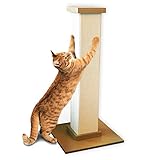
A tall sisal post: the SmartCat Ultimate Scratching Post, a 32-inch post wrapped in woven sisal on a 16 by 16 inch base that the maker says stops tipping and wobbling (Pioneer Pet). More in our scratching post guide.

The tallest option: the Amazon Basics Sturdy Scratching Post, Large, 35.4 inches of jute fiber on a wood base, for long or large cats. More in our scratching post guide.
Links to Amazon, chosen from the makers’ specs in our buyer’s guides. We haven’t tested them, and we may earn a commission if you buy.
3. Put it right next to the damage
Cornell says to put the new post next to the spot your cat already likes, and to put a post near each spot if it scratches in several places. The FelineVMA’s Alternatives to Declawing brochure gives the example of placing a scratcher near or in front of the corner of the couch. Because cats often scratch on waking, iCatCare, the FelineVMA and the San Francisco SPCA also suggest one near your cat’s bed.
In a home with more than one cat, iCatCare recommends one post per cat plus one more, in different places. If space is tight, scratching panels can be fixed to a wall.
4. Make the post the best place in the room
The SF SPCA calls rewarding your cat every time it uses the post the most important step. Ways to draw a cat to a new post, from the sources:
- Play with a wand toy around the base of the post; once the claws touch it, that is often enough to get it started (iCatCare).
- Put treats or catnip on or around the post (Cornell, ASPCA), or choose a post that already has catnip in it, for cats that respond to catnip (iCatCare).
- Reward with treats, praise or gentle strokes when your cat scratches it (Cornell, iCatCare).
- Scratch the post lightly with the tip of a screw to give a visual cue (iCatCare).
- Keep the post when it looks shredded. The ASPCA says cats prefer torn objects they can really dig into, and Cornell says a ragged post is a sign that it is doing its job.
Don’t hold your cat’s paws on the post and drag them down. The ASPCA and iCatCare both warn that it can frighten your cat and put it off the post, and off you.
5. Make the furniture less inviting
While the new habit forms, take away the old spot or make it unappealing. Cornell says the only guaranteed way to stop scratching in one place is to block access to it. Where that isn’t practical, the sources suggest covers:
- a thick, heavy blanket, or a one-sided sticky plastic film (iCatCare);
- double-sided sticky tape, plastic, sandpaper, or a vinyl carpet runner laid upside down with the knobby side up (ASPCA);
- aluminum foil (SF SPCA), once your cat is already using its post.
Always pair the cover with the new post right beside it. The ASPCA calls the posts the “legal” alternatives.
6. Move the post slowly
Once your cat uses the new post every day, you can move it toward where you’d like it, a little at a time (Cornell). If the scratching goes back to the furniture, move the post back.
Couch, carpet, doors and wood: what changes
How to stop a cat scratching the couch
The couch is the classic target. In the 2018 survey, fabric-covered furniture was among the things cats scratched most often. Match the texture with a sisal post (Cornell’s suggestion for nubby fabrics), stand it against the arm or corner your cat uses, and cover that corner with a heavy blanket or double-sided tape for now.
How to stop a cat scratching the carpet
iCatCare says many cats go for the bottom step of a staircase and scratch it lying down. For those cats, give them something flat on the floor, such as a horizontal cardboard scratcher, pieces of old or sample carpet near the stairs, or a log on its side (iCatCare, Cornell). iCatCare also says there is no evidence that a carpet-covered post makes a cat scratch other carpets more. The SF SPCA notes one catch with carpet posts: claws can get caught in the loops, and the cat may stop using the post. It suggests attaching the carpet upside down or using a more shreddable upholstery fabric.
How to stop a cat scratching doors and door frames
A door is a tall, upright surface, so offer a tall upright alternative. Some scratching posts hang from a doorknob or the back of a door (SF SPCA), and Cornell mentions posts that mount on a wall or door. If the door scratching is a request to be let in, keep in mind iCatCare’s point that cats can learn to scratch for attention when it gets a response. If the marks are on many doorways and windows, read the next section.
For wooden doors, frames and banisters that are already marked, iCatCare suggests washing the area with unscented soapy water, using a synthetic feline pheromone spray there, and putting a scratching post or panel nearby. A wooden one may suit a cat that likes wood.
When scratching is about stress
Not all scratching is about the claws. iCatCare says scratching may be linked to anxiety if it is widespread, if several cats share the home, or if many cats live nearby. Even major building work in the home can trigger it. The FelineVMA adds that ongoing scratching can be tied to stress, attention seeking or a cat that doesn’t feel secure. iCatCare’s answer is more resources around the home (bowls, litter boxes, scratching posts, beds) so cats don’t compete for them.
Both iCatCare and the FelineVMA mention synthetic feline pheromone sprays and plug-in diffusers. The FelineVMA’s brochure says to clean the old spot with soap and water first, spray the spot, and never spray the post you want your cat to use. There is one large study: in a 28-day randomized, placebo-controlled trial in *PLoS One* (Pereira and colleagues, 2023) with 1,060 cats, scratching became less frequent for 83.5% of cats with the pheromone diffuser and 68.5% with a placebo. Note that the study was funded by the diffuser’s maker, whose staff were among the authors, and that the placebo group improved too. The FelineVMA brochure was also sponsored by that maker. We don’t link any pheromone product.
Talk to your vet if
- the scratching is widespread around the home or seems linked to stress (iCatCare);
- your cat’s claws look overgrown or thick, or catch on soft furnishings. iCatCare says very overgrown or thickened claws can be a sign of disease, such as osteoarthritis or hyperthyroidism, so they need a vet’s look;
- you want to start nail trims. The FelineVMA suggests asking your vet for a demonstration;
- nothing is working. The ASPCA suggests a certified applied animal behaviorist or a board-certified veterinary behaviorist.
What not to do
- Don’t punish. iCatCare says your cat should never be punished for scratching. Punishing a normal behavior only confuses your cat, and if the scratching comes from anxiety, punishment adds to the distress and can make things worse. The FelineVMA adds that punishment can push a cat to scratch more, in the same or other places. In the 2018 survey, punishment was common but didn’t appear to change how often cats scratched.
- Don’t scold or spray your cat. The SF SPCA warns it can make your cat afraid of you, and your cat may learn to scratch the sofa when you’re out. The ASPCA treats startling a cat with a clap or water only as a last resort, for the same reason.
- Don’t throw out a shredded post (ASPCA, Cornell).
- Don’t force its paws onto the post (ASPCA, iCatCare).
Nail trims and nail caps
Trims and caps reduce damage; they don’t replace a post. iCatCare says claw trimming may limit the damage for now but doesn’t meet your cat’s need to scratch, so it prefers good alternatives over relying on trims. The FelineVMA advises proper cat nail trimmers, a calm room, rewards, and starting when cats are kittens so they get used to it. It says indoor cats, kittens and older cats need trims more often. Our guide to trimming kitten nails covers how.
Soft plastic nail caps are glued over the claws. Both the ASPCA and the FelineVMA say they need replacing every four to six weeks. The FelineVMA sees them as a less desirable option than trims, scratchers and enrichment.
What about declawing?
Declawing isn’t a scratching fix. The FelineVMA explains that it is the amputation of the last bone of each toe, and its position statement strongly opposes it as an elective procedure. The ASPCA is also strongly opposed and says declawing has not been proven to improve behavior problems. Both point owners to the steps above instead. If you are thinking about it, talk to your vet about the alternatives first.
Frequently asked questions
How long does it take to stop a cat scratching furniture?
None of our sources gives a timeline. What they agree on is the order: the new post goes in first, right beside the old spot, with rewards, and the old spot is covered while the habit moves. Cornell then suggests moving the post gradually to where you want it.
Does a carpet-covered post teach my cat to scratch the carpet?
iCatCare says there is no evidence that it does once the post is used regularly. The SF SPCA’s concern is different: claws can snag in carpet loops, so it suggests a more shreddable fabric, or the carpet turned upside down.
Why does my cat scratch the couch when it has a scratching post?
The usual reasons in the sources: the post is too short, too light or wobbly, in the wrong place (far from the couch or from where your cat sleeps), or the wrong texture or direction. iCatCare adds that an adult cat may have outgrown the short post it had as a kitten.
Are scratch pads or scratching posts better?
It depends on the cat. In the 2018 survey, cats used scratching posts more often than scratch pads, but some cats prefer to scratch flat, and kittens may like soft cardboard. Offering both is the simplest way to find out.
Should I get a kitten a scratching post right away?
Yes. Kittens start scratching from about 5 weeks, according to iCatCare, so a post should be in the kitten’s room from the first day. See our first week with a new kitten guide and the new kitten checklist.
Sources
- International Cat Care: Scratching on furniture and carpets (updated Oct. 7, 2026), checked Nov 1, 2026
- ASPCA: Destructive Scratching, checked Nov 1, 2026
- Cornell Feline Health Center: Destructive Behavior, management strategies for your cat’s innate behaviors (PDF), checked Nov 1, 2026
- San Francisco SPCA: Scratching Posts (PDF), checked Nov 1, 2026
- FelineVMA: Alternatives to Declawing (client brochure, 2024, PDF), checked Nov 1, 2026
- FelineVMA: Declawing position statement, checked Nov 1, 2026
- Moesta, Keys and Crowell-Davis (2018): Survey of cat owners on feline scratching of inappropriate objects, J Feline Med Surg 20(10), checked Nov 1, 2026
- Pereira et al. (2023): Efficacy of the Feliway Classic Diffuser in reducing undesirable scratching in cats, PLoS One 18(10), checked Nov 1, 2026