Your First Week With a New Kitten: A Day-by-Day Guide

Built from dated data and expert sources, not hands-on pet testing. Facts and prices checked November 1, 2026. We may earn a commission if you buy through links on this page. It never changes what we recommend. As an Amazon Associate we earn from qualifying purchases. How we research
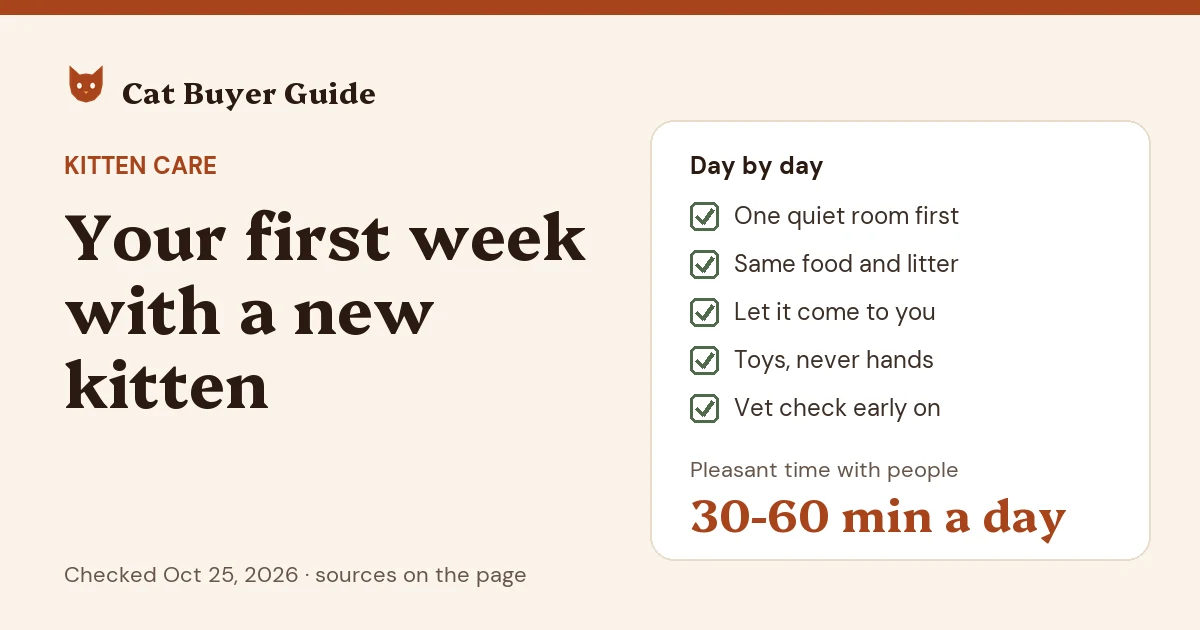
Keep your new kitten’s first week small and quiet. Before you pick it up, set up one quiet room with food, water, a litter box, a bed, a hiding place and a scratching post. On the first day, put the carrier in that room, open the door and let the kitten come out when it is ready. Feed the food and use the litter it already knows, play with toys rather than hands, let it come to you, and book a vet check in the first days. Open up the rest of the house only once it is relaxed in its room. Some kittens settle within hours, others take a few weeks.
We built this guide from the advice of International Cat Care, Cats Protection and the 2021 AAHA/AAFP Feline Life Stage Guidelines (written by vets for the American Animal Hospital Association and the American Association of Feline Practitioners), checked on October 25, 2026, with the key points re-checked on November 1, 2026. For what to buy, see the new kitten checklist.
The first week at a glance
| When | What to do |
|---|---|
| Before pickup | Set up one quiet room; kitten-proof it; ask for a blanket that smells of the kitten |
| Day 1 | Carrier into the room, door open, no forcing; quiet house, no visitors |
| Night 1 | Leave the kitten in its room with everything it needs |
| Days 2–3 | Sit with it on its terms; short play with wand toys; meals little and often |
| Days 4–7 | Vet check; short handling sessions; more space once it is relaxed |
| After week 1 | Slow introductions to other pets; keep up vaccines and socializing |
The table is our arrangement of the sources’ advice, not a schedule any of them sets. Go at your kitten’s pace, not the calendar’s.
Before you pick up your kitten
Set up one quiet room
International Cat Care (iCatCare) says kittens in particular should be kept to one room for the first few days or weeks. Cats Protection, a UK cat charity, describes it as a small, escape-proof room with a door you can close, away from the busy parts of the home. A spare bedroom or an office works.
Put in it:
- Food and water bowls, apart from each other. Many cats prefer their water away from their food, Cats Protection notes.
- A litter box in a quiet corner, on the far side of the room from the food (iCatCare). Our guide to litter training a kitten covers the box and litter, and our litter box buyer’s guide compares low-entry boxes a kitten can climb into.
- A bed and a place to hide, such as a cardboard box on its side with a soft blanket in it.
- A scratching post. The AAHA/AAFP guidelines say cats should have scratching posts from the day they arrive. Our scratching post buyer’s guide compares sturdy posts.
- A high spot, such as a safe shelf (Cats Protection), and a few toys.
Some owners add a plug-in synthetic feline pheromone diffuser; both iCatCare and Cats Protection say it may help a nervous kitten feel calmer.
For the kitten’s room
A low litter box: the small Petmate Basic Litter Box, about 14 by 10.5 inches with 3.5-inch sides (Petmate). More in our litter box guide.
A tall, steady scratching post: the SmartCat Ultimate Scratching Post, a 32-inch sisal post on a 16 by 16 inch base (Pioneer Pet), still tall enough when your kitten is grown. More in our scratching post guide.
A carrier for pickup day and the vet: the Petmate Two Door Top Load Kennel, 19-inch, hard plastic with doors on top and in front, for pets up to 10 lb (Petmate). More in our carrier guide.
Links to Amazon, chosen from the makers’ specs in our buyer’s guides. We haven’t tested them, and we may earn a commission if you buy.
Make the room safe
Kittens can squeeze into very small spaces, iCatCare warns. Before the kitten arrives:
- Block gaps and fireplaces, and tidy away exposed cables.
- Take out poisonous plants. Lilies are highly toxic to cats, and Cats Protection says not to keep them in the home at all. See what is poisonous to cats.
- Keep medicines and cleaning products out of reach, and secure cupboard doors.
- Avoid a room with full-length curtains: iCatCare says a kitten will likely climb them and get stuck at the top.
- Put away breakable things and toys with string; string toys are for supervised play only.
Ask for familiar smells, food and litter
- Swap scents. A few days before pickup, Cats Protection suggests leaving a blanket or a piece of clothing that smells of you with the kitten. Bring home bedding that smells of the kitten, and rub it over things in its room.
- Ask what it eats and which litter it uses, and buy the same. iCatCare advises the same diet and litter for the first one to two weeks, so something is familiar.
- Bring a sturdy carrier. In the car, secure it with a seatbelt (Cats Protection). Our carrier guide compares hard-sided models.
Your first day with a new kitten
- Go straight to the kitten’s room. Put the carrier down, open the door and let the kitten come out in its own time. Don’t pull it out (iCatCare, Cats Protection). Leave the carrier there as a safe place.
- Keep the house calm. For the first 24 hours, iCatCare says, don’t overwhelm the kitten with lots of new people and children. Cats Protection suggests no visitors until it has settled.
- Show it the essentials, then give it space. Once it is exploring, you can gently show it the litter box, bowls and bed. When it has found its food, water and box, iCatCare suggests leaving the room for a while.
- Don’t worry if it eats little at first. iCatCare says a new kitten may not show much interest in food at the start.
- Check in quietly. Cats Protection suggests about an hour alone, then calm, quiet visits. Get down to the kitten’s level, wait for it to come to you, and hold out a hand for it to sniff.
The first night
Leave the kitten in its room with food, water, the litter box and a bed, Cats Protection advises for a new cat’s first night. It may sleep somewhere else entirely; let it.
If it cries at night, Cats Protection suggests working out why:
- Can it reach everything? Check the food, water and litter box first.
- Does it want company? If attention settles it, you may decide to let it sleep in your room. Cats Protection warns that this is rarely “just for tonight,” so decide before you start.
- Is it just unsettled? That is natural, and the crying should stop as it feels at home. A soft toy or a radio on low may help, Cats Protection says. Call your vet if you’re worried.
Days 2 and 3: let your kitten come to you
- Interact on its terms. If the kitten hides, don’t coax it out, iCatCare says. Sit in the room, read or watch TV, and let it come to you. Being on the floor at its level helps.
- Don’t wake it to play. Kittens need a lot of sleep, and both iCatCare and Cats Protection say to let them rest undisturbed.
- Play with toys, never hands. Use a wand (fishing-rod) toy, a ball or a toy mouse. The AAHA/AAFP guidelines say not to let kittens play with hands or feet, because it can lead to scratching or biting injuries later. If your kitten pounces on you, keep still and offer a toy instead (Cats Protection).
- Feed little and often. Cats Protection says kittens should be fed at least four times a day; iCatCare suggests splitting the daily amount into 4 to 5 meals. Follow the amounts on the food and ask your vet if you’re unsure.
- Help with the box if needed. If the kitten hasn’t found it, iCatCare suggests placing it in the box after it wakes, after meals, or when it starts sniffing and crouching.
- Never punish. Cats Protection says punishment makes kittens anxious or fearful; redirect what you don’t want and reward what you do.
Days 4 to 7: the vet check, handling and more space
Book a vet check in the first days
Cats Protection advises registering with a vet as soon as possible and arranging a health check soon after the kitten comes home. Bring any records from the breeder or shelter. The AAFP’s retrovirus guidelines say a cat should be tested for feline leukemia virus (FeLV) and feline immunodeficiency virus (FIV) as soon as possible after you get it. Your vet will also set the vaccine plan: see our kitten vaccination schedule, and the new kitten checklist for what the first visit costs.
The AAHA/AAFP guidelines call the first visit a chance to make the vet a pleasant place, and suggest treat-based carrier training so the carrier, and the trip, feel less scary.
Start gentle handling and socializing
A kitten’s most sensitive period for getting used to new people, animals and experiences begins as early as 2 to 3 weeks and may be closing by 9 to 10 weeks, the AAHA/AAFP guidelines say, so for a kitten that comes home at 8 weeks or older, much of it has already passed. Gentle new experiences still help. They recommend, ideally, 30 to 60 minutes a day of pleasant time with people, and getting kittens used to gentle handling, brushing, nail trims, household noises and car travel, paired with food or other rewards.
- Keep sessions short. Stop if the kitten struggles or seems distressed, and try again later in smaller steps (Cats Protection).
- Children: supervised and gentle at first, iCatCare says, and never let a child chase the kitten (Cats Protection).
- New people and pets: let the kitten approach and engage on its own terms (AAHA/AAFP).
Open up more of the house
When the kitten has explored its room and seems comfortable there, you can let it explore the rest of the house, Cats Protection says. Keep its room open as a place to retreat to. A shy kitten may need longer; iCatCare says it can take some cats several weeks to feel safe.
If you have other pets
Don’t rush it. iCatCare’s advice on introducing cats is to keep the newcomer in a room your resident cat doesn’t use, with its own (or new) bowls, box and bed, and to let it settle first: anywhere from several days to a week or two. Then:
- Swap scents, for example by swapping a blanket between beds.
- Swap spaces, letting each cat explore the other’s area while the other is elsewhere.
- Let them see each other through a barrier, such as a glass door, a stair gate or a mesh barrier. If either cat hisses or growls, calmly call it away; don’t punish it, and don’t use food or play as a distraction.
- Short meetings without the barrier, a few minutes at first, building up only while both stay relaxed. At any sign of tension, put the barrier back and go back a step.
Give each cat its own food, water, litter box, bed and scratching post, plus one extra, in different places. iCatCare notes that some cats never accept another cat. Introduce dogs just as slowly and always supervise, with places the kitten can escape to (Cats Protection).
Food, litter and going outside
- Change food slowly. If you want to switch foods, mix the new food into the old over 7 to 14 days, iCatCare says; a sudden change on top of the stress of moving can upset a kitten’s stomach.
- No cow’s milk. iCatCare says it can cause diarrhea. Fresh water should always be available.
- Litter: the AAHA/AAFP checklist suggests starting with unscented clumping sand-type litter and/or the litter the kitten was using. If you need to buy some, Dr. Elsey’s Ultra unscented clumping clay litter is one such litter.
- Outdoors: not in the first week. iCatCare keeps a new cat indoors for at least two to three weeks, and says a kitten with outdoor access shouldn’t go out until at least a week after its first vaccine course is finished, and should be spayed or neutered first. Our guide on when to spay or neuter covers the timing. Whether your cat goes outside at all is your choice; ask your vet about the risks where you live.
When to call your vet in the first week
- Kittens can go downhill fast. Cats Protection says a kitten’s health can deteriorate quickly, so call your vet straight away if it seems unwell.
- Watch for runny eyes or nose, dirty ears, or a dirty or sore area under the tail, which can mean diarrhea. iCatCare lists these as signs of ill health in kittens.
- Not eating: a new kitten may eat little at first. A very anxious cat may not eat or use the box for the first 24 hours, iCatCare says, but if that goes on, speak to your vet.
- Lashing out when touched, after the first days, can be a sign of pain or illness, iCatCare notes. Ask your vet.
- Don’t give any medicine, supplement or flea product without your vet’s advice.
FAQ
How long does it take a new kitten to settle in?
It varies. Some kittens adapt quickly and others take a few weeks to feel safe, says Cats Protection. Let your kitten set the pace, and open up the house once it is relaxed in its room.
Should my kitten sleep in my bedroom on the first night?
You can choose either. Cats Protection suggests the first night in the kitten’s own room with everything it needs. If it cries for company and settles with you, it can sleep in your room, but it will probably expect to every night after.
Is it normal for a new kitten to hide?
Yes. Hiding helps cats feel safe. Give it a hiding place, sit quietly nearby and let it come out on its own (iCatCare, Cats Protection).
Is it normal for a new kitten to cry at night?
Often, yes. Check that it can reach food, water and the litter box, and that it isn’t asking for company. Crying from feeling unsettled should fade as it settles (Cats Protection).
Is the first week with a new cat different from a kitten’s?
The plan is the same: one room, a calm house, interaction on the cat’s terms. Kittens should be kept to one room at first; iCatCare says a confident adult cat may not need to be, unless you have another cat. An anxious adult may eat and use the box only at night for the first days.
When can my kitten meet my other cat?
Only after it has settled in its own room (several days to a week or two, iCatCare says) and after scent swapping. Rushing can lead to long-term stress or conflict between the cats, Cats Protection warns.
Sources
- International Cat Care: Helping your new cat or kitten settle in, checked Nov 1, 2026
- International Cat Care: Introducing cats, checked Oct 25, 2026
- International Cat Care: Choosing a kitten, checked Oct 25, 2026
- Cats Protection: Bringing a new kitten home, checked Nov 1, 2026
- Cats Protection: What to expect on the first night with your new cat, checked Nov 1, 2026
- AAHA and AAFP: 2021 Feline Life Stage Guidelines: Behavior and Environmental Needs, Kittens, checked Oct 25, 2026
- AAHA Trends: From the Guidelines: Kitten checklist (2021 AAHA/AAFP Feline Life Stage Guidelines), checked Oct 25, 2026
- AAFP 2020 Feline Retrovirus Testing and Management Guidelines (Little et al., JFMS), checked Oct 25, 2026