What Is Poisonous to Cats? Plants, Foods and Household Dangers

Built from dated data and expert sources, not hands-on pet testing. Facts and prices checked October 7, 2026. No affiliate links on this page. How we research
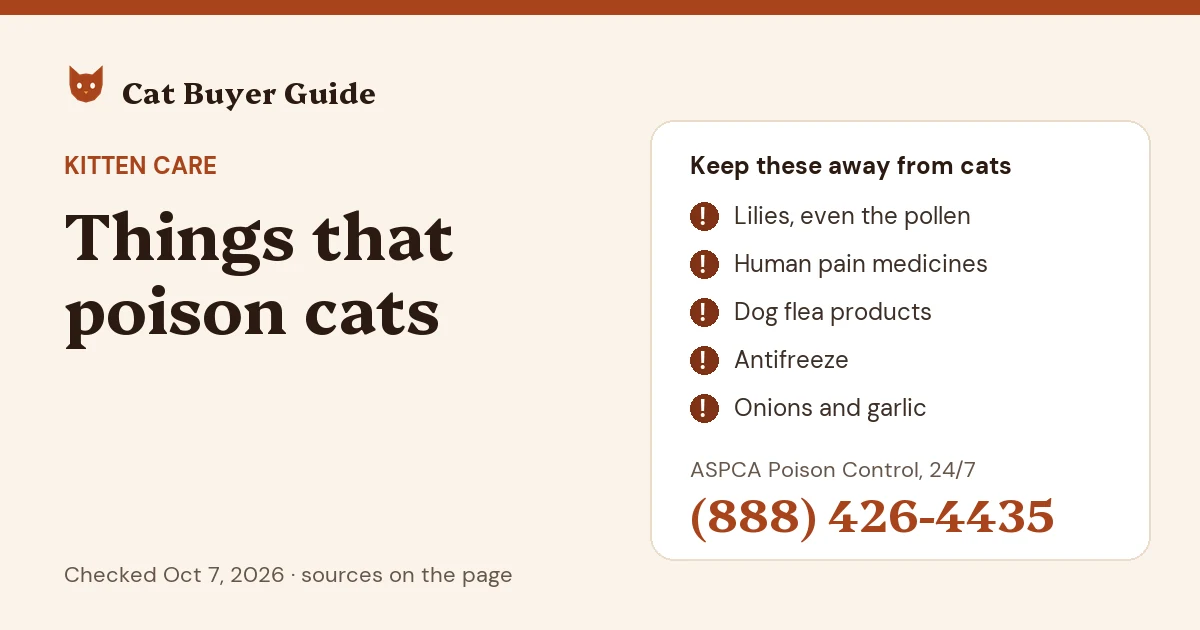
What’s poisonous to cats? The dangers vets and poison centers warn about most are lilies, human medicines such as acetaminophen (Tylenol) and ibuprofen, dog flea products that contain permethrin, antifreeze, rat and mouse poison, essential oils, household chemicals, some people foods and many houseplants. Lilies come first: a nibble of a leaf, a lick of pollen or a sip of vase water can kill a cat. If you think your cat was exposed, call your vet or a poison hotline at once, before signs appear.
We checked the ASPCA, FDA, Cornell’s Feline Health Center, International Cat Care, Pet Poison Helpline and EPA on Oct 7, 2026. This doesn’t replace your vet’s advice.
The short answer
- If your cat may have been exposed, call your vet, an emergency clinic, ASPCA Poison Control at (888) 426-4435 or Pet Poison Helpline at (855) 764-7661. Both run 24/7, and a fee may apply (details).
- Don’t make your cat vomit or give any home remedy unless a vet tells you to.
- Bring the package, label or plant, or a photo of it.
- Never keep true lilies or daylilies in a home with a cat.
- Never give a cat human medicine without your vet’s OK, or any dog flea product.
On this page
- Lilies: the most urgent danger
- Medicines, flea products and household chemicals
- People foods that are toxic to cats
- Plants that are toxic and non-toxic to cats
- Toads and other outdoor dangers
- Signs of poisoning in cats
- What to do if your cat ate something poisonous
- Kitten-proofing your home against poisons
- FAQ
Lilies: the most urgent danger
Lilies in the true lily (Lilium) and daylily (Hemerocallis) families are very dangerous for cats. The whole plant is toxic, even the pollen and the water in the vase. A small bite of a leaf or petal, a few pollen grains licked off the fur, or a drink from the vase can cause “fatal kidney failure in less than 3 days,” the FDA warns. The toxin is unknown and affects only cats. Cornell calls lilies especially toxic to cats, and the ASPCA’s entries for Easter lilies and daylilies list vomiting, loss of appetite, lethargy, kidney failure and death.
The FDA’s timeline:
- 0 to 12 hours: less activity, drooling, vomiting, loss of appetite.
- 12 to 24 hours: signs of kidney damage, such as peeing more and dehydration.
- 24 to 72 hours: kidney failure, fatal without treatment.
If treatment starts 18 hours or more after the cat ate the lily, the kidney failure is generally irreversible, the FDA says, so don’t wait for signs. International Cat Care warns that “pollen-free” lilies are still dangerous. Keep them out of your home, and out of your garden if cats roam nearby (FDA).
Not every “lily” is a true lily (FDA):
| Plant | What it can do to a cat |
|---|---|
| True lilies (Lilium) | Kidney failure, fatal without treatment. Includes Easter, tiger, Asiatic, Oriental, stargazer, Japanese show, rubrum and wood lilies |
| Daylilies (Hemerocallis) | Kidney failure, as with true lilies |
| Lily of the valley | A heart rhythm problem that can be life-threatening; vomiting, diarrhea, weakness |
| Gloriosa (flame) lily | Its roots or tubers can cause failure of several organs |
| Peace and calla lilies | Crystals irritate the mouth: pawing at the face, drooling, vomiting. Signs usually pass on their own |
The ASPCA lists peace and calla lilies and lily of the valley as toxic to cats too.
Medicines, flea products and household chemicals
Cats groom chemicals off their fur, and their liver can’t break some of them down, so recovery can be harder (International Cat Care). The household dangers the sources list:
| Danger | Why it matters for cats |
|---|---|
| Acetaminophen (Tylenol) | Also called paracetamol. Cats can’t break it down; it damages the liver and red blood cells (International Cat Care). Look for it in cold, flu and allergy products (Pet Poison Helpline) |
| Ibuprofen, naproxen | Can cause severe stomach ulcers and kidney failure. Never give any NSAID without asking your vet (Pet Poison Helpline) |
| Aspirin | Cats are much more sensitive than dogs. It’s also in Pepto-Bismol, some skin products and muscle rubs (Pet Poison Helpline) |
| Dog flea products | Permethrin in dog spot-ons can kill a cat, even through contact with a freshly treated dog (International Cat Care) |
| Antifreeze | Even the smallest amount of ethylene glycol can cause kidney failure and death (International Cat Care). Watch for car leaks and garage containers (Pet Poison Helpline) |
| Rat and mouse poison | Different baits need different treatments (Pet Poison Helpline). Bromethalin has no antidote, and cats are more sensitive to it than dogs (Pet Poison Helpline) |
| Garden chemicals | Insecticides, snail baits, weed killers, fertilizers (Cornell). Keep your cat in until sprays have dried (International Cat Care) |
| Essential oils, potpourri | Cats lack a liver enzyme they need to clear the oils (Pet Poison Helpline). Liquid potpourri can burn the mouth (Pet Poison Helpline; Cornell) |
| Cleaning products | Most are fine used as labeled, but undiluted bleach, detergent pods, dryer sheets and fabric softener can burn or sicken pets (ASPCA), and so can some disinfectants (International Cat Care) |
Dog flea products: a mistake that can kill a cat
The most common cause of permethrin poisoning is human error: owners put a dog’s flea product on a cat by mistake, sometimes thinking a smaller amount will be fine. Even a very small amount can make a cat seriously ill (International Cat Care), and EPA veterinarians found cats’ exposure to dog products an important problem (EPA). Use only flea products labeled for cats, and on a kitten only if the label allows it (EPA). If you have a dog too, International Cat Care suggests a permethrin-free dog product, or keeping the pets apart for 72 hours after using one.
People foods that are toxic to cats
These are on the ASPCA’s list of people foods to keep from pets, Cornell’s list for cats, or both:
| Food | What it can do |
|---|---|
| Onions, garlic, chives | Damage red blood cells, which can lead to anemia, and upset the stomach. Cats are more sensitive than dogs (ASPCA; Pet Poison Helpline) |
| Chocolate, coffee, tea | Vomiting, diarrhea, hyperactivity, abnormal heart rhythm, tremors, seizures, even death. Darker chocolate is riskier (ASPCA; Pet Poison Helpline) |
| Alcohol, raw yeast dough | Vomiting, incoordination, breathing trouble, coma, even death. Dough also swells in the stomach (ASPCA; Pet Poison Helpline) |
| Xylitol | In sugar-free gum, candy and some toothpaste. Low blood sugar and possible liver damage (ASPCA). On Cornell’s list for cats |
| Grapes and raisins | On Cornell’s list for cats, though poisoning is mainly reported in dogs (Pet Poison Helpline) |
Plants that are toxic and non-toxic to cats
The ASPCA keeps a plant list for cats, and Cornell says hundreds of plants are poisonous to cats. Before you rely on a list:
- Check the scientific name. Common names overlap: the ASPCA uses “ribbon plant” both for the non-toxic spider plant and for toxic dracaena.
- No list is complete. The ASPCA’s list covers the plants it sees most often.
- Non-toxic isn’t harmless to eat. Any plant can cause vomiting, the ASPCA says, though it doesn’t expect non-toxic plants to be life-threatening. Even grass can upset a cat’s stomach (International Cat Care).
Toxic to cats
Each plant links to its ASPCA entry; we put the ASPCA’s terms in plain words.
| Plant | Scientific name | Toxin and signs (ASPCA) |
|---|---|---|
| Aloe | Aloe vera | Saponins, anthraquinones. Vomiting, lethargy, diarrhea (the gel is considered edible) |
| Amaryllis | Amaryllis spp. | Lycorine and others. Vomiting, depression, diarrhea, abdominal pain, drooling, loss of appetite, tremors |
| Azalea | Rhododendron spp. | Grayanotoxin. Vomiting, diarrhea, weakness, heart failure |
| Chrysanthemum (mum) | Chrysanthemum spp. | Pyrethrins and other irritants. Vomiting, diarrhea, drooling, incoordination, skin inflammation |
| Cyclamen | Cyclamen spp. | Terpenoid saponins. Drooling, vomiting, diarrhea; after large amounts of the tubers, heart rhythm problems, seizures, death |
| Daffodil | Narcissus spp. | Lycorine and other alkaloids. Vomiting, drooling, diarrhea; after large amounts, convulsions, low blood pressure, tremors, heart rhythm problems. Bulbs are most poisonous |
| Dieffenbachia (dumb cane) | Dieffenbachia | Insoluble calcium oxalates. Burning, irritated mouth, drooling, vomiting, trouble swallowing |
| Dracaena (corn plant) | Dracaena fragrans | Saponins. Vomiting (sometimes with blood), depression, loss of appetite, drooling, dilated pupils |
| English ivy | Hedera helix | Triterpenoid saponins. Vomiting, abdominal pain, drooling, diarrhea; leaves are more toxic than berries |
| Gladiola | Gladiolus species | Toxin unknown. Drooling, vomiting, lethargy, diarrhea; most toxin in the corms (bulbs) |
| Golden pothos | Epipremnum aureum | Insoluble calcium oxalates. Burning, irritated mouth, drooling, vomiting, trouble swallowing |
| Hyacinth | Hyacinthus orientalis | Possibly narcissus-like alkaloids. Intense vomiting, diarrhea, occasionally with blood, depression, tremors |
| Jade plant | Crassula argentea | Toxin unknown. Vomiting, depression, incoordination |
| Kalanchoe | Kalanchoe spp. | Bufadienolides. Vomiting, diarrhea, rarely an abnormal heart rhythm |
| Oleander | Nerium oleander | Cardiac glycosides. Drooling, abdominal pain, diarrhea, colic, depression, death |
| Philodendron (heartleaf) | Philodendron hederaceum | Insoluble calcium oxalates. Mouth pain and swelling, drooling, vomiting, trouble swallowing |
| Poinsettia | Euphorbia pulcherrima | Irritant sap. Irritates the mouth and stomach, sometimes vomiting; “generally over-rated in toxicity” |
| Sago palm | Cycas revoluta | Cycasin. Vomiting, black stools, jaundice, increased thirst, bleeding, bruising, liver failure, death |
| Snake plant | Sansevieria trifasciata | Saponins. Nausea, vomiting, diarrhea |
| Swiss cheese plant | Monstera deliciosa | Insoluble calcium oxalates. Burning, irritated mouth, drooling, vomiting, trouble swallowing |
| Tulip | Tulipa spp. | Tulipalin A and B. Vomiting, depression, diarrhea, drooling; most toxin in the bulb |
| Yucca | Yucca spp. | Saponins. Vomiting |
Non-toxic to cats
The ASPCA lists these as non-toxic to cats:
| Plant | Scientific name |
|---|---|
| African violet | Saintpaulia spp. |
| Areca palm | Dypsis lutescens |
| Baby rubber plant | Peperomia obtusifolia |
| Boston fern | Nephrolepis exalta bostoniensis |
| Calathea | Calathea spp. |
| Cast iron plant | Aspidistra elatior |
| Christmas cactus | Schlumbergera bridgesii |
| Haworthia | Haworthia species |
| Hens and chickens | Echeveria elegans |
| Parlor palm | Chamaedorea elegans |
| Phalaenopsis orchid | Phalaenopsis sp. |
| Pony tail plant | Beaucarnea recurvata |
| Prayer plant | Calathea insignis |
| Spider plant | Chlorophytum comosum |
Toads and other outdoor dangers
All toads release toxins from their skin, and a pet that mouths or eats one will likely drool and vomit (Pet Poison Helpline). Most US toads cause only a mild stomach upset, but a Bufo, cane or Colorado River toad can kill an untreated cat. A cat can be poisoned just by licking or touching one, and signs can start within minutes or hours: red, inflamed gums, eye irritation, vomiting, diarrhea, an abnormal heart rhythm, breathing problems and seizures (Pet Poison Helpline). If your cat caught a toad you can’t identify, or one of those kinds, get emergency care at once.
Outdoor cats also meet poisoned prey: rat and mouse poison most often reaches cats through rodents that ate the bait (International Cat Care).
Signs of poisoning in cats
Signs depend on the poison, and cats hide illness (International Cat Care). By the time an owner notices, a cat may already be at serious risk, Cornell warns. Signs the sources list:
| Body system | Signs to watch for |
|---|---|
| Stomach and gut | Vomiting, diarrhea, drooling, not eating, blood in the stool |
| Nervous system | Tremors, twitching, wobbly walking, seizures, sluggishness, collapse, coma |
| Breathing and heart | Difficulty breathing, coughing, an irregular heartbeat |
| Mouth and skin | A red, swollen or blistered mouth, throat or skin; pawing at the face |
| Bleeding | Bruising, nosebleeds, blood in the urine |
| Kidneys and liver | Drinking and peeing more, being unable to pee, yellow gums or skin (jaundice) |
Sources: Cornell; International Cat Care; Pet Poison Helpline; FDA (pawing at the face).
What to do if your cat ate something poisonous
- Move your cat away from the source and keep other pets away (Pet Poison Helpline; International Cat Care). If something is on its fur or paws, stop it grooming.
- Call right away: your vet, or if they’re closed, an emergency clinic or a poison hotline (Cornell). The sooner, the easier and safer the treatment (Pet Poison Helpline).
- Don’t make your cat vomit unless a vet tells you to. Some poisons do more damage coming back up (Cornell), and hydrogen peroxide is never safe for cats (Pet Poison Helpline).
- No home remedies. Milk isn’t an antidote and can worsen stomach upset; salt and oils can do harm too (Pet Poison Helpline).
- Bring the evidence: the package or label, a sample, the plant or a photo, and the time it happened (Cornell; FDA; International Cat Care). With rat poison, bring the label: the ingredient can’t be told from the bait’s color or shape (Pet Poison Helpline).
| Hotline | Phone | Open | Fee, as stated |
|---|---|---|---|
| ASPCA Poison Control | (888) 426-4435 | 24 hours a day, 365 days a year | “A consultation fee may apply.” No amount given |
| Pet Poison Helpline | (855) 764-7661 | 24/7, phone or chat | “a $99 USD per incident fee applies,” follow-ups included (its FAQ still says $85) |
Checked Oct 7, 2026. The FDA calls the ASPCA line the ASPCA Animal Poison Control Center.
Talk to your vet
- Call your vet, an emergency clinic or a poison hotline as soon as you think your cat ate, licked or touched something toxic. Don’t wait for signs.
- Never give your cat medicine your vet hasn’t prescribed. If you think it’s in pain, book a vet visit (International Cat Care).
- At your kitten’s first vet visits (see our kitten vaccination schedule), ask which flea treatment suits its age and weight.
Kitten-proofing your home against poisons
Kittens are especially at risk: they’re curious, they chew plants, and because they’re small, a fairly small amount can poison them (International Cat Care). Before your kitten comes home (see what age to bring a kitten home):
- No lilies in the house or garden, including bouquets and “pollen-free” lilies.
- Check every plant against the ASPCA list by scientific name; keep toxic ones out, especially with an indoor cat (International Cat Care).
- Lock up medicines and chemicals in closed cupboards, since cats push things off shelves (International Cat Care), and pick up dropped pills (Cornell).
- Keep your cat off freshly cleaned or treated surfaces until they’re dry (International Cat Care). For the litter box, see how to litter train a kitten.
- Use only flea products labeled for cats (EPA).
- Cover potpourri with a lid your cat can’t open (Cornell), and be cautious with essential oil diffusers (Pet Poison Helpline).
- Keep people food and the trash out of reach (Cornell).
- Seal antifreeze and clean up spills at once (International Cat Care).
The new kitten checklist covers the rest: cables, small gaps, windows and string.
FAQ
Is a ZZ plant poisonous to cats?
It isn’t on the ASPCA’s cat list, and Pet Poison Helpline has no entry for it. NC State Extension’s plant database says the ZZ plant (Zamioculcas zamiifolia) has “medium toxicity to cats and dogs,” from calcium oxalate, with vomiting and diarrhea if the leaves are eaten in quantity.
Is gladiolus poisonous to cats?
Yes. The ASPCA lists gladiolus as toxic to cats: drooling, vomiting, lethargy and diarrhea, with the most toxin in the corms (bulbs). Pet Poison Helpline adds that large amounts can cause an unsteady walk.
Is kalanchoe poisonous to cats?
Yes. The ASPCA lists kalanchoe (also called mother-in-law plant, devil’s backbone, chandelier plant or mother of millions) as toxic to cats: vomiting, diarrhea and, rarely, an abnormal heart rhythm. Usually it only upsets the stomach, says Pet Poison Helpline, but larger amounts can affect the heart and cause collapse.
Is yucca poisonous to cats?
Yes, though usually mildly. The ASPCA lists yucca as toxic to cats, with vomiting. Pet Poison Helpline says it typically causes only mild vomiting and diarrhea, possibly with dilated pupils, and its sharp leaf tips can injure the skin or gut. Yucca isn’t yuca (cassava).
Can I use essential oils or a diffuser if I have a cat?
Only with care. Cats can’t clear essential oils well, and tea tree, eucalyptus, peppermint, citrus, pine and wintergreen oils are among those known to poison them (Pet Poison Helpline). Never put concentrated oil on a cat. If your cat drools, coughs or breathes hard near a diffuser, move it into fresh air, and get emergency care if the signs don’t clear quickly.
Sources
- FDA: Lovely Lilies and Curious Cats: A Dangerous Combination (content current as of Sept. 16, 2021), checked Oct 21, 2026
- ASPCA: Toxic and Non-Toxic Plant List, Cats (and the plant entries linked in the tables), checked Oct 7, 2026
- ASPCA: Toxic and Non-Toxic Plants List, checked Oct 7, 2026
- ASPCA Poison Control, checked Oct 21, 2026
- ASPCA: People Foods to Avoid Feeding Your Pets, checked Oct 7, 2026
- ASPCA: Poisonous Household Products, checked Oct 7, 2026
- Cornell Feline Health Center: Common Cat Hazards, checked Oct 7, 2026
- Cornell Feline Health Center: Poisons, checked Oct 7, 2026
- Cornell Feline Health Center: Beware Holiday Hazards, checked Oct 7, 2026
- International Cat Care: Lily poisoning in cats (updated Sept. 2025), checked Oct 7, 2026
- International Cat Care: Cats and poisons (updated Sept. 2025), checked Oct 7, 2026
- International Cat Care: Poisonous plants (updated March 2026), checked Oct 7, 2026
- International Cat Care: Permethrin poisoning (updated Sept. 2025), checked Oct 7, 2026
- International Cat Care: Paracetamol poisoning in cats (updated Sept. 2025), checked Oct 7, 2026
- International Cat Care: Disinfectant poisoning in cats (updated Sept. 2025), checked Oct 7, 2026
- Pet Poison Helpline: home page (hours, fee and emergency steps), checked Oct 21, 2026
- Pet Poison Helpline: Frequently Asked Questions, checked Oct 21, 2026
- Pet Poison Helpline: Toads, checked Oct 7, 2026
- Pet Poison Helpline: My Cat Ate a Toad: What Can Happen Next?, checked Oct 7, 2026
- Pet Poison Helpline: Essential Oils and Cats (Kia Benson, DVM), checked Oct 7, 2026
- Pet Poison Helpline: Liquid Potpourri, checked Oct 7, 2026
- Pet Poison Helpline: Acetaminophen, checked Oct 7, 2026
- Pet Poison Helpline: NSAIDs, checked Oct 7, 2026
- Pet Poison Helpline: Aspirin, checked Oct 7, 2026
- Pet Poison Helpline: Antifreeze, checked Oct 7, 2026
- Pet Poison Helpline: Mouse and Rat Poison, checked Oct 7, 2026
- Pet Poison Helpline: Bromethalin, checked Oct 7, 2026
- Pet Poison Helpline: Onions, checked Oct 7, 2026
- Pet Poison Helpline: Raisins, checked Oct 7, 2026
- Pet Poison Helpline: Caffeine, checked Oct 7, 2026
- Pet Poison Helpline: Bread Dough, checked Oct 7, 2026
- Pet Poison Helpline: Kalanchoe, checked Oct 7, 2026
- Pet Poison Helpline: Yucca, checked Oct 7, 2026
- Pet Poison Helpline: Gladiolas, checked Oct 7, 2026
- Pet Poison Helpline: Clinical Signs of Poisoning in Cats, checked Oct 7, 2026
- Pet Poison Helpline: “Can I Use Peroxide on Cats?” Five At-Home First Aid Myths, checked Oct 7, 2026
- EPA: Controlling Fleas and Ticks on Your Pet (updated June 2026), checked Oct 7, 2026
- EPA: Evaluation of Pet Spot-on Products: Analysis and Plans for Reducing Harmful Effects (updated Sept. 2026), checked Oct 7, 2026
- NC State Extension Gardener Plant Toolbox: Zamioculcas zamiifolia (ZZ plant), checked Oct 7, 2026