How to Become a Cat Breeder, and Whether You Should

Built from dated data and expert sources, not hands-on pet testing. Facts and prices checked October 7, 2026. No affiliate links on this page. How we research
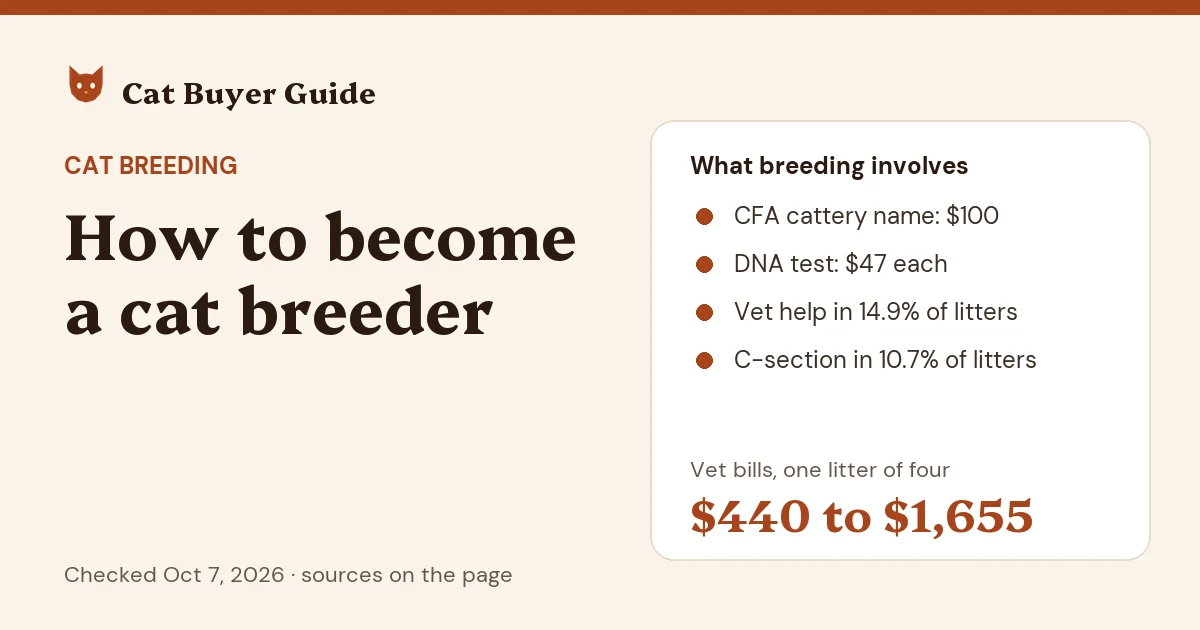
To become a cat breeder, you learn one breed in depth, buy healthy cats sold with breeding rights, register a cattery name with a registry such as CFA ($100 for five years) or TICA ($75 one time for members), health-test every cat you plan to breed, and check whether your state wants a license. Registration is paperwork, not a seal of approval: both registries say they don’t vouch for the breeders they list. Done well, breeding is slow and costly, and even CFA says careful breeding doesn’t pay.
We don’t breed cats. On Oct 7, 2026, we read the registries’ rules and price lists, veterinary guidelines, lab prices and five states’ laws, and added our own vet-fee data. Here’s what it takes, and why many people decide not to.
How to become a cat breeder: the steps
- Learn one breed in depth. CFA suggests showing a spayed or neutered cat of the breed for a season or two first (CFA).
- Find a mentor. CFA’s code of ethics asks breeders to mentor newcomers, and CFA suggests asking your female’s breeder to help you find a stud.
- Buy cats sold with breeding rights. Breeders often hold back a pet kitten’s papers until it’s spayed or neutered (CFA).
- Register a cattery name, then your cats and each litter.
- Health-test every cat before you pair it, with your vet.
- Set up space and a vet plan, including nighttime birth emergencies.
- Check the law in your state and city.
- Plan for every kitten: vaccines, a written contract and a home at 12 to 16 weeks.
How to become a registered cat breeder
To become a registered cat breeder, you register a cattery name, the prefix every kitten you breed will carry, and then register your cats and litters. The two big US registries are the Cat Fanciers’ Association (CFA) and The International Cat Association (TICA). Their published fees on Oct 7, 2026:
| Item | CFA | TICA |
|---|---|---|
| Cattery name | $100 for 5 years; $60 per renewal | $75 for members, $80 for others; one time |
| Name rules | Up to 12 characters | One word, up to 15 letters |
| Litter | $20 within 4 months of birth, then $25 | Not on its public pages |
| Each kitten | $20 on the litter application | Not on its public pages |
| Breeder listing | Optional, $50 a year | Optional, $80 a year; members with the signed code |
| Ethics code | Breeder Code of Ethics | Voluntary code, $10, yearly vet inspection |
CFA’s fees come from its price list, effective May 1, 2026. TICA’s cattery fee is from its registration form, revised in August 2021 and still linked in August 2026; we couldn’t find its litter fees on its public pages. To register a litter with CFA, both parents must be registered or recorded with CFA, and the female’s owner applies as the breeder (CFA rules).
What registration doesn’t mean
CFA’s application asks for name choices, an address, a signature and the fee. Nothing on it asks you to own a cat, pass an inspection or show a health test. CFA makes no representations about the breeding or business practices of the breeders it lists (CFA). TICA says it doesn’t endorse listed breeders unless noted, and won’t settle disputes between buyers and sellers (TICA).
The higher bar is voluntary. CFA’s code asks breeders to house cats better than its minimum cattery standard. TICA’s Outstanding Cattery program asks breeders to sign a code of ethics every year and have a licensed vet inspect the cattery, scoring at least 75 of 88 points (TICA).
How to check if a cat breeder is registered
- CFA: search the Cattery Name Index, which lists every current registered cattery name. CFA’s Find a Breeder pages show only breeders who pay to be listed.
- TICA: its breeder pages list only members who pay for a listing, and we found no public cattery index, so ask TICA directly.
- Either way, contact the cattery through the registry’s details, not an ad’s. Scammers borrow real cattery names; see how to spot a kitten scam.
Health testing before you breed
Vets expect it. The Feline Veterinary Medical Association (formerly the AAFP) says vets should use preventive genetic and health testing, such as heart scans (echocardiograms) for hypertrophic cardiomyopathy (HCM). It doesn’t condone breeding cats with inherent malformations, such as Scottish Folds and Manx, or breeds with severely flattened faces (FelineVMA, 2024). CFA has barred folded-ear to folded-ear matings since May 2022 (CFA rules).
DNA tests use a cheek swab. UC Davis’s Veterinary Genetics Laboratory charges $47 per test per cat, with results in at least 15 business days (UC Davis VGL). Common tests by breed:
| Breed | Tests to discuss with your vet |
|---|---|
| Maine Coon | HCM DNA test, heart scan, PK deficiency, SMA |
| Ragdoll | HCM DNA test, heart scan |
| Persian, Exotic | PKD1 (kidney cysts), Persian PRA (eyes) |
| Bengal | PK deficiency, Bengal PRA, heart scan |
| Abyssinian, Somali | PK deficiency, PRA eye tests |
| Burmese | Head defect, hypokalemia, GM2 |
| British Shorthair | Blood type both parents, heart scan |
Sources: UC Davis VGL (HCM, PKD1, PK), CFA’s magazine and Cornell.
A DNA test finds only the mutation it looks for. Cornell calls the echocardiogram the gold standard for diagnosing HCM and says genetic results need a vet’s interpretation. One HCM screening clinic, at an American Cat Fanciers Association show in August 2026, listed $120 per cat (ACFA).
For every cat you plan to breed, ask your vet about testing for feline leukemia virus (FeLV) and FIV before mating. In breeds with many type B cats, such as British Shorthairs, Devon Rex and Birmans, blood-type both parents: kittens of a type B queen and a type A tom can die of neonatal isoerythrolysis (Holst, 2022). And go easy on close relatives: CFA warns that inbreeding can bring smaller litters, immune problems and more birth defects.
Vet care for the queen and kittens
Before breeding, the queen needs a checkup, her tests and up-to-date vaccines. The 2020 AAHA/AAFP vaccination guidelines advise against giving pregnant queens a modified-live panleukopenia vaccine, so plan the timing with your vet.
Pregnancy lasts about 63 to 65 days (International Cat Care). Holst’s review advises keeping the pregnant queen away from other cats for at least the last 2 to 3 weeks, and quarantining any new cat, or one back from a show or a mating, for 2 to 3 weeks.
Births don’t always go well. In a 2024 survey of breeders in 29 countries covering 853 litters born in 2019, 14.9% of litters needed a vet’s help and 10.7% a C-section. Counting stillbirths, kitten deaths up to 12 weeks ranged from 7.1% in Cornish Rex to 23.4% in Bengals. Drugs for a stalled labor work in only about 30% of cases, according to Holst. International Cat Care says to call the vet if a queen strains for 20 to 30 minutes without producing a kitten, or if labor hasn’t started after her due date.
Kittens start core vaccines no earlier than 6 weeks, repeated every 3 to 4 weeks until 16 to 20 weeks (AAHA/AAFP). TICA’s voluntary code says no kitten leaves before two vaccinations; CFA’s code says not before it has proper immunity. Kittens also need handling: ideally 30 to 60 minutes a day of pleasant contact with people, says the 2021 AAHA/AAFP Life Stage Guidelines. Pedigree kittens usually go home at 12 to 16 weeks: CFA’s magazine says 16, or at least 12, and TICA’s leaflet 14 or older. See what age to adopt a kitten.
Talk to your vet before the first pairing
Book a pre-breeding visit. Ask which tests your breed needs, when to vaccinate, how to confirm a pregnancy, and which emergency clinic to use for a birth at night or on a weekend. Ask for a C-section estimate in advance. Don’t give a pregnant or nursing queen any medicine, flea product or supplement unless your vet says so.
Do you need a license to breed cats?
It depends on your state, your city and your numbers. Laws vary and change, so check with your state’s agriculture department and your city or county before the first litter.
Federal rule. A USDA Animal Welfare Act license ($120, valid three years) is for dealers. You’re exempt if every buyer sees the kitten in person before buying it, or if your household keeps four or fewer breeding female pets (dogs and cats count together) and sells only their offspring, born and raised there (9 CFR 2.1; 1.1; 2.5). Ship kittens sight unseen with more than four breeding females, and you generally need one.
Five state examples:
| State | You need a license if you | Fee |
|---|---|---|
| Colorado | Breed more than 3 litters, or transfer more than 24 cats, in 12 months | $400 |
| Illinois | Sell or rehome cats you bred and keep more than 5 females able to breed | $350 application fee |
| Minnesota | Keep 10 or more adult intact dogs or cats and have more than 5 litters a year | $10 per intact adult, up to $250; the same again for the first inspection |
| Missouri | Keep more than 3 intact females mainly to breed for sale | $100 plus a per-animal fee, up to $2,500, plus $25 |
| New Hampshire | Transfer 30 or more cats a year | $200 a year |
Licensed breeders can owe buyers paperwork: Illinois cat breeders covered by the law must give buyers vaccination records and proof of a registered microchip (225 ILCS 605). Some rules reach smaller breeders too. Missouri’s hobby or show breeders, with up to 10 intact females, skip the license but must register each year, free. And cities add their own: Los Angeles requires a yearly breeding permit for each dog or cat allowed to breed (LAMC 53.15.2).
Time, space and money
Time. From mating to the last kitten leaving takes about five to six months: roughly nine weeks of pregnancy, then 12 to 16 weeks of kittens. A female who isn’t bred keeps coming back into season, calling about every three weeks in the breeding season (International Cat Care).
Space. Intact males mark territory with strong-smelling urine, sometimes indoors, says International Cat Care. TICA’s inspection form expects breeding males and females to be securely separated, an isolation area for new, show or sick cats, a quiet birthing area, and young kittens kept apart from the other cats for their first six weeks. Cornell notes that FIP seems more common in crowded catteries and recommends no more than three cats per room. CFA’s minimum standard sets 30 cubic feet for one cat’s enclosure, plus daily exercise if the cat can’t move freely in it.
Money. The costs we found, checked Oct 7, 2026:
| Cost | Price |
|---|---|
| Cattery name | CFA $100 for 5 years; TICA $75 to $80 once |
| CFA litter registration | $20 to $25, plus $20 a kitten |
| DNA test (UC Davis) | $47 per test, per cat |
| HCM heart scan | $120 per cat at a 2026 show clinic |
| Vet exam | $20 to $95.95 a visit |
| FVRCP vaccine | $15 to $46 a shot |
| FeLV/FIV test | $20 to $55 |
| Spay or neuter | $89 to $368.95 |
| State license, if needed | $200 (N.H.) to $400 (Colo.); Missouri up to $2,500 |
Example: vet bills for one litter of four. We took the lowest and highest published prices in our vet-fee data. A pre-breeding exam and FeLV/FIV test for the queen, plus two exams, two FVRCP shots, a deworming and a microchip for each kitten, came to $440 to $1,655. Spaying or neutering all four before they leave, as TICA’s code asks breeders to try, brings it to $796 to $3,130. That’s before food, litter, tests, registration or any emergency. No single clinic charged every high price, and some charge less for extra pets seen at the same visit. Our new kitten checklist names the clinics behind each price.
CFA’s legislative group puts it bluntly: “Conscientious breeding of cats is not profitable” (CFA).
The ethics, and why many people don’t breed
CFA’s Breeder Code of Ethics asks breeders to aim for healthy kittens that improve the breed, disclose illness, place kittens only once they’re properly immunized, sell so they can keep advising owners, and mentor newcomers. TICA’s voluntary code adds: breed only if you can find suitable homes, guarantee health at sale with a written agreement, try to spay or neuter kittens before they leave, and answer buyers’ questions promptly. International Cat Care says a bred cat must be no less healthy than an ordinary one.
The honest reasons many people stop at owning cats:
- Shelters are full. About 3 million cats entered US shelters and rescues in 2025; about 2.2 million were adopted and 277,000 euthanized (ASPCA, from Shelter Animals Count data). CFA argues that fewer than 1% of cats handled by US animal agencies are identified as pedigreed, but every kitten you breed still needs a home.
- Your cat carries the risk: difficult births, C-sections and lost kittens, as the survey above shows.
- Careful breeding doesn’t pay, by CFA’s own account.
- It doesn’t end at the sale. Both codes expect you to keep advising buyers afterward.
- Your home changes: separate rooms, spraying males and calling females.
If you still want to: a checklist
- Show a spayed or neutered cat of your breed for a season or two, and find a mentor.
- Buy foundation cats with breeding rights, tested parents and a written contract.
- Register a cattery name, and consider TICA’s vet-inspected Outstanding Cattery program.
- Test every breeding cat for its breed’s risks, FeLV and FIV, and blood type where it matters. Ask your vet which results rule a cat out.
- Set up separate spaces: for an intact male, quarantine, birth and kittens.
- Line up your vet and a 24-hour emergency clinic, get a C-section estimate, and budget for it.
- Check your state, county and city rules, and the USDA rule if you’ll ship kittens.
- Write a contract covering vaccines, spay or neuter, a health guarantee, and whether you’ll take the cat back.
- Keep every kitten until 12 to 16 weeks, with at least two vaccinations and its vet records.
FAQ
Does a registered cat breeder mean a good breeder?
No. It means the cattery name is on a registry’s books. CFA and TICA both say they don’t vouch for the breeders they list. Ask for health tests, vet records and a written contract.
Do I need a license to breed cats at home?
It depends on your state, your city and your numbers. Colorado’s license starts above three litters a year, Missouri’s above three intact females kept to breed for sale, and Los Angeles requires a permit for any breeding.
Is breeding cats profitable?
Not when it’s done carefully, says CFA’s legislative group. In our example, vet bills alone for one litter of four came to $440 to $1,655.
Should I let my cat have one litter before she’s spayed?
No. International Cat Care says it’s unnecessary and of no benefit to her. Cats can get pregnant from about 4 months old, so ask your vet when to spay.
How long is a cat pregnant?
About 63 to 65 days, or nine weeks, says International Cat Care. Holst’s review puts the average at about 65 days, within a range of 57 to 72. Your vet can confirm it.
Sources
- Our fee data: registry, lab and license fees (28 items, checked Oct 7, 2026), checked Oct 7, 2026
- Our vet-fee data: published price lists of five clinic groups plus ASPCA estimates (collected Oct 7, 2026), checked Oct 7, 2026
- CFA: Register a Cattery Name and Cattery Name Index, checked Oct 7, 2026
- CFA: Price List, effective May 1, 2026, checked Oct 7, 2026
- CFA: Cattery Name Registration Application, checked Oct 7, 2026
- CFA: Registration Overview (litters, individual cats, leases), checked Oct 7, 2026
- CFA: Rules for Registration (effective February 2026), checked Oct 7, 2026
- CFA: Become a Breeder (breeding FAQs), checked Oct 7, 2026
- CFA: Breeder Code of Ethics, checked Oct 7, 2026
- CFA: Cattery Standard Minimum Requirements, checked Oct 7, 2026
- CFA: Find a Breeder (listing service and disclaimer), checked Oct 7, 2026
- CFA Legislative Group: Opposition to Breeder/Cattery Licensing (guidance), checked Oct 7, 2026
- CFA Cat Talk: Genetic Testing for Pedigreed Cats (Bennett, 2026), checked Oct 7, 2026
- CFA Cat Talk: Good Things Come To Those Who Wait (Preston and Giddings, 2024), checked Oct 7, 2026
- TICA: Register a Cattery (Cattery Registration form, revised Aug. 25, 2021), checked Oct 7, 2026
- TICA: Outstanding Cattery Code of Ethics (voluntary, revised Aug. 26, 2021), checked Oct 7, 2026
- TICA: Cattery Evaluation Form (revised Aug. 25, 2021), checked Oct 7, 2026
- TICA: Breeder Advertising, checked Oct 7, 2026
- TICA: Disclaimers, checked Oct 7, 2026
- TICA: Finding the Purrfect Pedigreed Kitten (buyer leaflet), checked Oct 7, 2026
- Feline Veterinary Medical Association (formerly AAFP): 2024 Responsible Breeding in Feline Medicine, checked Oct 7, 2026
- UC Davis Veterinary Genetics Laboratory: Hypertrophic Cardiomyopathy (HCM) in Ragdolls, checked Oct 7, 2026
- UC Davis Veterinary Genetics Laboratory: Hypertrophic Cardiomyopathy (HCM) in Maine Coons, checked Oct 7, 2026
- UC Davis Veterinary Genetics Laboratory: Polycystic Kidney Disease (PKD1), checked Oct 7, 2026
- UC Davis Veterinary Genetics Laboratory: Erythrocyte Pyruvate Kinase Deficiency (PK Deficiency), checked Oct 7, 2026
- ACFA Annual Convention show, Fargo, N.D.: HCM clinic flyer (August 2026), checked Oct 7, 2026
- Cornell Feline Health Center: Hypertrophic Cardiomyopathy, checked Oct 7, 2026
- Cornell Feline Health Center: Feline Infectious Peritonitis, checked Oct 7, 2026
- AAHA and AAFP: 2020 Feline Vaccination Guidelines (Stone et al., JFMS), checked Oct 7, 2026
- AAHA and AAFP: 2021 Feline Life Stage Guidelines (Quimby et al., JFMS and JAAHA), checked Oct 7, 2026
- Holst: Feline breeding and pregnancy management: What is normal and when to intervene (JFMS, 2022), checked Oct 7, 2026
- Černá, Pugalendhi, Shaw et al.: Feline dystocia and kitten mortality up to 12 weeks in pedigree cats (JFMS, 2024), checked Oct 7, 2026
- International Cat Care: Cat pregnancy, checked Oct 7, 2026
- International Cat Care: Cat birth, checked Oct 7, 2026
- International Cat Care: Why do I need to neuter my cat?, checked Oct 7, 2026
- International Cat Care: Position Statement on the Breeding of Pedigree Cats, checked Oct 7, 2026
- ASPCA: U.S. Animal Shelter Statistics (2025 data from Shelter Animals Count), checked Oct 7, 2026
- 9 CFR 2.1, Requirements and application (USDA Animal Welfare Act licensing), via Cornell LII, checked Oct 7, 2026
- 9 CFR 1.1, Definitions (retail pet store), via Cornell LII, checked Oct 7, 2026
- 9 CFR 2.5, Duration of license, via Cornell LII, checked Oct 7, 2026
- Colorado Department of Agriculture: PACFA Licensing, checked Oct 7, 2026
- Illinois Department of Agriculture: Animal Welfare Act License Application and Renewal, checked Oct 7, 2026
- Illinois Animal Welfare Act, 225 ILCS 605 (Animal Legal & Historical Center copy), checked Oct 7, 2026
- Minnesota Statutes 347.57, Definitions (commercial dog and cat breeders), checked Oct 7, 2026
- Minnesota Statutes 347.58, Licensing and inspections, checked Oct 7, 2026
- Missouri Animal Care Facilities Act, RSMo 273.325-273.357 (Animal Legal & Historical Center copy), checked Oct 7, 2026
- Missouri rule 2 CSR 30-9.020 (license fees), via Cornell LII, checked Oct 7, 2026
- New Hampshire RSA 437 (Animal Legal & Historical Center copy), checked Oct 7, 2026
- Los Angeles Municipal Code 53.15.2, breeding permits (CFA Legislative Group compilation, May 2024), checked Oct 7, 2026
- Emancipet: Healthy Pet Services prices, checked Oct 7, 2026
- Emancipet: Spay & Neuter prices, checked Oct 7, 2026
- Humane Society of Sonoma County: Spay/Neuter Clinic pricing (effective July 1, 2026), checked Oct 7, 2026
- Animal Welfare Society (Maine): Wellness & Preventative Care prices, checked Oct 7, 2026
- Animal Welfare Society (Maine): Spay/Neuter Services prices, checked Oct 7, 2026
- Skaer Veterinary Clinic (Wichita, Kan.): Our Fees, checked Oct 7, 2026
- Banfield Pet Hospital, San Diego: estimate prices (page updated May 14, 2025), checked Oct 7, 2026