How to Spot a Kitten Scam Before You Pay

Built from dated data and expert sources, not hands-on pet testing. Facts and prices checked October 7, 2026. No affiliate links on this page. How we research
A kitten scam is an ad for a kitten that doesn’t exist, or isn’t the seller’s to sell. You pay a deposit, then a string of “shipping” fees, and no kitten arrives. The script rarely changes, and a few checks before you pay will expose it.
The short answer
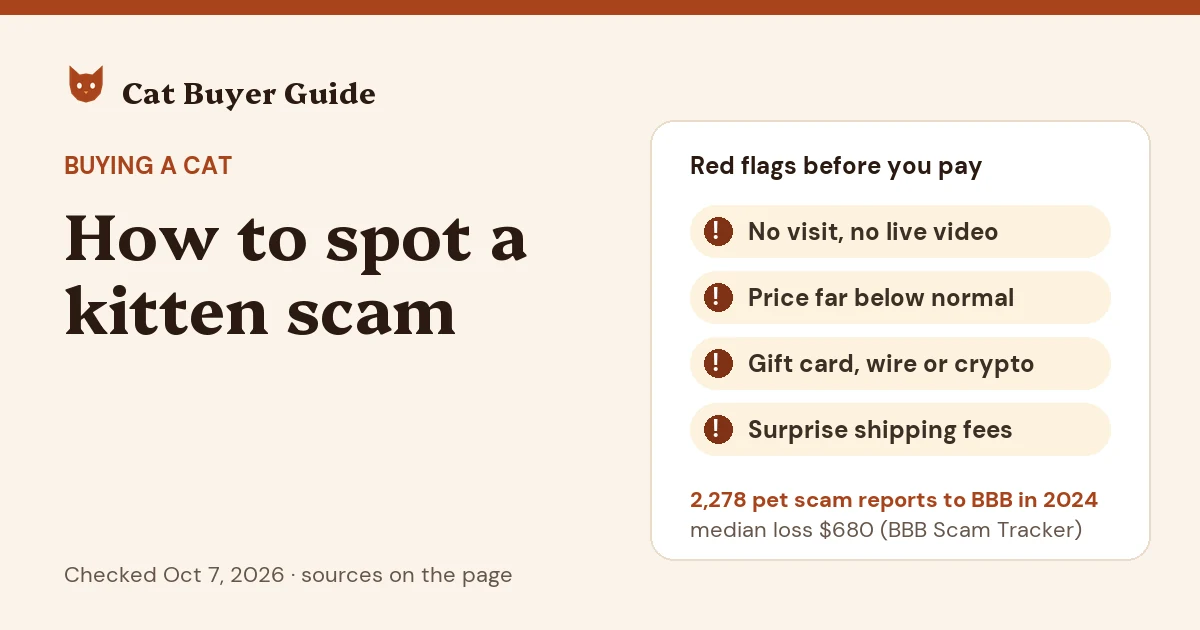
The strongest warning signs of a kitten scam:
- You can’t see the kitten. The seller won’t let you visit and won’t do a live video call.
- The price is too good. A popular breed far below the usual price, or a “free” kitten that only needs shipping paid.
- They want payment you can’t reverse. Gift cards, wire transfers, crypto, or a payment app like Zelle or Venmo.
- The fees keep coming. After you pay, new charges appear for a crate, insurance, vaccines or a “permit.”
The key number: BBB Scam Tracker logged 2,278 reports of online pet scams in 2024, with a median loss of $680 (BBB). In BBB’s 2025 data, pets were the second most-mentioned product in online purchase scam reports, behind apparel (BBB Scam Tracker Risk Report).
How common are kitten scams?
Puppies are the most common bait, but the same scheme sells kittens. In BBB’s 2020 study update, 12% of pet scam complaints were about kittens or cats, and BBB said FTC data showed kitten scams had more than doubled since 2017 (BBB, 2020). BBB’s 2025 update still calls cats a popular lure.
| Year | Pet scam reports to BBB | Median loss |
|---|---|---|
| 2023 | 2,899 | $700 |
| 2024 | 2,278 | $680 |
| 2025 (Jan–Sep) | 1,632 | $600 |
Source: BBB Scam Tracker figures in BBB’s 2025 study update. BBB adds that more than half of pet scams start on a website found through a search engine or social media.
About these numbers
Scam Tracker counts come from people who choose to report, so they show trends, not totals. BBB says the real number of pet scams is likely far higher. A median loss means half the reports lost more and half lost less.
How a kitten scam works
BBB has documented the same script since its first pet scam study in 2017 (BBB, 2017; BBB, 2025):
- The ad. A polished website, social media post or marketplace listing shows kittens, often a sought-after breed at a low price. Or an “owner” offers a cat free to anyone who covers shipping (AARP). The photos are usually stolen, and some sites copy a real breeder’s name and pages.
- The screening. The seller seems careful, sometimes with a fake application or screening. But a visit or video call is never possible, because the kitten “will be shipped.”
- The payment. They want a deposit or the full price up front. BBB found payment apps like Zelle and Cash App had largely replaced wire transfers by 2020 (BBB, 2020), and the FTC also warns about gift cards and crypto (FTC).
- The fees. New costs appear: shipping, a “temperature-controlled crate,” insurance, vaccines, paperwork or customs, sometimes in emails from a fake shipper or airline (IPATA).
- The pressure. If you hesitate, the kitten is suddenly stuck at the airport, sick, or about to die. Some threaten to report you for animal abandonment, which AARP notes doesn’t apply here (AARP).
- The disappearance. When you stop paying, the seller goes quiet, and the website may return under a new name.
In one case in BBB’s 2025 update, a buyer ordered a $700 Siamese kitten. A $250 shipping charge followed, then more demands totaling $4,500. She had lost $1,900 by the time she stopped.
Most of these operations run from overseas, so little money is ever recovered. A PetScams.com review of about 3,500 scam sites, reported by BBB, placed 31% in Cameroon and 30% in South Africa.
Red flags to watch for
| Red flag | Why it matters |
|---|---|
| No visit, no live video | Real breeders, shelters and rescues welcome an in-person or video visit (FTC; BBB). A scammer can’t show a kitten that doesn’t exist. |
| Price far below normal | Know the breed’s usual price range. A much lower price is the classic lure (TICA). |
| Free kitten plus fees | A “free” kitten that needs shipping or other fees paid first is a common setup (TICA). |
| Many kittens ready now | Good breeders have few kittens at a time, and you often wait. A site full of available kittens of a rare breed is suspect (CFA). |
| Kittens sold at 6–8 weeks | Most breeders let kittens go at 12 to 16 weeks. CFA warns: “In scam situations kittens are often sold at 6 to 8 weeks of age.” |
| Gift card, wire or crypto | The FTC says no legitimate seller will require these, and never to pay anyone who insists on them (FTC; FTC). |
| Payment app to a stranger | Apps like Venmo make it hard to get your money back, the FTC warns (FTC). |
| Big deposit or full price | A small deposit with clear refund terms is normal. A large nonrefundable deposit, or full payment before you choose a kitten, is a warning sign (CFA; TICA). |
| Email or text only | No phone calls, no address, no real contact details (TICA; NC Attorney General). |
| Asks to switch apps | In BBB’s 2025 survey of people who reported scams (all types), 16.4% said the scammer asked them to switch channels, often away from platforms that might flag the scam (BBB). |
| Fees after you pay | Surprise charges for crates, insurance, vaccines or customs are the heart of the scam (IPATA). |
How to check a seller before you pay
A real breeder or rescue will pass these checks without fuss. If a seller fails one, stop there.
- Reverse image search the photos. Put the kitten photos into Google Lens or TinEye. If they appear on other sites or under other names, walk away. Search a sentence of the ad’s text too, since scammers reuse wording (FTC; BBB, 2017).
- Search the seller. Search the cattery name, phone number and email with “scam” or “complaint” (FTC). Check them on BBB Scam Tracker and PetScams.com, which list reported scams. ICANN Lookup shows when a site’s domain was registered; a weeks-old site doesn’t fit a breeder claiming years of experience.
- Ask for a live video call. Ask to see the kitten with its mother, next to a sheet of paper with your name and today’s date. A few scammers now use AI-generated video, even on live calls. In one case BBB describes, asking the “seller” to wave exposed the fake: the hand had too many fingers. So ask for something unscripted on camera (BBB, 2025).
- Visit, and pick the kitten up yourself. See the kitten, its mother and where the kittens are raised. CFA advises collecting in person when you can and leaving shipping for repeat purchases from a breeder you already trust (CFA).
- Check the registration yourself. Look the cattery up in CFA’s Find a Breeder and Cattery Name Index or TICA’s breeder listings, and ask the registry if you can’t find it. Then contact the cattery using details from the registry, not the ad, because scammers borrow real breeders’ names and copy their sites (Indiana BOAH; BBB, 2025). Ask for the kitten’s registration papers and the parents’ records.
- Get a written contract. It should cover the price, the deposit and when it’s refunded, the health guarantee and the return policy. Expect vaccination and vet records, registration paperwork and any microchip registration (TICA; CFA).
- Pay by credit card, and keep any deposit small. A credit card gives you the most protection (FTC). Under the Fair Credit Billing Act, you can dispute a charge for goods that weren’t delivered (FTC).
- Never pay a stranger by gift card, wire, crypto or payment app. “Nobody legit will ever require you to pay by gift card,” the FTC says, and the same goes for wires and crypto. Payment apps make your money hard to recover (FTC).
- Don’t let anyone rush you. Pressure to pay now because another buyer is waiting is a reason to slow down (TICA).
Shipping and “pet transport” scams
Many kitten scams end with a fake delivery company. IPATA, the trade group for pet shippers, says scammers use real shippers’ names, copy their websites and logos, and set up fake airline websites and email accounts (IPATA). IPATA doesn’t ship animals itself.
- The airline “requires” something. A temperature-controlled crate, shipping insurance, more paperwork or shots: IPATA describes these exact demands as the typical scam (IPATA).
- The kitten is “held” in another state. Government agencies don’t charge fees to move pets within the US, says Indiana’s State Board of Animal Health, so a “permit fee” to release a kitten is a scam (Indiana BOAH).
- Check the shipper yourself. Find it in IPATA’s Find a Pet Shipper directory, call it using the details listed there, and ask whether it knows the breeder (IPATA).
- Watch the phone numbers. IPATA flags numbers starting with +237 (Cameroon) or +234 (Nigeria).
Some legitimate breeders do ship kittens. For a first kitten, though, CFA’s advice is to pick it up in person.
If you’ve already paid
Stop sending money, whatever the next fee is for. Then contact whoever handled the payment right away and ask for your money back. The FTC’s advice by payment type (FTC):
- Credit or debit card: contact the card issuer or bank and ask for a refund. For a credit card, also send a written dispute within 60 days after the first statement showing the charge (FTC).
- Zelle, Venmo, Cash App, PayPal or a bank transfer: report it to the bank or app and ask it to reverse the payment.
- Gift card: contact the card’s issuer, say it was used in a scam, and keep the card and receipt.
- Wire transfer: contact the wire company, such as Western Union or MoneyGram, and ask for a refund.
- Crypto: contact the exchange or crypto ATM operator. Crypto lacks the legal protections that cards have.
Save the ad, screenshots of the website, messages, receipts, phone numbers, email addresses and web addresses. Then report it:
- ReportFraud.ftc.gov, which the FTC uses to build cases and spot trends.
- BBB Scam Tracker, so the next buyer who searches that website or number is warned.
- IC3, the FBI’s Internet Crime Complaint Center, for scams that happened online.
- Your state attorney general’s consumer protection office (find yours).
- PetScams.com, and IPATA if a fake pet shipper was involved.
- In Canada, the Canadian Anti-Fraud Centre.
Watch out for: a second scam. People who have lost money may hear from “recovery” services that promise to get it back for an upfront fee. The FTC says never to pay upfront for that (FTC), and the IC3 says it never contacts victims directly to ask for money (IC3).
Safer ways to find a kitten
- Start with a shelter or rescue. The FTC suggests a local shelter or rescue first, where you can adopt for a small fee, and there are breed-specific rescues too (FTC). You meet the cat before you pay. Check a rescue the same way: search its name with “scam” or “complaint,” and expect to visit.
- For a pedigreed kitten, find the breeder through the registries or at a cat show (CFA). Expect to wait: good breeders rarely have many kittens ready at once.
- Know when a kitten should come home. CFA says most breeders let kittens leave at 12 to 16 weeks. See what age a kitten should be when you bring it home for why.
- Get ready before the kitten arrives. The new kitten checklist covers what to buy and what it costs.
Kitten scam FAQ
Is a “free” kitten online a scam?
Often, if it has to be shipped. TICA and Indiana’s State Board of Animal Health both warn that “free” pets needing a shipping or other fee first are a common setup. A genuine rehoming lets you meet the cat and collect it yourself.
Is it normal for a breeder to ask for a deposit?
Yes. A small deposit to hold a kitten is common, and CFA says most breeders refund it under some conditions, so ask what they are and get them in writing. A large nonrefundable deposit, or full payment before you choose, is a warning sign.
Can a kitten be shipped safely?
Some breeders do ship, but fake shipping is at the heart of many kitten scams. Pick up in person if you can, and if a kitten must travel, check the shipper in IPATA’s directory and call it yourself.
Does a CFA or TICA listing prove a breeder is honest?
No. It shows the cattery is on the registry’s records, and neither CFA nor TICA vouches for the breeding or business practices of those listed (CFA; TICA). Scammers also copy real cattery names, so contact the breeder through the registry, not the ad.
Can I get my money back after a kitten scam?
Sometimes, if you act fast. A credit card dispute gives you the best chance; gift cards, wires, crypto and payment apps are much harder to reverse. Contact the company you paid right away, then report the scam to the FTC and BBB.
When are kitten scams most common?
Since 2022, December and January have brought BBB the most pet scam reports (BBB, 2025). Take extra care when looking for a kitten around the holidays.
Sources
- BBB: Puppy Scams 2025 Study Update, checked Oct 7, 2026
- BBB Institute for Marketplace Trust: 2025 BBB Scam Tracker Risk Report (published 2026), checked Oct 7, 2026
- BBB: Puppy Scam Study Update (2020), checked Oct 7, 2026
- BBB: Puppy Scams, How Fake Online Pet Sellers Steal from Unsuspecting Pet Buyers (2017), checked Oct 7, 2026
- BBB: Pet scams resources, checked Oct 7, 2026
- BBB Scam Tracker, checked Oct 7, 2026
- FTC: Get the dog or cat instead of the scam (consumer alert, 2023), checked Oct 7, 2026
- FTC: What To Do if You Were Scammed (updated June 2026), checked Oct 7, 2026
- FTC: How To Avoid a Scam, checked Oct 7, 2026
- FTC: Using Credit Cards and Disputing Charges, checked Oct 7, 2026
- FTC: Refund and Recovery Scams, checked Oct 7, 2026
- FTC: ReportFraud.ftc.gov, checked Oct 7, 2026
- IPATA: Pet Scams, checked Oct 7, 2026
- IPATA: Current Pet Scams, checked Oct 7, 2026
- IPATA: Tips for Buyers, checked Oct 7, 2026
- IPATA: Find a Pet Shipper, checked Oct 7, 2026
- CFA: Could This Kitten Be A Scam? (Cat Talk, 2025), checked Oct 7, 2026
- CFA: Find a Breeder, checked Oct 7, 2026
- CFA: Register a Cattery Name and Cattery Name Index, checked Oct 7, 2026
- TICA: Pet Buyer’s Guide, checked Oct 7, 2026
- TICA: Find a Breeder, checked Oct 7, 2026
- TICA: Disclaimers, checked Oct 7, 2026
- Indiana State Board of Animal Health: consumer advisory on pet scams (November 2025), checked Oct 7, 2026
- North Carolina Department of Justice: Watch out for Scams When Buying Puppies and Kittens (2025), checked Oct 7, 2026
- AARP: Pet Scams, checked Oct 7, 2026
- FBI Internet Crime Complaint Center (IC3), checked Oct 7, 2026
- PetScams.com, checked Oct 7, 2026
- Google Search Help: Search with an image on Google, checked Oct 7, 2026
- TinEye reverse image search, checked Oct 7, 2026
- ICANN Lookup, checked Oct 7, 2026
- Canadian Anti-Fraud Centre: Report fraud, checked Oct 7, 2026
- NAAG: Find My AG, checked Oct 7, 2026