How to Litter Train a Kitten: A Step-by-Step Guide Based on Vet Advice

Built from dated data and expert sources, not hands-on pet testing. Facts and prices checked October 7, 2026. We may earn a commission if you buy through links on this page. It never changes what we recommend. As an Amazon Associate we earn from qualifying purchases. How we research
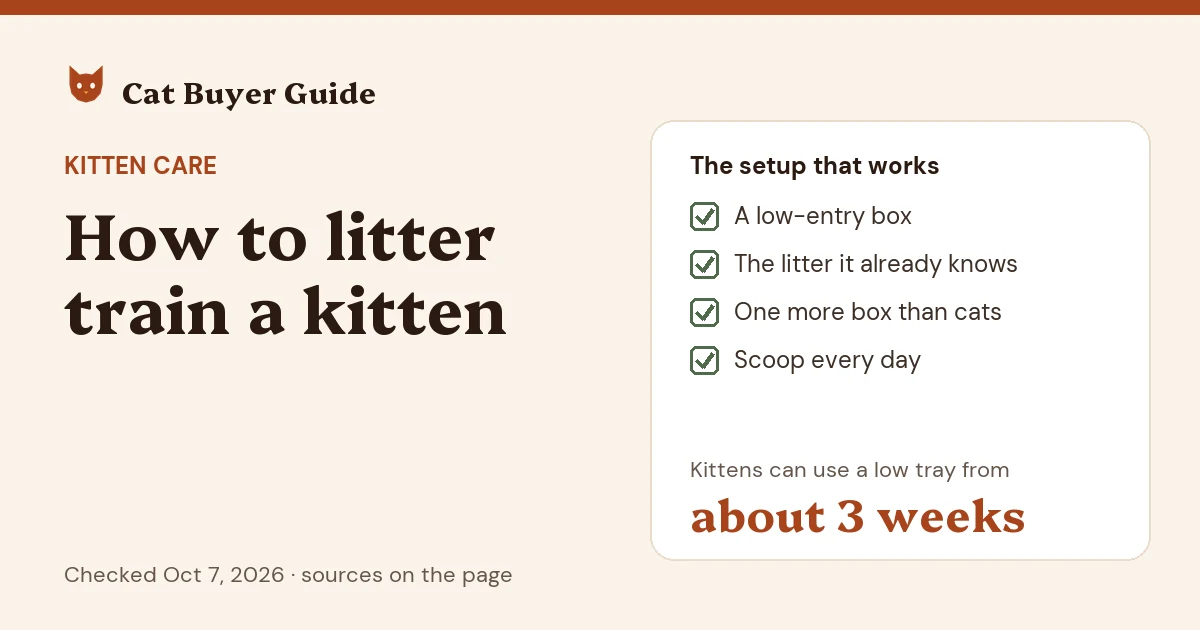
Most kittens need very little litter training. They start using a low-sided litter tray at about 3 to 4 weeks old, largely by copying their mother, so a kitten old enough to come home has often been using one for weeks. What it has to learn is where the box is in your house. Give it a box it can step into easily, with the litter it already knows, in a quiet corner of its room, and if it seems unsure, set it in the box after naps and meals.
We checked the advice of the Cornell Feline Health Center, the AAHA/AAFP Feline Life Stage Guidelines, International Cat Care, the ASPCA and the Feline Veterinary Medical Association on Oct 7, 2026. For boxes, see our guide to the best litter boxes for kittens; for everything else, the new kitten checklist.
On this page
- The setup at a glance
- Why litter box training is usually easy
- Set up the box before your kitten comes home
- How to litter train a kitten, step by step
- How long does it take to litter train a kitten?
- Kitten not using the litter box? Check these first
- How to clean up accidents
- When it’s a health problem
- FAQ
The setup at a glance
| Item | What to do | Source |
|---|---|---|
| Boxes | Two for one kitten: one per cat, plus one | Cornell, AAHA/AAFP |
| Sides | Low enough to step in and out easily | Cornell, AAHA/AAFP, iCatCare |
| Lid | None: most cats prefer an open box | Cornell |
| Litter | Unscented, and the kind your kitten knows | Cornell, iCatCare |
| Depth | 1 to 2 inches | Cornell, ASPCA |
| Place | Quiet, easy to reach, away from food | Cornell, iCatCare |
| Cleaning | Scoop at least once a day | Cornell, AAHA/AAFP, ASPCA |
Why litter box training is usually easy
For the first few weeks, a mother cat licks her kittens to make them pee and poop (Best Friends Animal Society). As weaning gets going, at around 3 to 4 weeks, kittens start to go on their own. International Cat Care advises a low-sided tray from about 3 weeks, and Best Friends says kittens start digging in loose material such as litter, and relieving themselves in it, at about 4 weeks.
Much of the rest comes from the mother. The 2021 AAHA/AAFP Feline Life Stage Guidelines, written by vets for the American Animal Hospital Association and the American Association of Feline Practitioners (now the Feline Veterinary Medical Association, or FelineVMA), list toileting habits among the things kittens learn from her, and International Cat Care says kittens usually learn to use a tray by copying her. Most cats will use a litter box by instinct, notes the Cornell Feline Health Center.
Kittens usually go home at 8 to 12 weeks, a little older from pedigree breeders (International Cat Care’s kitten booklet), and TICA’s buyer leaflet says a 14-week-old is weaned and litter trained. (For why the age matters, see what age to adopt a kitten.) So your job is mostly the setup: a box your kitten likes, in a place it can find.
Set up the box before your kitten comes home
Two boxes, in two spots
The rule from Cornell and the AAHA/AAFP guidelines is one box per cat, plus one, so a single kitten gets two. International Cat Care’s booklet suggests putting them in separate spots in the kitten’s room, since some cats like one tray to pee in and another to poop in. Don’t set them side by side: the FelineVMA says a cat treats boxes close together as one big box.
Low sides, no lid
Kittens need boxes with low sides, say Cornell and the AAHA/AAFP guidelines. Leave the lid off: most cats prefer an uncovered box that lets odors out and gives them a view all around (Cornell), and open boxes are easier for kittens in training to get in and out of (Best Friends). International Cat Care advises against liners and self-cleaning boxes, which may upset a kitten.
A small open pan does the job at first. One example is the Van Ness Small Cat Pan on Amazon, which the maker sells for kittens and small cats: 14.38 by 10.75 inches, with 4-inch sides. Your kitten will outgrow it: International Cat Care says to move up to a bigger tray as a kitten grows. The FelineVMA’s target is about 1.5 times the cat’s length, from nose to the base of the tail; many commercial boxes are smaller, and a large storage container is one way to get there.
Litter: familiar, unscented, 1 to 2 inches deep
Start with the litter your kitten already uses, so it recognizes what the box is for (International Cat Care); ask the shelter or breeder which one that is. Most cats prefer unscented, finer-textured litter about 1 to 2 inches deep, says Cornell, and the ASPCA gives the same depth. The FelineVMA adds that most cats prefer soft, unscented, clumping litter.
Very young kittens are the exception. Best Friends advises only non-clumping litter for kittens under 8 weeks, because they tend to taste and play in it, and International Cat Care suggests starting kittens on sand, wood or paper litter rather than clay, since some try to eat it, with no silica gel litter under 8 weeks. For a kitten 8 weeks or older that’s used to clumping litter, Dr. Elsey’s Ultra unscented clumping litter on Amazon fits the advice: the maker describes it as unscented, medium-grain clay that controls odor without perfumes or deodorants.
To switch litters later, do it gradually, mixing small amounts of the new one into the old (Cornell).
A quiet spot, away from food
Keep your kitten in one quiet room for the first week or two, with its boxes there; International Cat Care says this helps keep toileting in the tray. Put a box in a discreet corner, the food bowl on the opposite side and the water away from both. Cornell says most cats want a box that’s quiet, private, away from where they eat and easy to reach day and night.
Avoid spots next to a washer, dryer or furnace: Best Friends says a cat startled by a noisy appliance may refuse to use the box there. Skip closets and dead ends where a kitten could be cornered (FelineVMA, ASPCA). Once the box has a home, leave it there; the ASPCA’s cat care guide says to move a box only if you must, a few inches a day.
How to litter train a kitten, step by step
- Before pickup day, set up the kitten’s room with two low-sided boxes, filled 1 to 2 inches deep with the litter it already uses.
- Let your kitten find the box. Open the carrier in its room and let it come out in its own time. Kittens often learn where to toilet from their mother, says International Cat Care’s booklet, so you may only need to put the tray where it’s easy to reach.
- If it seems unsure, set it in the box when it wakes up, after meals, and when it sniffs around, scratches at the floor or starts to crouch (International Cat Care). A little soiled litter left in the tray can remind a young kitten what the tray is for, International Cat Care adds.
- Let it dig, then leave it be. Don’t move its paws in the litter; Best Friends says that isn’t necessary and can put a kitten off. Skip treats, too: the ASPCA advises against treat-training a cat to use the box as you would a dog, because many cats don’t like attention while they’re going.
- Scoop at least once a day (Cornell, AAHA/AAFP, ASPCA). Wash the box every 1 to 4 weeks with hot water and a little mild, unscented soap or none (FelineVMA, ASPCA, AAHA/AAFP). Never use ammonia or scented cleaners on it, and avoid disinfectants that turn cloudy in water, which International Cat Care says are toxic to cats.
- Open up the house slowly. After the first week or two, give your kitten more rooms, gradually and under supervision (International Cat Care). Put a box on each floor: young kittens may not make it down a long flight of stairs in time, Best Friends notes.
- Never punish accidents. Don’t scold, rub its nose in the mess or carry it to the box as punishment (ASPCA, AAHA/AAFP). Cats can’t connect a punishment with the mess, Cornell explains, and the FelineVMA warns it can lead to soiling in less obvious places.
How long does it take to litter train a kitten?
Not long, as a rule, though no guidance we read gives a set number of days. A kitten that comes home at 8 weeks or older has often had weeks of practice; what it’s learning is where your box is. “Kittens learn where to toilet very quickly,” says International Cat Care’s booklet, which suggests keeping a new kitten in one room with its tray for the first week or two.
Expect a few accidents: Best Friends’ foster manual says they will happen while kittens learn, and that kittens with too much free space can forget where the box is. If so, give your kitten a smaller area again, with a box close by. If accidents continue once the box, litter and location are right, don’t wait it out. Cornell warns that the longer house soiling goes on, the more likely it is to become a habit, and the AAHA/AAFP guidelines say a kitten that soils the house should be checked by a vet.
Kitten not using the litter box? Check these first
- A dirty box. Cats are less likely to use a soiled tray (International Cat Care), and some refuse a box with any waste in it at all (Cornell).
- A box that’s hard to use: too far away, too high, too small, or with a hood or liner (ASPCA).
- The litter: a sudden change, a scent, or too much of it (Cornell, ASPCA).
- A bad experience there, such as being trapped in the box, given medicine there or startled by a loud appliance nearby (FelineVMA).
- A spot it prefers, such as a rug or a pile of laundry. Clean it well, then put a box there, or the food bowl or toys, since cats prefer not to go where they eat (FelineVMA, Cornell, ASPCA). Foil or double-sided tape also makes a spot less inviting (ASPCA).
- Illness, such as diarrhea (Best Friends). See the vet box below.
How to clean up accidents
Clean accidents soon, and remove the smell rather than cover it: cats go back to spots marked with their own scent, and Cornell says odors must be neutralized, not just deodorized, to get past a cat’s keen sense of smell. The ASPCA recommends an enzymatic cleaner designed to neutralize pet odors, and Best Friends also says to use one.
- Blot up as much as you can with an absorbent towel first.
- Test the cleaner on a hidden spot, then treat an area bigger than the stain: up to three times its size, says the FelineVMA.
- Never use an ammonia cleaner. Urine contains ammonia, so it can draw your kitten back to the same spot (ASPCA). Cornell rules out vinegar too.
Enzyme cleaners are sold for this job. One example is Rocco & Roxie Stain & Odor Eliminator on Amazon, which the maker describes as a bio-enzymatic formula for urine, poop and vomit; its directions say to test it on a hidden area first and leave it on for 30 to 60 minutes before blotting. We haven’t tested this or any product on this page. Each was picked because the maker’s own description matches the vet advice above.
When it’s a health problem
Talk to your vet
- A kitten that keeps soiling the house should be checked. The AAHA/AAFP guidelines say vets look for causes such as intestinal parasites, infections, or problems present from birth in the urinary or digestive tract.
- Call right away if your kitten strains in the box with little or nothing coming out, cries while going, or has blood in its urine. The ASPCA and the AAHA/AAFP guidelines warn that some urinary problems, such as a blockage, can be life-threatening.
- Diarrhea can make a kitten miss the box, and it can dehydrate a kitten, Best Friends warns. Call your vet about it.
- What to expect: a full exam and a urine test, says the FelineVMA, and sometimes a fecal test when the accidents are poop.
- Don’t give any medicine or supplement without your vet’s advice.
FAQ
When do kittens start using a litter box?
At about 3 to 4 weeks: International Cat Care advises a low-sided tray from about 3 weeks, and Best Friends says kittens can go on their own at about 4 weeks.
How long does it take to litter train a kitten?
Usually not long: kittens often come home already using a tray, though no guidance we read gives a set number of days. Call your vet if accidents keep happening.
Should I use clumping litter for a kitten?
Not before 8 weeks, says Best Friends, because younger kittens tend to taste their litter. After that, start with the litter your kitten knows; most cats prefer soft, unscented, clumping litter (FelineVMA).
Why does my kitten poop right next to the box?
Cornell lists going right next to the box among signs that a cat dislikes something about it. Check that the box is clean, the litter hasn’t suddenly changed and the sides are low enough. If it keeps happening, ask your vet.
Sources
- Cornell Feline Health Center: Feline Behavior Problems: House Soiling, checked Oct 7, 2026
- Cornell Feline Health Center: Choosing and Caring for Your New Cat, checked Oct 7, 2026
- AAHA and AAFP: 2021 Feline Life Stage Guidelines (Quimby et al., JFMS and JAAHA), checked Oct 7, 2026
- AAHA and AAFP: 2021 Feline Life Stage Guidelines: General Litter Box Considerations, checked Oct 17, 2026
- Feline Veterinary Medical Association: Feline House-soiling: Useful Information for Cat Caregivers (2026), checked Oct 17, 2026
- Feline Veterinary Medical Association: Introducing the FelineVMA (the AAFP’s new name, Sept. 2024), checked Oct 7, 2026
- International Cat Care: Life stage guide to caring for your new kitten (booklet), checked Oct 17, 2026
- International Cat Care: Helping your new cat or kitten settle in, checked Oct 7, 2026
- International Cat Care: Choosing a litter tray for your cat, checked Oct 7, 2026
- International Cat Care: Bringing up a litter of kittens: health considerations, checked Oct 7, 2026
- ASPCA: Litter Box Problems, checked Oct 17, 2026
- ASPCA: General Cat Care, checked Oct 7, 2026
- Best Friends Animal Society: Kitten Foster Manual, checked Oct 7, 2026
- TICA: Finding the Purrfect Pedigreed Kitten (buyer leaflet), checked Oct 7, 2026
- Van Ness Pets: Small Cat Pan For Cats, Kittens and Small Animals (maker’s specifications), checked Oct 7, 2026
- Dr. Elsey’s: Ultra cat litter (maker’s description), checked Oct 7, 2026
- Rocco & Roxie: Stain & Odor Eliminator (maker’s description and directions), checked Oct 7, 2026