How Much Is Cat Insurance? Published Prices from Insurers and the Industry (2026)

Built from dated data and expert sources, not hands-on pet testing. Facts and prices checked October 7, 2026. No affiliate links on this page. How we research
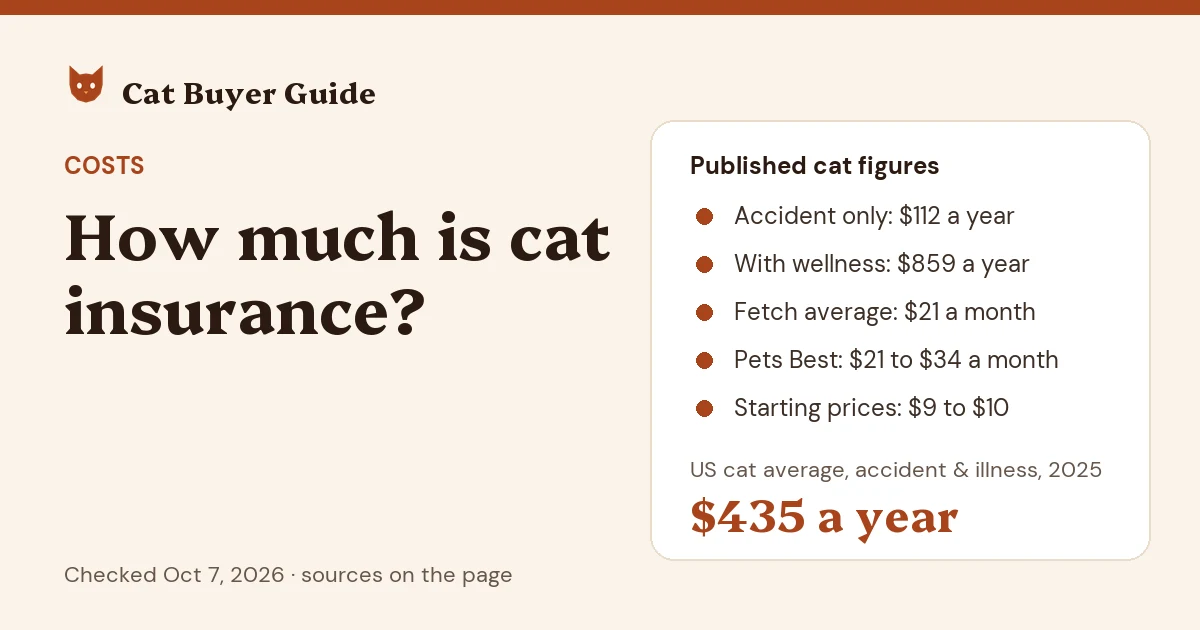
How much is cat insurance? In the US, the average accident-and-illness policy for a cat cost $435 a year in 2025, or about $36 a month, according to the North American Pet Health Insurance Association (NAPHIA). An accident-only policy averaged $112 a year, and a policy with wellness care built in averaged $859. Insurers’ own published cat figures are lower: Fetch says its cat policies average $21 a month, Lemonade about $27, and Pets Best $21 to $34 for its most comprehensive plans. Starting prices run from $9 to $10 a month.
These are published figures, checked on Oct 7, 2026, from NAPHIA’s industry report and the websites of six insurers. We didn’t fill in any quote forms, and your own quote will differ.
We’re not an insurance agent
Cat Buyer Guide isn’t a licensed insurance agent or broker, and we don’t sell insurance. This page gives information, not advice about which policy to buy. We don’t rank insurers: the figures below are each company’s own, measured in different ways, so they aren’t a like-for-like price comparison. We have no affiliate links on this page.
On this page
- Published cat insurance prices, by source
- Real quotes for six cats
- Why the industry average is higher than insurers’ “typical” prices
- What changes the price of a cat’s policy
- Policy terms that matter when you insure a kitten
- What cat insurance usually doesn’t cover
- What insured cats claim for
- How to compare quotes
- How we got these figures
- FAQ
Published cat insurance prices, by source
| Source | Published cat figure | What it’s based on |
|---|---|---|
| NAPHIA (industry) | $435 a year (about $36.25 a month) | Average accident-and-illness premium per insured US cat, 2025 |
| NAPHIA (industry) | $112 a year (about $9.33 a month) | Average accident-only premium, 2025 |
| NAPHIA (industry) | $859 a year (about $71.58 a month) | Average for insurance with wellness built in, 2025 |
| Fetch | $21 a month | Average, $10,000 limit, $300 deductible, 80% back; July 2024 to June 2025 |
| Lemonade | About $27 a month | Average across its cat policyholders’ ages, breeds and locations; no date given |
| Pets Best | $21 to $34 a month | Its most comprehensive accident-and-illness plans; 2024 new policyholders, pets up to age 10 |
| Embrace | $10 to $30 a month | What most of its cat policyholders pay, from 2025 policyholder data |
| Embrace | From $9.17 a month | 2026 quote: 6-month-old mixed-breed cat, Little Rock, Ark., $2,000 limit, $1,000 deductible |
| Spot | From $9 a month | 2-year-old mixed cat, Lakeland, Fla., $750 deductible, $2,500 limit, 80% back |
| Lemonade | From about $10 a month | Its base accident-and-illness policy, dogs or cats |
A monthly figure here is the yearly premium divided by 12. NAPHIA’s report is compiled by Willis Towers Watson and covers an estimated 99% of the pet insurance premium written in the US and Canada, NAPHIA says.
Real quotes for six cats
Embrace is the only insurer we checked that publishes sample quotes for specific cats. All six are 2026 quotes for a male cat, with 70% back and a $5,000 yearly limit. Embrace doesn’t say which deductible they use.
| Cat | Age | Where | Monthly premium |
|---|---|---|---|
| Russian Blue | 6 months | Springfield, Mo. | $13.95 |
| Bengal | 10 months | Sioux Falls, S.D. | $19.38 |
| Bombay | 1 year | Knoxville, Tenn. | $19.04 |
| Siamese | 2 years | Wichita, Kan. | $14.09 |
| American Shorthair | 4 years | Omaha, Neb. | $13.76 |
| Domestic Shorthair | 5 years | Des Moines, Iowa | $18.82 |
The six run from $13.76 to $19.38 a month, with a median of $16.46. All six fall inside Embrace’s $10-to-$30 typical range and well under NAPHIA’s average, with a modest $5,000 limit, in cities in the Midwest and South. Age alone doesn’t set the price: the 10-month-old Bengal had the highest quote and the 4-year-old American Shorthair the lowest.
Why the industry average is higher than insurers’ “typical” prices
NAPHIA’s $435 and the insurers’ $9 to $34 a month measure different things:
- Every insured cat versus new or sample policies. NAPHIA averages the premium of every cat insured at the end of 2025, seniors included. Starting prices are quotes for one young cat with a high deductible or a low limit.
- Premiums rise with age. Embrace’s terms say premiums are based on the pet’s current age and may go up at renewal. A policy bought for a kitten is likely to cost more each year.
- Prices are rising fast. NAPHIA’s average cat accident-and-illness premium was $370 in 2021 and $386 in 2024, then jumped 12.6% to $435 in 2025.
Watch out for: a starting price. Embrace’s $9.17 comes with a $1,000 deductible and a $2,000 yearly limit, and Spot’s $9 with a $750 deductible and a $2,500 limit. On those terms the cat’s first $750 to $1,000 of covered bills each year is all yours.
What changes the price of a cat’s policy
- The settings you pick. The yearly limit, the deductible and the share of the bill you get back. At Embrace, the limit runs from $2,000 to unlimited, the deductible from $200 to $1,000, and the reimbursement is 70%, 80% or 90%. Trupanion pays 90% with a deductible from $0 to $1,000 and no payout limit. A higher deductible lowers the premium, Embrace notes.
- Age, breed and location. Embrace’s terms say the first premium can depend on the breed and the premium can change with your home address. Lemonade’s guide notes that vet care costs more in some states, such as California, than in others, such as Tennessee.
- Wellness add-ons. Routine care, such as vaccines and spaying, usually isn’t in an accident-and-illness policy. Spot’s top wellness add-on costs $24.95 a month for up to $450 a year, including up to $150 toward a spay or neuter.
- Discounts. Embrace lists 10% off for more than one pet and 5% for active-duty military and veterans where available; Pumpkin lists a 10% multi-pet discount.
Cats cost less to insure than dogs. In NAPHIA’s 2025 figures, the average dog accident-and-illness policy was $836 a year, nearly twice the cat average.
Policy terms that matter when you insure a kitten
What each insurer’s cat page said on Oct 7, 2026. “Not stated” means the page we read didn’t say; check the sample policy before you buy.
| Insurer | Kittens from | Upper age limit | Money back | Yearly limit | Illness waiting period |
|---|---|---|---|---|---|
| Embrace | 6 weeks | None | 70%, 80% or 90% | $2,000 to unlimited | 14 days |
| Fetch | 6 weeks | None | Up to 90% | Not stated | Up to 15 days |
| Pets Best | 7 weeks | None | Up to 90% | Not stated | Not stated |
| Pumpkin | 8 weeks | None | Up to 90% | $5,000 to unlimited | 14 days or less |
| Trupanion | Not stated | Not stated | 90% | None | Not stated |
Pre-existing conditions are excluded by all five. Four say they may later cover a curable condition that has cleared up: Embrace after 12 months free of symptoms and treatment, Fetch after a year completely symptom-free, Pumpkin after 180 days (except knee and hind-leg ligament problems), and Pets Best once the condition has healed. Fetch has no waiting period for accidents. That’s one reason insurers urge enrolling young: a kitten has had less time to develop a condition that would be excluded later.
What cat insurance usually doesn’t cover
Embrace lists these exclusions for its cat policies:
- pre-existing conditions;
- routine wellness care, such as vaccines and checkups, unless you add a wellness plan;
- breeding, pregnancy and mating;
- cosmetic procedures, such as declawing, unless medically necessary;
- food and supplements for general health.
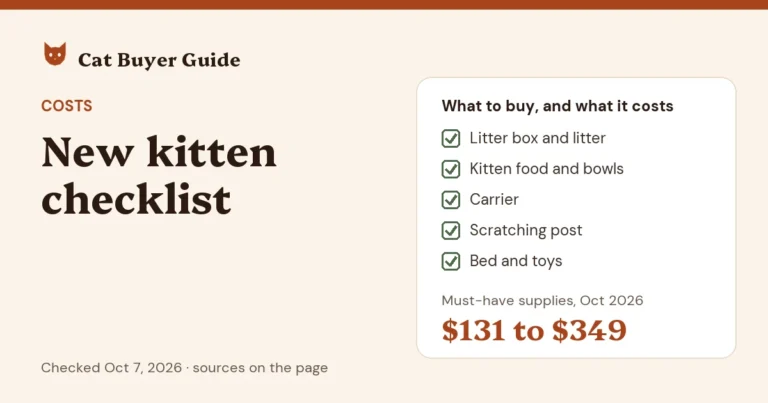
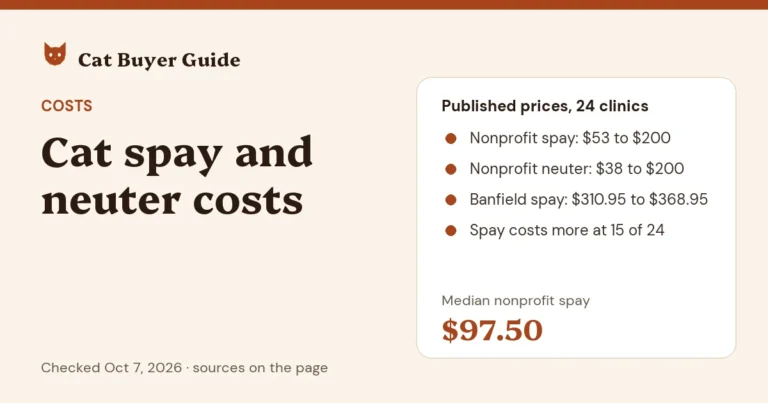
Pre-existing conditions are excluded at all five insurers in the table above, and Fetch says its accident-and-illness plan doesn’t include preventive care. Trupanion also leaves out vet exam fees and taxes. Fetch and Pumpkin say their plans cover sick-visit exam fees. For our own figures on what routine kitten care costs without insurance, see the new kitten checklist, what a spay or neuter costs and the kitten vaccination schedule.
What insured cats claim for
Few cats are insured. NAPHIA counted 1.75 million insured US cats at the end of 2025, about 2.29% of the country’s cats, against 5.99% of dogs. In its members’ 2025 data for North America, the most common conditions in cat claims were gastrointestinal problems, dental disease and urinary tract infections. The largest cat claim it lists was about $51,600, paid for cancer in a 4-year-old cat.
Whether a policy is worth it for your cat depends on your savings, your cat and the terms. We look at that question in is pet insurance worth it for a kitten.
Talk to your vet
- Ask what common problems cost to treat at your clinic, such as a urinary blockage, a dental extraction or an emergency visit. That’s the bill a policy would help with.
- Ask whether your cat’s breed has known health problems. A condition found before you enroll is usually excluded.
- Your vet, not the insurer, decides your cat’s treatment.
How to compare quotes
- Use the same settings. Ask each insurer for the same deductible, reimbursement and yearly limit, or the prices don’t compare.
- Read the sample policy. Look for the waiting periods, how pre-existing conditions are defined, and whether exam fees are covered.
- Ask how the premium changes with age. A low price for a kitten isn’t the price you’ll pay at 10.
- Count the add-ons. A wellness plan or extra cover adds to the monthly price.
- Check the deductible type. Embrace and Pets Best describe theirs as yearly: you pay it once each policy year.
How we got these figures
- On Oct 7, 2026 we read NAPHIA’s 2026 State of the Industry highlights (2025 data) and the cat insurance pages of Embrace, Fetch, Lemonade, Pets Best, Pumpkin, Spot and Trupanion. Every figure on this page is what the source itself published that day.
- We didn’t fill in quote forms or enter any details about a cat or an owner. That leaves out most insurers’ real prices, which you only see in a quote.
- We couldn’t read Healthy Paws’ or ASPCA Pet Health Insurance’s pages: both blocked automated access. They aren’t in the data.
- We left out one comparison: Lemonade’s own table of five insurers’ quotes for a 1-year-old cat. Its text says six insurers, the table lists five, and the stated average doesn’t match the five prices.
- The raw figures, with each source’s wording, are in our data file. Monthly figures for NAPHIA are its yearly averages divided by 12. The median of Embrace’s six quotes is computed from that file.
Limits of this data
- The insurers’ figures aren’t comparable with each other: some are averages, some are ranges, some are one sample quote, and each uses different settings and dates.
- NAPHIA’s averages cover all insured cats in force, of all ages and plan types, so they say little about a kitten’s first-year price.
- Only one insurer, Embrace, publishes quotes for specific cats, and all six of its examples are male cats in the Midwest and South.
- Prices change every year. We plan to re-check these figures about every 60 days.
FAQ
How much is cat insurance per month?
About $36 a month on average for an accident-and-illness policy in the US, from NAPHIA’s 2025 figure of $435 a year. Insurers publish lower typical figures: $21 a month at Fetch, about $27 at Lemonade, and $10 to $30 for most Embrace cat policyholders.
How much is pet insurance for a kitten?
Embrace’s published 2026 quotes for a 6-month-old Russian Blue and a 10-month-old Bengal were $13.95 and $19.38 a month, with 70% back and a $5,000 limit. Its starting price, $9.17, is for a 6-month-old mixed-breed cat with a $1,000 deductible.
Is cat insurance cheaper than dog insurance?
Yes. NAPHIA’s 2025 averages were $435 a year for a cat’s accident-and-illness policy and $836 for a dog’s.
Does cat insurance cover spaying or vaccines?
Not usually in a standard accident-and-illness policy: Embrace lists routine wellness care as excluded. Several insurers sell wellness add-ons that pay toward it. Spot’s costs $24.95 a month and pays up to $150 toward a spay or neuter.
Sources
- Our price data (published cat insurance figures from 6 insurers and NAPHIA, collected Oct 7, 2026)
- NAPHIA: 2026 State of the Industry Report Highlights (2025 data, June 2026, PDF), checked Oct 18, 2026
- Embrace Pet Insurance: Cat Insurance, checked Oct 18, 2026
- Fetch: Is Fetch Pet Insurance expensive? (FAQ), checked Oct 18, 2026
- Fetch: Cat insurance, checked Oct 7, 2026
- Lemonade: How Much Is Pet Insurance? (updated June 3, 2026), checked Oct 7, 2026
- Pets Best: Cat Insurance, checked Oct 18, 2026
- Spot Pet Insurance: Cat Insurance, checked Oct 7, 2026
- Pumpkin: Cat Insurance, checked Oct 7, 2026
- Trupanion: Cat Insurance, checked Oct 7, 2026
- Fetch: Pre-existing conditions, checked Oct 11, 2026
- Pets Best: Pre-existing coverage, checked Oct 11, 2026
- Embrace: Pet insurance waiting periods, checked Oct 11, 2026