How Many Litter Boxes per Cat? The Rule and What the Research Says

A buyer's guide built from specifications, warranties and return policies, not hands-on testing. Facts and prices checked October 30, 2026. We may earn a commission if you buy through links on this page. It never changes what we recommend. As an Amazon Associate we earn from qualifying purchases. How we research
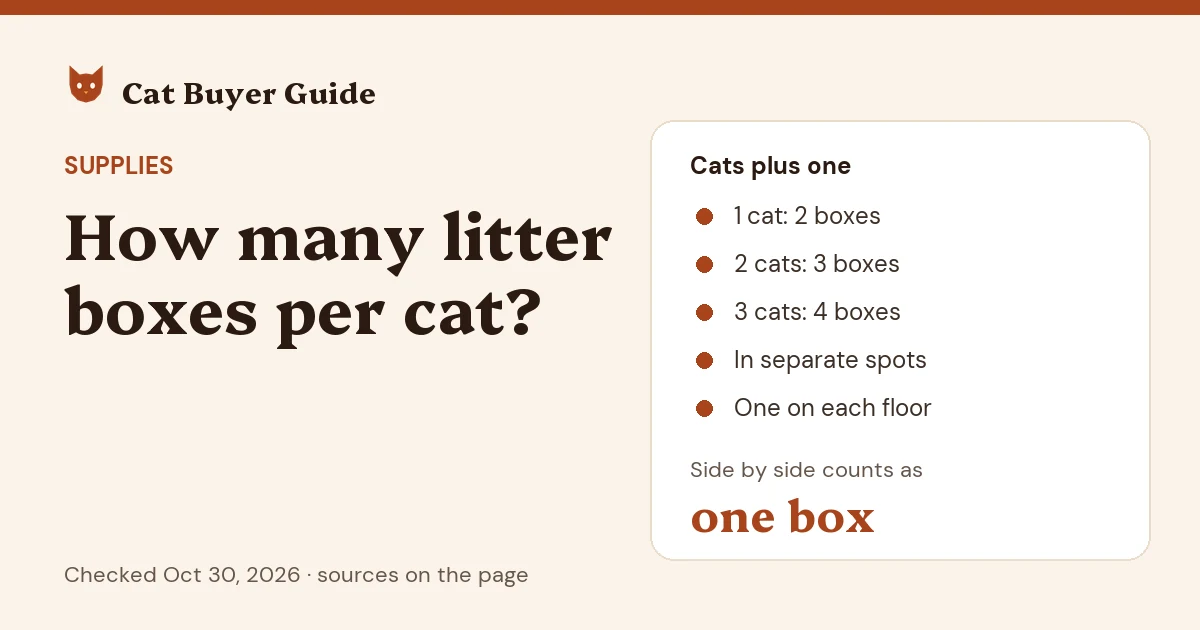
You need one litter box per cat, plus one more: two boxes for one cat, three for two cats, four for three. The Cornell Feline Health Center, the AAHA/AAFP vet guidelines, the Feline Veterinary Medical Association, the ASPCA and International Cat Care all give the same rule. Just as important, the boxes go in separate places: two boxes side by side count as one big box to a cat. In a home with more than one floor, put a box on each level.
The rule is vets’ advice, not a proven formula, and we explain below what one large study found. For choosing the boxes themselves, see our litter box buyer’s guide.
The short answer
- How many: the number of cats plus one. One cat needs 2 boxes, three cats need at least 4 (ASPCA).
- Where: in different, quiet spots, away from food and water, where no cat can be cornered or blocked. One on each floor.
- Not side by side: a cat sees boxes close together as one large box (FelineVMA).
- How big: at least 1.5 times your cat’s length (AAHA/AAFP, FelineVMA). Most store-bought boxes are smaller.
- First: if a cat is going outside the box, see your vet before you add boxes. Medical problems can be the cause (Cornell).
The rule: one box per cat, plus one
| Cats in the home | Boxes (cats + 1) |
|---|---|
| 1 | 2 |
| 2 | 3 |
| 3 | 4 |
| 4 | 5 |
| 5 | 6 |
That’s the minimum. If your home has more than one floor, you may need a box on each level as well (ASPCA, FelineVMA), so a two-story home with one cat can still end up with two boxes, one per floor.
Why the extra box? The Cornell Feline Health Center says it cuts competition and gives each cat a box of its own. The ASPCA adds that in some homes one cat controls the way to the boxes and keeps the others from using them. Conflict between cats can be enough to cause litter box problems, even with no open fighting.
What each vet source says
The five sources agree on the count, but differ on the details: how to place the boxes, how often to clean them, and how to measure size.
| Source | How many | Where | Scooping |
|---|---|---|---|
| Cornell | Cats plus one | Different areas; quiet, private, away from food | Daily (clumping litter) |
| AAHA/AAFP | Cats (or social groups) plus one | Different quiet spots, with an escape route | Every day |
| FelineVMA | Cats plus one | Multiple spots, kept apart; one per level | At least once a day |
| ASPCA | Cats plus one; 3 cats need at least 4 | Away from busy, loud spots; maybe one per level | At least once a day |
| International Cat Care | Cats plus at least one | Spaced around the house, not all together | At least twice a day |
The AAHA/AAFP Feline Life Stage Guidelines, written by vets for the American Animal Hospital Association and the American Association of Feline Practitioners, call it a rule of thumb. They also offer a second version: one box per social group, plus one, if you know how your cats group themselves.
Cats that share, and cats that don’t
The Feline Veterinary Medical Association (FelineVMA, formerly the AAFP) explains the social-group idea. Cats that know each other well, share a territory and groom, play or rest together may be more willing to share boxes. A home can hold more than one such group, and each group needs enough boxes of its own.
So two bonded littermates might happily share. Two cats that avoid each other are a different matter: each needs a box it can reach without passing the other. The safe starting point is still the full count, cats plus one, because you can’t always tell how your cats see each other, especially in the first weeks.
Where to put the boxes
Placement decides whether the extra boxes do any good.
- Apart, not in a row. FelineVMA says a cat considers boxes close to each other to be one large box. International Cat Care says not to put them all in one area, or another cat can block the way.
- Where no cat gets trapped. Avoid a closet, a small room or the end of a hallway where another cat can block the entry (FelineVMA). The AAHA/AAFP guidelines want an escape route.
- Quiet, but easy to reach. Not next to the washer and dryer or in heavy foot traffic (ASPCA), and reachable 24 hours a day (Cornell).
- Away from food and water. Cornell, the ASPCA and International Cat Care all say so.
- One on each floor. In a multi-level home, put a box on each level. For an older cat, FelineVMA says to make sure there’s one on the floor where it spends most of its time, since stairs may be hard.
Watch out for: putting the “extra” box in the laundry room next to the first one. It adds a box but not a choice, and it’s the kind of busy, noisy spot the ASPCA says cats avoid.
A new kitten: start with one room
A kitten needs the same count as an adult, two boxes for one kitten, but not on day one. International Cat Care advises keeping a new kitten in one room at first, with its food and water, bed, toys, scratching post and a litter tray in a quiet corner, food on the opposite side (International Cat Care). Once the kitten has the run of the house, add the second box elsewhere.
A kitten needs a box with low sides it can climb into. Our litter box buyer’s guide compares six boxes from the makers’ specs, and our guide to litter training a kitten covers the first lessons. For the full list of what to buy before the kitten arrives, see the new kitten checklist.
What kind of extra box
The extra box should meet the same standard as the first: open, easy to get into, and big enough. The AAHA/AAFP guidelines and FelineVMA both say a box should be at least 1.5 times your cat’s length. AAHA/AAFP measures from the nose to the tip of the tail, FelineVMA to the base of the tail, and both say many commercial boxes are too small; a large storage container is one way around that. Cornell says most cats prefer an uncovered box.
A plain open pan is often enough for the second box. Petmate’s Basic litter box comes in a jumbo size of about 22 by 16.5 inches with low, rimmed sides, open from any side (Petmate’s figures); Amazon’s listing calls it the XL Nonstick Pan: see the jumbo Petmate Basic on Amazon. For a big cat, IRIS USA makes its XX-Large Side Entry box for large breeds such as Maine Coons and Ragdolls and for multi-cat homes: 30 by 20 inches, with 14-inch walls and a 6.5-inch entrance (IRIS’s figures): see the IRIS XX-Large on Amazon. Both are picks in our litter box buyer’s guide, which explains the choice. This page isn’t a hands-on test: we haven’t used either box.
Skip self-cleaning boxes as the only box. International Cat Care says their movements and noises can startle cats, and many are small.
More boxes need more cleaning
Every box needs the same care, so three boxes are three times the scooping.
- Scoop: daily (AAHA/AAFP; Cornell, for clumping litter) or at least once a day (FelineVMA, ASPCA); International Cat Care says at least twice.
- Wash and refill: weekly (ASPCA); every 1 to 4 weeks (FelineVMA); every 2 to 4 weeks with clumping litter, weekly with non-clumping (International Cat Care).
- What with: hot water is best (AAHA/AAFP); FelineVMA allows soap and hot water only; the ASPCA allows unscented soap or baking soda. Avoid strong chemicals and anything ammonia-based.
Is “one per cat plus one” proven?
Not by a controlled study, as far as we found. Every source above presents it as a rule of thumb.
The biggest study we found is an online survey of the owners of 3,106 cats in Italy, published in the Journal of Feline Medicine and Surgery in 2023 (Padalino and colleagues). About 1 in 6 cats house-soiled. Cats with more than one box were almost twice as likely to house-soil as cats with one, which looks like the opposite of the rule. The authors don’t read it that way: they say more boxes are likely an owner’s attempt to fix a problem, not its cause. They describe the advice to add boxes as good practice that is “not statistically validated.” Cats with four or more boxes were less likely to leave feces outside the box than cats with one.
One more finding matters for placement. Among owners with two or more boxes, the median number of places with a box was one: at least half kept all their boxes in a single room. By FelineVMA’s reasoning, those cats effectively had one big box.
So the rule rests on vets’ experience rather than proof. It costs little, though, and the advice around it (separate places, clean boxes, enough size) is what the guidelines stress.
Talk to your vet
- If a cat starts going outside the box, see your vet before you change the boxes. Cornell says medical problems such as urinary tract inflammation can cause litter box trouble, and that a cat having problems using the box consistently should be checked by a veterinarian. The ASPCA’s advice on adding boxes starts once a vet has ruled out a medical cause.
- Ask your vet about FelineVMA’s suggestion of an extra box in the spot where the cat has soiled.
FAQ
How many litter boxes for 2 cats?
Three, in three different places. The ASPCA’s example: three cats need a minimum of four boxes.
Can two cats share one litter box?
Some can. FelineVMA says cats that are friendly with each other may be more willing to share, but the guidelines still advise one box per cat plus one, so each cat always has a free box.
Do I need two litter boxes for one cat?
Yes, by the same rule: cats plus one. A kitten can start with one box in its first room, and you add the second when it has the run of the house (International Cat Care).
Do two boxes next to each other count as two?
No. FelineVMA says a cat considers boxes close to each other one large box. Put them in different spots.
Do I need a litter box on every floor?
In a multi-level home, the ASPCA says you may need one, and FelineVMA says to put one on each level, especially for an older cat.
Sources
- Cornell Feline Health Center: Feline Behavior Problems: House Soiling (updated January 2015), checked Oct 30, 2026
- AAHA/AAFP 2021 Feline Life Stage Guidelines: General Litter Box Considerations, checked Oct 30, 2026
- Feline Veterinary Medical Association: House-Soiling (client brochure, updated February 2026, PDF), checked Oct 30, 2026
- ASPCA: Litter Box Problems, checked Oct 30, 2026
- International Cat Care: Choosing a litter tray for your cat (updated Dec. 10, 2025), checked Oct 30, 2026
- International Cat Care: Helping your new cat or kitten settle in (updated Sept. 26, 2025), checked Oct 30, 2026
- Padalino B, et al. Factors associated with house-soiling in Italian cats. J Feline Med Surg, 2023, checked Oct 30, 2026
- Petmate: Basic Litter Box (sizes), checked Oct 30, 2026
- IRIS USA: XX-Large Side Entry Cat Litter Box, checked Oct 30, 2026