Best Cat Water Fountains: A Buyer’s Guide (2026)

A buyer's guide built from specifications, warranties and return policies, not hands-on testing. Facts and prices checked October 22, 2026. We may earn a commission if you buy through links on this page. It never changes what we recommend. As an Amazon Associate we earn from qualifying purchases. How we research
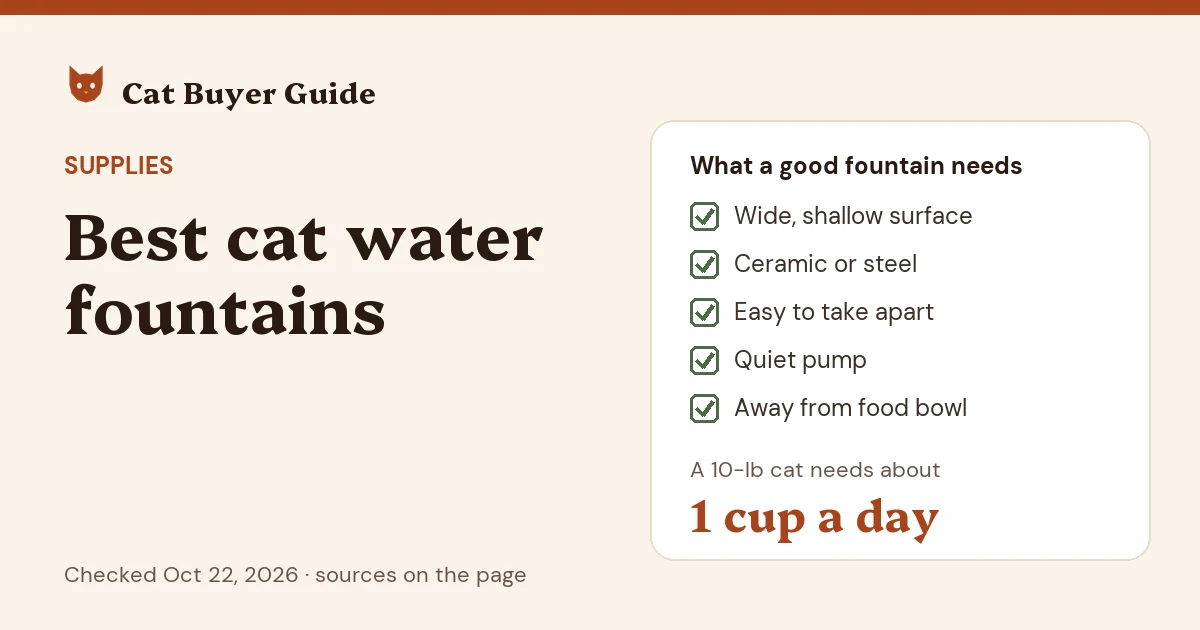
The best cat water fountain is one your cat will actually use: a wide, shallow drinking surface in ceramic or stainless steel, parts that come apart for weekly cleaning, and a quiet pump, placed away from the food bowl and the litter box. But a fountain is a nice extra, not a must. In two veterinary studies, cats on average drank little or no more from a fountain than from a bowl, though some individual cats clearly preferred one.
This is a buyer’s guide built from the makers’ published specifications, cleaning instructions and warranty pages, checked on Oct 22, 2026. It is not a hands-on test: we didn’t buy, handle or try any of these fountains.
The short answer
- Best overall: Pioneer Pet Raindrop Stainless Steel (60 oz, low open bowl, dishwasher safe).
- Ceramic pick: Pioneer Pet Big Max Ceramic (128 oz, heavy at 7 lb).
- For several cats: PetSafe Drinkwell Stainless Steel Multi-Pet (128 oz, drink from any side).
- Small and quiet: Catit PIXI with stainless steel top (67.5 oz, auto-shutdown when water runs low).
- Keep a plain bowl too. Some cats won’t take to a fountain, and wet food adds more water than any fountain.
Cat water fountain or bowl: what the research says
Many cats like moving water, says International Cat Care (iCatCare), and it lists pet fountains among the ways to offer it. The Cornell Feline Health Center agrees that some cats drink more from a fountain, but adds that preferences vary from cat to cat.
The studies point the same way:
- In owners’ homes (2010). A study of 13 healthy cats in the Journal of Feline Medicine and Surgery measured water intake from a bowl and from a fountain. For 12 cats, intake was slightly higher from the fountain, but their urine was no more dilute. The 13th cat refused to drink from the fountain at all. The author concluded the fountain didn’t substantially increase intake.
- In a laboratory (2018). A later study in the same journal gave 14 cats on dry food a still bowl, a circulating bowl and a free-falling one, two weeks each. Average daily intake didn’t differ between them. Three cats showed a clear preference, and each preferred a different type.
So the makers’ line that fountains make pets drink more is true of some cats, not cats in general. What does raise water intake reliably is food: Cornell says wet food can be up to 80% water, and both Cornell and iCatCare suggest wet food, or water added to food, for cats that need to drink more. Ask your vet before you change your cat’s diet.
How much water does a cat need? About 4 ounces per 5 pounds of lean body weight a day, Cornell says, so about one cup for an average 10-pound cat. A cat on wet food gets much of that from its food and may drink less, which is normal.
What to look for in a cat water fountain
Most of what iCatCare says about water bowls applies to a fountain’s drinking surface, and its caregiver guide adds advice for fountains in particular.
A wide, shallow drinking area. Most cats prefer not to put their head deep into a bowl, and they don’t like their whiskers touching the sides, iCatCare says. Look for an open, low bowl or a broad top rather than a narrow spout.
Ceramic or stainless steel over plastic. Cats generally prefer glass or ceramic bowls to plastic ones, iCatCare says. Its guide notes that plastic scratches easily and holds bacteria, while metal can be noisy, cold and reflective, which puts some cats off. Fountains come in all three materials; every fountain below has a ceramic or stainless steel drinking surface.
Easy to take apart and clean. iCatCare says a fountain must be taken apart and cleaned thoroughly on a regular basis, with the filter changed as the maker recommends. Dishwasher-safe parts make that easier. Pioneer Pet, for example, says to clean its fountains once a week, change the filter every two to four weeks and clean the pump once a month. Filters are an ongoing cost, so check that replacements are easy to find.
A quiet pump, kept topped up. Some models are noisier than others, and some get noisy when the water runs low, the guide says. A silicone or rubber mat underneath can cut the vibration.
Enough capacity for your household. Capacity doesn’t change how often you should clean, but a bigger reservoir needs topping up less often. For more than one cat, iCatCare’s rule for bowls is one per cat plus one extra, so a fountain should be one water source among several, not the only one.
| What to look for | Why it matters | Source |
|---|---|---|
| Wide, shallow surface | Whiskers don’t touch; head stays up | iCatCare |
| Ceramic or steel | Cats prefer them; plastic holds bacteria | iCatCare |
| Comes apart easily | Weekly cleaning and filter changes | iCatCare, makers |
| Quiet pump | Noise can put a cat off | iCatCare |
| Not the only water | Some cats ignore fountains | iCatCare, 2010 and 2018 studies |
Four cat water fountains that meet the criteria
Every spec below comes from the maker’s own page. We included only fountains with a ceramic or stainless steel drinking surface, published dimensions and capacity, and parts the maker says can go in the dishwasher.
| Fountain | Drinking surface | Capacity | Size (inches) |
|---|---|---|---|
| Pioneer Raindrop Stainless | Stainless steel | 60 oz | 11.75 x 9.75 x 4.25 |
| Pioneer Big Max Ceramic | Ceramic | 128 oz | 13.5 x 13.5 x 7 |
| PetSafe Drinkwell Multi-Pet | Stainless steel | 128 oz | 14.3 x 14.3 x 9.3 |
| Catit PIXI, steel top | Steel top, plastic base | 67.5 oz | 8 x 8 x 6.7 |
1. Best overall: Pioneer Pet Raindrop Stainless Steel Fountain
The Raindrop is a low fountain with a stainless steel bowl: at 4.25 inches tall, it’s easy for a kitten to reach as well as an adult cat. Pioneer Pet says it is made of 18/8 stainless steel and is dishwasher safe, and it uses a replaceable charcoal filter.
- Capacity and size: 60 oz; 11.75 x 9.75 x 4.25 inches; 1.7 lb.
- Cleaning: wash the fountain weekly, change the filter every two to four weeks and clean the pump monthly, per the maker.
- Filters: Pioneer Pet’s #3002 (3-pack) or #3014 (4-pack); the same filters fit its other ceramic and stainless fountains.
- Warranty and returns: no warranty listed. Pioneer Pet doesn’t sell it on its own store, so its 30-day return policy for direct orders doesn’t apply; the retailer’s policy does.
Best for: most single-cat homes, and kittens, since it sits low.
Watch out for: iCatCare notes that metal can be noisy and reflective for some cats. If yours hesitates, the ceramic Big Max below is the alternative.
See the Pioneer Pet Raindrop Stainless Steel Fountain on Amazon
2. Ceramic pick: Pioneer Pet Big Max Ceramic Fountain
Ceramic is the material cats generally prefer for bowls, per iCatCare, and the Big Max is a ceramic fountain with a large drinking area. It holds 128 ounces, more than a gallon, and Pioneer Pet says it suits households with several cats. At 7 pounds it’s heavy, so it’s less likely to slide around, but harder to carry to the sink.
- Capacity and size: 128 oz; 13.5 x 13.5 x 7 inches; 7 lb.
- Cleaning: dishwasher safe; the same weekly, filter and pump schedule as the Raindrop.
- Filters: the same #3002 or #3014 charcoal filters.
- Warranty and returns: as for the Raindrop: no warranty listed, and the retailer’s return policy applies.
Best for: cats that dislike metal, and homes with two or three cats.
Watch out for: ceramic can chip or crack if dropped. Check the bowl for chips when you clean it.
See the Pioneer Pet Big Max Ceramic Fountain (black, 128 oz) on Amazon
3. For several cats: PetSafe Drinkwell Stainless Steel Multi-Pet Fountain
PetSafe’s multi-pet fountain is round, so cats can drink from any side, which fits iCatCare’s advice that cats like to reach their water from all sides. It holds 128 ounces, and five spout attachments set up to five free-falling streams. PetSafe says pets can still reach the water if the power goes out, and it filters through a carbon filter and a foam filter.
- Capacity and size: 128 oz; 14.3 x 14.3 x 9.3 inches.
- Cleaning: top-rack dishwasher safe; wash the pump by hand.
- Warranty: PetSafe covers labor and parts for the first year of ownership; the warranty isn’t transferable, and replacement pumps bought separately carry 90 days.
Best for: homes with several cats (or a cat and a dog), where more than one may want to drink at once.
Watch out for: at 9.3 inches it’s the tallest here, and the free-falling streams make more movement than a gentle flow. Introduce it slowly, as in the steps below.
See the PetSafe Drinkwell Stainless Steel Multi-Pet Fountain on Amazon
4. Small and quiet: Catit PIXI with Stainless Steel Top
The PIXI is the smallest fountain here, at 8 x 8 inches, with a stainless steel top that Catit describes as wide and shallow so whiskers don’t brush the sides. Catit calls the pump super-silent; it runs on a USB adapter at under 1 watt. LED lights warn when the water is low or the reservoir is empty, and the pump has an auto-shutdown, which matters because some fountains get noisy when they run low.
- Capacity and size: 2 liters (67.5 oz); 8 x 8 x 6.7 inches; 1.49 lb. (The all-plastic PIXI in colors holds more, 84.5 oz.)
- Cleaning: the steel top is dishwasher safe; the pump comes out fully for cleaning.
- Warranty: Catit’s product page doesn’t state one; check the retailer’s return policy.
Best for: small spaces, a bedroom or office, and cats that are wary of noise.
Watch out for: only the top is steel; the base and reservoir are plastic, though the water your cat drinks from sits on the steel top.
See the Catit PIXI Drinking Fountain with stainless steel top on Amazon
How we chose, and what we left out
- We started from iCatCare’s and Cornell’s advice above, then read each maker’s product, cleaning and policy pages on Oct 22, 2026. For each Amazon link we opened the product’s own Amazon page, which showed it in stock that day.
- We left out Pioneer Pet’s ceramic Raindrop (out of stock at the maker and not found on Amazon), Catit’s Stainless Steel Flower Fountain (not found on Amazon), plastic-bowl fountains (iCatCare’s caution about plastic) and unbranded fountains with no maker page. We didn’t assess cordless, battery or app-connected fountains.
- The makers’ claims that fountains make pets drink more, or that a material prevents infection or acne, are theirs. We found no veterinary source for the material claims, and the studies above found little average effect on drinking.
- Prices change daily, so we don’t show any. For what the first supplies cost, see our new kitten checklist.
How to introduce a water fountain
Cats don’t like sudden changes to their food and water, iCatCare says, so introduce a fountain in steps:
- Put the fountain where it will stay, empty and switched off, and let your cat investigate it.
- Once your cat is comfortable with it, add water.
- Then switch the pump on.
Keep the old water bowl out while your cat gets used to the fountain, and keep at least one plain bowl afterwards.
Where to put a cat water fountain
iCatCare’s advice on placement:
- Away from the food bowl. Cats prefer not to drink next to their food; avoid double bowls with food and water side by side.
- Away from the litter box.
- Somewhere quiet, away from busy doors and noisy machines such as washing machines.
- Away from the wall, so your cat can drink without its back to the room. The caregiver guide shows a fountain placed this way.
- More than one water source: one bowl or fountain per cat plus one, and one on each floor of the home. Older cats with stiff joints may prefer water that’s raised off the floor.
If you’re kitten-proofing, keep the cord where a kitten can’t chew it; our guide to what is poisonous to cats covers other household dangers.
Talk to your vet
- Call your vet if your cat seems to be drinking much more or much less than usual. iCatCare notes that drinking too much can come with weight loss, a bigger appetite or behavior changes.
- Lethargy, weakness, poor appetite and dry gums can be signs of dehydration, Cornell says; contact a vet promptly.
- If your vet wants your cat to drink more (for kidney disease, bladder problems or urinary stones, for example), ask whether wet food or adding water to food should come first. A fountain may help some cats, but the studies show it isn’t reliable on its own.
Cat water fountain FAQ
Are water fountains good for cats?
They’re good for cats that like them. Some cats drink more from moving water, but in two veterinary studies the average cat drank about the same from a fountain as from a bowl, and one cat refused a fountain entirely. Offer one alongside a plain bowl and see which your cat uses.
Stainless steel, ceramic or plastic?
iCatCare says cats generally prefer ceramic or glass to plastic, and plastic scratches and holds bacteria. Stainless steel is easy to clean, but metal can be noisy, cold and reflective for some cats. Ceramic is heavier and can chip.
How often should you clean a cat water fountain?
Follow the maker’s schedule. Pioneer Pet says weekly for the fountain, every two to four weeks for the filter and monthly for the pump. iCatCare says to take a fountain apart and clean it thoroughly on a regular basis.
Do kittens need a water fountain?
No. A kitten needs fresh, clean water it can reach easily, in a wide, shallow bowl or a low fountain. If you choose a fountain, a low one like the Raindrop is easy for a small kitten to reach. Our new kitten checklist covers the other day-one supplies.
My cat won’t drink from the fountain. What now?
Go back a step: switch the pump off, or remove the water, and let your cat get used to it again. Check that it isn’t next to the food bowl or the litter box, and keep a plain bowl out. Some cats simply prefer still water.
Sources
- International Cat Care: How to encourage your cat to drink (updated Sep. 26, 2025), checked Oct 22, 2026
- International Cat Care: Encouraging your cat to drink, a guide for caregivers (2024, PDF), checked Oct 22, 2026
- Cornell Feline Health Center: Hydration (updated 2021), checked Oct 22, 2026
- Grant DC. Effect of water source on intake and urine concentration in healthy cats. Journal of Feline Medicine and Surgery, 2010 (abstract), checked Oct 22, 2026
- Quantified water intake in laboratory cats from still, free-falling and circulating water bowls. Journal of Feline Medicine and Surgery, 2018, checked Oct 22, 2026
- Pioneer Pet: Raindrop Premium Stainless Steel Drinking Fountain, 60 oz (#6023), checked Oct 22, 2026
- Pioneer Pet: Big Max Durable Ceramic Drinking Fountain, 128 oz (#3005), checked Oct 22, 2026
- Pioneer Pet: Return policy, checked Oct 22, 2026
- PetSafe: Drinkwell Stainless Steel Multi-Pet Fountain (PWW00-13705), checked Oct 22, 2026
- PetSafe: Return and warranty information, checked Oct 22, 2026
- Catit: PIXI Drinking Fountain with stainless steel top (#43720), checked Oct 22, 2026