Covered vs Uncovered Litter Box: Which Do Cats Prefer?

A buyer's guide built from specifications, warranties and return policies, not hands-on testing. Facts and prices checked November 5, 2026. We may earn a commission if you buy through links on this page. It never changes what we recommend. As an Amazon Associate we earn from qualifying purchases. How we research
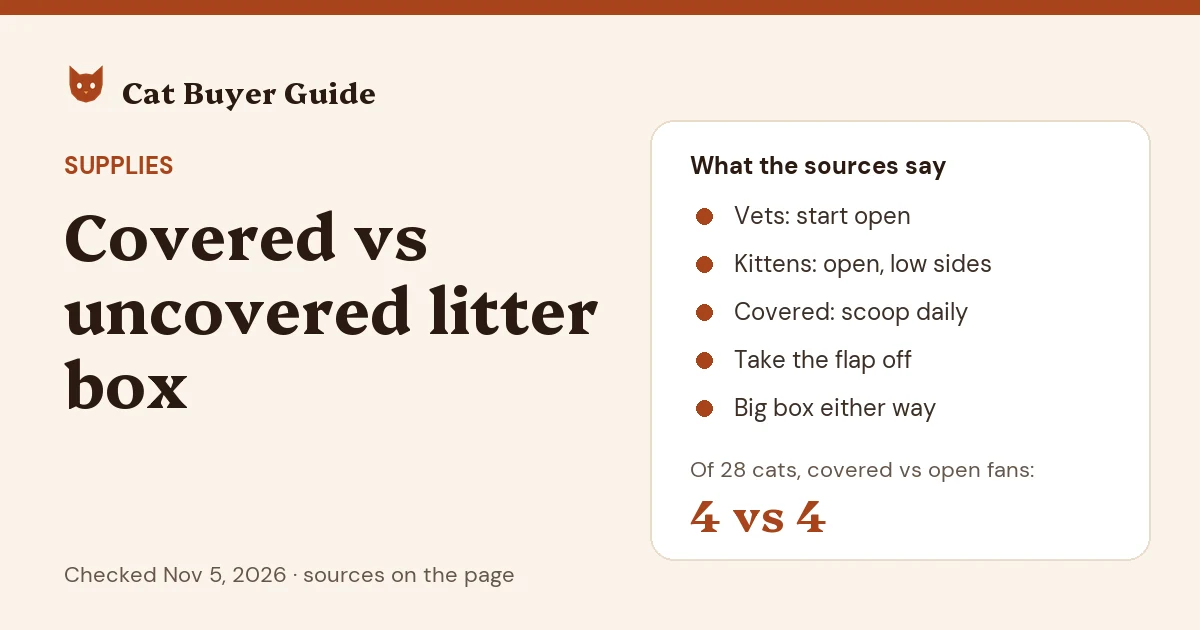
Should a litter box be covered or uncovered? Start with an uncovered box. The Cornell Feline Health Center says most cats prefer an open box that lets odors escape and gives them a 360-degree view, and the ASPCA says most cats don’t like lids. But the evidence is softer than the advice: in the one controlled study, most cats used a covered and an uncovered box equally, as long as both were large and scooped every day. So a covered box can work for a cat that happily uses it. What matters more than the lid is a big box, scooped at least once a day.
We built this comparison from the advice of Cornell, the ASPCA, International Cat Care (iCatCare), the AAHA/AAFP vet guidelines and the Feline Veterinary Medical Association (FelineVMA), plus two published studies, all checked on November 5, 2026. We don’t own a cat and haven’t tested any box. For which box to buy, see our litter box buyer’s guide.
The short answer
- First choice: an open box, big enough (at least 1.5 times your cat’s length) and easy to get into (Cornell, ASPCA, AAHA/AAFP).
- Kittens: open, with low sides, says Cornell.
- A covered box can work if your cat already uses it without trouble, but scoop it at least daily and take the flap off (iCatCare).
- Go open at once if your cat avoids the box, goes beside it, shares a home with other pets, or is a large breed.
- Want less mess without a lid? A large, high-sided open box holds in scattered litter.
Covered vs uncovered litter box at a glance
| Uncovered (open) | Covered (hooded) | |
|---|---|---|
| What most vets advise | Yes, the default | Only if your cat is fine with it |
| Smell for you | You notice it sooner | Contained, for people |
| Smell for your cat | Odors escape | Covers hold odors in (Cornell) |
| Stray litter | More can be kicked out | Less, mostly |
| View and way out | 360-degree view, any way out | One entrance, one way out |
| Scooping | Easy to see and reach | Lid must come off; dirt is easy to miss |
| Room to dig | Limited only by box size | Small hoods can cramp big cats (iCatCare) |
| Kittens | Best with low sides | Can be hard for a small kitten to get into |
| Homes with other pets | Better: no ambush spot | Riskier: a cat can be cornered |
The table sums up the sources below. The main trade-off is simple: a cover helps the people in the house (less smell, less scattered litter) and can make the box worse for the cat (smells kept in, one way out).
What vets and cat-welfare groups say
Cornell Feline Health Center. People like covered boxes because they reduce odor and stray litter, but “from your cat’s point of view, covers hold odors in” (Cornell). Its quick tips say most cats prefer an uncovered box with a 360-degree view. If another pet bothers your cat in the box or as it leaves, Cornell’s advice is to swap a covered box for one with an all-round view and place it with more than one way out.
ASPCA. It lists a hood or liner that makes a cat uncomfortable among the common reasons for litter box problems, and says most cats dislike lids. For a cat that has stopped using its box, the ASPCA says to take the covers and liners off every box. Cats like to see who is coming and to have several escape routes.
International Cat Care. iCatCare is the most balanced. Many cats adapt well to a covered tray, it says, and owners pick them for privacy and to keep the smell down. But holding the smell in makes it harder to remove soiled litter promptly, and cats are less likely to use a box that already smells. Some cats feel vulnerable with only one exit, especially with other cats in the home, and large cats may not have room to turn, scrape and dig in a small hooded tray. If you use a covered tray, iCatCare suggests removing the flap, which can put cats off (iCatCare).
The AAHA/AAFP vet guidelines. The 2021 Feline Life Stage Guidelines list box style, covered among them, as one of the reasons cats stop using their box, alongside size, location, cleaning, illness and stress. They say size and whether the box is open or covered may matter to some cats, and that a box should be at least 1.5 times the cat’s length, nose to tail tip. Most boxes sold are smaller than that.
What the studies found
The controlled study: no average preference. In a 2013 study in the *Journal of Feline Medicine and Surgery* (Grigg and colleagues), 28 cats with no recent litter box problems each had a covered and an uncovered box to themselves for 14 days. Both boxes were made from the same large plastic storage tub, about 32.5 by 20 inches, filled with clumping litter and scooped every day. Overall there was no significant difference in use. Eight cats did show a preference, four for the covered box and four for the open one. The authors think that most cats won’t prefer either style if the boxes are cleaned at least daily, and suggest offering a cat both to find out.
Two things to keep in mind. The boxes were much bigger than most store-bought ones, and they were scooped daily, so the study tells you about good boxes, not small, neglected ones. The same paper also summarizes an earlier study of 144 cats that found no link between box style and house-soiling. Even so, the cats with problems and covered boxes went five days on average between cleanings, while the cats without problems were more likely to have their boxes cleaned daily.
The big survey: mixed results. A 2023 survey of the owners of 3,106 cats in Italy (Padalino and colleagues) found that, overall, cats with an open box were 1.4 times more likely to house-soil than cats with a covered box. Yet among the cats that did house-soil, covered boxes went with more urinating outside the box. The authors call the two results conflicting. Their possible explanations: litter and waste scatter more easily from an open box, a cat in a busy multi-pet home may feel less protected in one, and owners may not notice when a covered box is dirty. A survey shows links, not causes, and the authors conclude that no real preference for open or covered boxes has been shown, as long as the box is clean and the right size.
So the research doesn’t prove covered boxes are bad. It does back the part every source agrees on: clean daily, and big enough.
When a covered box can work
A covered box is a reasonable choice when all of these hold:
- Your cat already uses it every time, with no accidents beside it.
- It’s big enough for your cat to turn around and dig. iCatCare warns that large cats can struggle in small hooded trays.
- You scoop it at least once a day, lifting the lid to check, because the smell you don’t notice is still there for your cat.
- The flap is off, as iCatCare suggests.
- Your cat isn’t ambushed by another pet near the box, and the box isn’t surrounded on three sides, so there’s more than one way out (Cornell).
If your cat has been using a covered box without trouble, there’s no need to switch. The Grigg study found most cats used either style equally.
When to choose an uncovered box
Go open, or take the lid off, if:
- It’s for a kitten. Kittens need low sides (Cornell), and the ASPCA notes that very young cats can have trouble with sides that are too high or a top opening. Our guide on how to litter train a kitten covers the first box in detail.
- Your cat avoids the box or goes beside it. The ASPCA’s first step for a litter box problem is to remove covers and liners.
- You have other pets. One entrance means one way out. Cornell and iCatCare both point to cats feeling cornered or ambushed.
- Your cat is large. A small hood can stop a big cat from turning and digging (iCatCare).
- Your cat is old or stiff. Cornell says elderly cats need boxes with low sides, and the ASPCA says top-entry or high-sided boxes can be hard for them.
Less mess without a lid
Cornell says people like covers for two reasons: less smell and less stray litter. Both have fixes that don’t box your cat in.
- For smell, scoop more often. Cornell, the ASPCA and FelineVMA all say to scoop waste at least once a day, and FelineVMA says to wash the box every one to four weeks with soap and hot water only. A cover hides odor from you, not from your cat.
- For scatter, choose a high-sided open box. Tall walls catch kicked litter while leaving the top open. The IRIS USA XX-Large Side Entry Cat Litter Box has 14-inch walls and a 6.5-inch curved entrance and measures 30 by 20 inches, which IRIS says keeps litter and urine in (IRIS). The PetFusion BetterBox is an open box with high walls and a lower front, 22.6 by 18.1 inches and 8 inches tall (Petmate). Both are picks in our litter box buyer’s guide, which says who each one suits.
- Or use a storage tub. FelineVMA suggests a large storage container or concrete mixing tray as a box, with the lid placed behind it to protect the wall. Grigg’s study used storage tubs too.
- Mind the litter itself. Most cats prefer unscented, clumping litter about 1 to 2 inches deep (Cornell, ASPCA), and FelineVMA says many cats dislike scented litters, deodorizers and box liners.
How many boxes you need matters as much as their style: our guide on how many litter boxes per cat explains the “one per cat plus one” rule.
How to switch from covered to uncovered (or test both)
You don’t have to guess. Cornell says you may need to try several kinds of box to find what your cat likes, iCatCare suggests trying both types, and the Grigg study’s authors suggest offering a choice of styles.
- Put an open box next to the covered one, both clean, with the same litter.
- Scoop both daily and see which one your cat uses more over a week or two (the study ran 14 days).
- If your cat clearly picks one, keep that style. If it uses both, either is fine.
- Once the choice is made, move the extra box to a different spot rather than throwing it out, if you need another box anyway. Two boxes side by side count as one to a cat (FelineVMA).
Talk to your vet if
- Your cat suddenly stops using its box, or pees or poops just outside it. Cornell advises a vet exam to look for an underlying medical problem first, because cats with medical conditions may not act sick.
- Changing the box doesn’t solve a litter box problem.
Covered vs uncovered litter box: FAQ
Do cats prefer covered or uncovered litter boxes?
Most vet sources say most cats prefer uncovered boxes (Cornell, ASPCA). The one controlled study found no average preference when both boxes were large and scooped daily: of 28 cats, 4 preferred covered, 4 preferred uncovered and the rest used both (Grigg, 2013).
Are covered litter boxes bad for cats?
Not for every cat. iCatCare says many cats adapt well. The risks are smells trapped inside, dirt you don’t notice, a single exit in a home with other pets, and too little room for a big cat. If your cat uses a covered box without problems and you scoop daily, it’s fine.
Do covered litter boxes smell less?
For people, yes: the lid holds the smell in. For your cat, that’s the problem, says Cornell. Scooping at least daily deals with the smell for both of you.
Should a kitten have a covered litter box?
No. Start with an open box with low sides (Cornell, ASPCA). See our litter box buyer’s guide for boxes kittens can climb into.
Should I take the flap off a covered litter box?
Yes, iCatCare suggests it: a flap can put cats off and holds in even more smell.
My cat stopped using its covered box. What should I do?
See your vet first to rule out a medical cause (Cornell). Then take the lid off, as the ASPCA advises, scoop daily and make sure there are enough boxes in separate places.
Sources
- Cornell Feline Health Center: Feline Behavior Problems: House Soiling (updated January 2015), checked Nov 5, 2026
- ASPCA: Litter Box Problems, checked Nov 5, 2026
- International Cat Care: Choosing a litter tray for your cat (updated Dec. 10, 2025), checked Nov 5, 2026
- AAHA/AAFP: 2021 Feline Life Stage Guidelines (full text on PMC), checked Nov 5, 2026
- FelineVMA: House-Soiling (client brochure, updated Feb. 2026, PDF), checked Nov 5, 2026
- Grigg, Pick and Nibblett (2013): Litter box preference in domestic cats: covered versus uncovered, J Feline Med Surg 15(4), checked Nov 5, 2026
- Padalino et al. (2023): Factors associated with house-soiling in Italian cats, J Feline Med Surg, checked Nov 5, 2026
- IRIS USA: XX-Large Side Entry Cat Litter Box (product page), checked Nov 5, 2026
- Petmate: PetFusion BetterBox Cat Litter Box (product page), checked Nov 5, 2026