How to Introduce a Kitten to a Cat: A Step-by-Step Plan from Vets

Built from dated data and expert sources, not hands-on pet testing. Facts and prices checked November 11, 2026. We may earn a commission if you buy through links on this page. It never changes what we recommend. As an Amazon Associate we earn from qualifying purchases. How we research
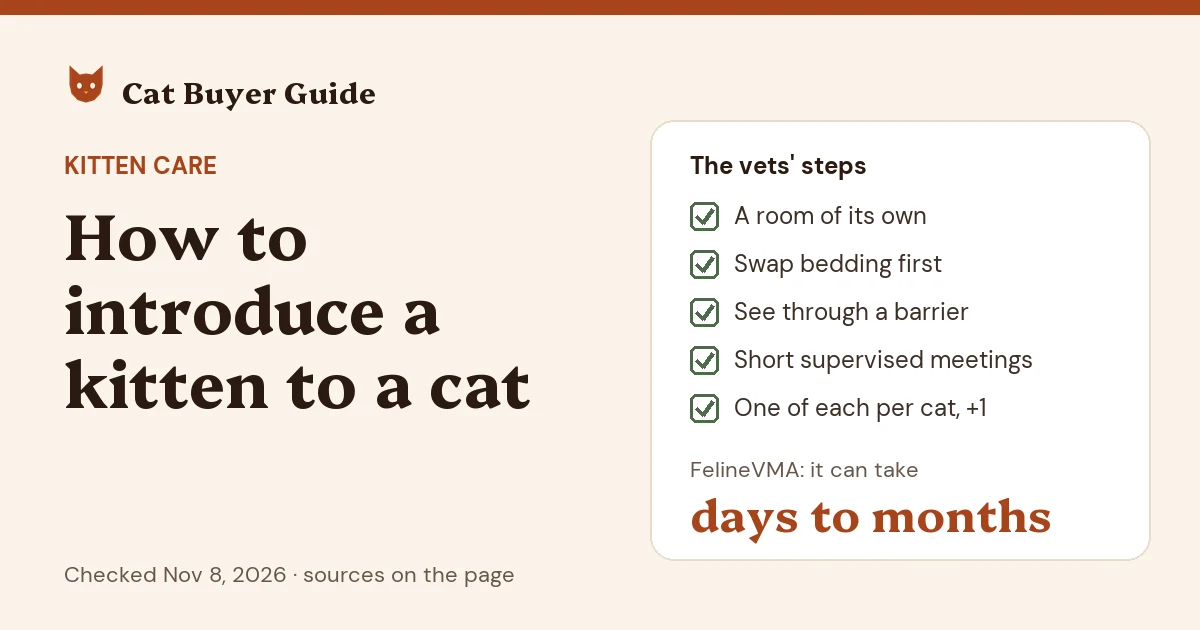
To introduce a kitten to a cat, keep them apart at first. Give the kitten its own room with everything it needs, swap their bedding so each cat gets used to the other’s smell, then let them see each other through a gate or glass door, and only then allow short, supervised time together. Move to the next step only when both cats are calm at the current one. The Feline Veterinary Medical Association (FelineVMA) says the whole process can take a few days to a few months, and sometimes longer.
That is the method of International Cat Care (iCatCare) and FelineVMA, whose step-by-step guide accompanies the AAFP’s 2024 guidelines on tension between cats. We built this guide from their advice and from Best Friends Animal Society, all checked on November 11, 2026. We don’t own a cat; nothing here is from our own experience.
The short answer
- Vet check first. All the cats should have had a recent check-up, and your vet should test the kitten for common contagious diseases (FelineVMA).
- A room of its own for the kitten, with food, water, a litter box, a bed, hiding places, toys and a scratching post (iCatCare).
- Scent before sight. Swap bedding until neither cat reacts to the other’s smell (iCatCare, FelineVMA).
- Sight through a barrier, such as a glass door or a tall gate, in short sessions (iCatCare, FelineVMA).
- Short supervised meetings, then a few minutes unsupervised, building up slowly (iCatCare).
- One of everything per cat, plus one, spread around the home (iCatCare, FelineVMA).
On this page
- Before you bring the kitten home
- Step 1: Set up the kitten’s room
- Step 2: Swap scents
- Step 3: Let each explore the other’s space
- Step 4: Let them see each other through a barrier
- Step 5: Supervised time together
- Step 6: Short unsupervised time, then more
- Give each cat its own things, plus one
- Introducing a kitten to more than one cat
- When it isn’t working
- FAQ
Before you bring the kitten home
Think about your cat. iCatCare says it is hard to predict whether a cat will accept another. In general, the younger the resident cat, the more likely it is to accept a newcomer, and neutered cats are much more likely to get along. It isn’t a good time if your cat is unwell. FelineVMA goes further: don’t consider another cat if your resident cat is in poor health, or is a senior with medical problems.
A kitten and an older cat can be a poor match. A kitten may want to play far more than an older cat does, and an older cat with joint disease may find a kitten’s rough play uncomfortable (iCatCare). Best Friends says a young kitten is probably not a good idea with an older or more reserved cat. iCatCare suggests that two kittens who can play with each other may be a better choice than one, if you have the time and space for two.
Ask about the kitten’s early life. Kittens are most open to learning about other cats at about 2 to 8 weeks of age, and kittens with friendly encounters with other cats then are more likely to see cats positively for life (iCatCare). That is one reason the age a kitten comes home matters.
Talk to your vet first
FelineVMA advises a recent vet check-up for every cat in the home, and testing the new kitten for common contagious diseases, before the cats meet. Ask your vet which tests your kitten needs and when its first vaccines are due. If a cat stops eating or stays stressed for more than several days during the introduction, Best Friends says to consult your vet.
Step 1: Set up the kitten’s room
Choose a room your cat doesn’t use. iCatCare lists what to put in it: food, water, comfortable beds, hiding places, a litter tray, toys and a scratching post. These things should be new or the kitten’s own. Your cat’s belongings carry its scent, which can stress the kitten, and your cat may be upset to lose a resource such as its litter box (iCatCare). FelineVMA adds that the room should be quiet, away from busy areas, and able to be closed securely, with some high places and hiding spots.
Bring the kitten home in a carrier covered with a towel, straight to its room, so the cats don’t see each other on the way in (FelineVMA). Our first week with a new kitten guide covers the first days in that room. Our cat carrier buyer’s guide compares carriers for that trip and for vet visits.
Both iCatCare and FelineVMA say synthetic feline pheromone diffusers can help, in the kitten’s room and where your cat spends its time. FelineVMA suggests plugging them in 24 to 48 hours before the kitten arrives.
When to move on: when the kitten isn’t hiding all the time and explores its room with confidence (FelineVMA). iCatCare says settling in takes from several days to a week or two. Signs of a settled cat include friendly greetings when you come in, resting on its side, playing, rubbing its face on furniture, and normal eating and litter box use.
Step 2: Swap scents
Cats recognize their group by scent, so the aim is a shared smell before they meet (iCatCare). Put a piece of the kitten’s bedding in your cat’s bed, and a piece of your cat’s bedding in the kitten’s bed, keeping enough bedding that neither is left short. Repeat daily until neither cat reacts with tension (FelineVMA).
Signs that a cat isn’t ready include avoiding the item, hissing, growling, pacing, or using the floor instead of the litter box (FelineVMA). iCatCare says a cat that keeps avoiding or hissing at the bedding may be less likely to accept the newcomer, so go much more slowly.
FelineVMA then adds a scent transfer: gently rub a soft cloth that carries one cat’s scent over the other cat’s cheeks and chin. When that goes calmly, it suggests short play sessions on each side of a closed door, using two toys tied together with string, for 5 to 20 minutes.
Step 3: Let each explore the other’s space
Next, put your cat in another room for a short while, if that doesn’t upset it, and let the kitten explore the rest of the home. Then return the kitten to its room and let your cat explore the kitten’s room (iCatCare). FelineVMA suggests giving your cat treats and toys in its room while the kitten explores, so the change feels like a good thing. Increase the kitten’s exploring time over a few days.
Step 4: Let them see each other through a barrier
When both cats are relaxed with each other’s smell, let them see each other through something they can’t get past: a glass door, a door propped open a little, a tall gate or a mesh screen (iCatCare, FelineVMA). Keep the sessions short. The goal is two cats going about their business and glancing at each other now and then, not staring each other down (iCatCare).
At any hissing, growling, or ears turned back with a tense body, call the cat that started it away by name (iCatCare). Never punish either cat: it only frightens them more (iCatCare). If the cats aren’t comfortable, go back a step for a few more days (FelineVMA).
Should you use food or treats? The experts differ here. Best Friends suggests feeding the cats on each side of a closed door, bowls far apart at first and moved closer as they relax, and FelineVMA uses treats to reward calm behavior. iCatCare advises against using food or play to distract or reward a cat near the other cat, because cats eat and play alone and may feel stressed doing it in view of another. If you use food, start with the bowls far apart, as Best Friends suggests, and move them closer only while both cats seem comfortable.
Step 5: Supervised time together
Once both cats are calm at the barrier, open it quietly while they are busy with something else. Don’t force them together: the aim is that they are comfortable in the same room, not that they interact (iCatCare). FelineVMA suggests starting in a large room, with a helper playing with one cat while you play with the other, and gradually bringing them closer over several days.
Keep a cushion, a large towel or a piece of cardboard at hand. If you see tension, put it between the cats to break their line of sight; don’t pick a cat up in a tense moment, and don’t reach for a cat that is hissing or growling, because a cat that can’t reach the other may turn on the nearest target (FelineVMA).
Step 6: Short unsupervised time, then more
When supervised sessions pass without trouble, leave them together without supervision for a few minutes at first, and keep the kitten in its own room in between (iCatCare). Lengthen the time slowly while both seem friendly and relaxed, and make sure each can retreat to its own space. In time, the kitten’s room can stay open (iCatCare).
Give each cat its own things, plus one
FelineVMA says that not having enough resources, set apart from each other, is “the most common cause of tension between cats.” Both FelineVMA and iCatCare advise one of each per cat, plus one extra, spread around the home:
| Resource | With one cat and one kitten |
|---|---|
| Litter boxes | 3 |
| Food bowls | 3 |
| Water bowls | 3 |
| Scratching posts | 3 |
| Beds and hiding places | 3 |
Our guide on how many litter boxes per cat explains the rule and its limits. Shelves, perches and a cat tree give each cat its own high place, which iCatCare says helps them keep their own space.
A kitten has far more energy than most adult cats. FelineVMA suggests at least two play sessions a day of 5 minutes or more with a high-energy cat, so it doesn’t turn that energy on the other cat.
Introducing a kitten to more than one cat
Introduce the kitten to one resident cat at a time, then build up to the others if the kitten is comfortable (iCatCare). Each cat needs its own set of resources, plus one extra. If you’re bringing home two kittens that already get along, FelineVMA says they can share a room and go through the steps together; kittens that aren’t bonded each need their own room.
When it isn’t working
iCatCare is frank that some cats simply don’t want to live with other cats, even with the best introduction. Signs of stress to watch for include hiding, aggression, eating less and constant meowing (Best Friends). If you are struggling, or the cats fall out after a good start, iCatCare and Best Friends both recommend asking your vet, who may refer you to a qualified behaviorist.
FAQ
How long does it take to introduce a kitten to a cat?
FelineVMA says from a few days to a few months, and sometimes longer. The kitten’s settling-in period alone takes several days to a week or two (iCatCare). Go by the cats’ behavior, not the calendar.
Can I just put a kitten and a cat together?
Vet and welfare groups advise against it. iCatCare and FelineVMA both describe a gradual process with a separate room, scent swapping and a barrier first, and FelineVMA warns that moving on before each cat is comfortable can result in long-term tension between them.
Should I let them fight it out?
No. Never force the cats together or punish hissing (iCatCare). Break their line of sight with a cushion or towel, separate them, and go back a step (FelineVMA).
Is a kitten easier to introduce than an adult cat?
Younger cats are generally more likely to accept another cat (iCatCare). But a single kitten’s play can be too much for an older or quiet cat (iCatCare, Best Friends).
How do I introduce a cat to two kittens?
If the kittens are already bonded, they can share one room and go through the steps together; if not, each needs its own room (FelineVMA). Introduce them to your cat one at a time (iCatCare).
Sources
- International Cat Care: Introducing Cats (updated Nov. 28, 2025), checked Nov 11, 2026
- International Cat Care: Will my cat accept a new cat? (updated Sept. 26, 2025), checked Nov 11, 2026
- FelineVMA: Step-by-Step Guide: How to Introduce a New Cat to Other Cats in Your Home (2026, PDF), checked Nov 11, 2026
- Best Friends Animal Society: How to Introduce Cats to Each Other, checked Nov 11, 2026