How to Play with a Kitten: How Long, How Often and What Vets Advise

Built from dated data and expert sources, not hands-on pet testing. Facts and prices checked November 11, 2026. We may earn a commission if you buy through links on this page. It never changes what we recommend. As an Amazon Associate we earn from qualifying purchases. How we research
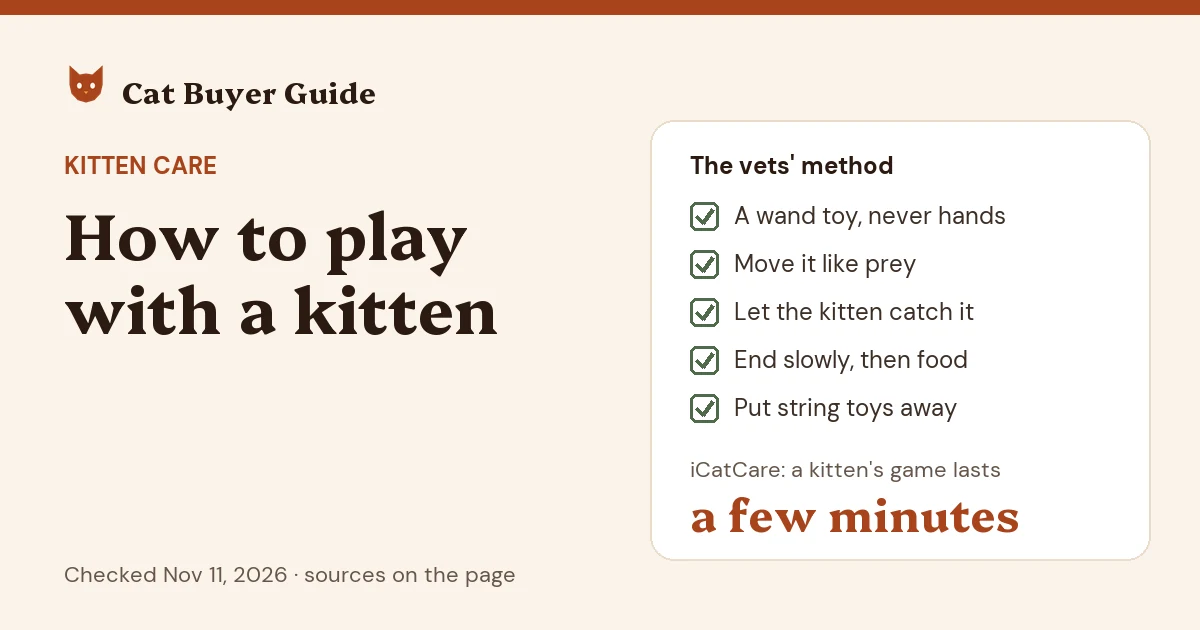
To play with a kitten, use a toy, not your hands. Move a wand toy the way prey moves, in quick, jerky runs along the floor or swoops through the air, and let the kitten stalk it, chase it, pounce and catch it. Keep each game short, play several times a day, and wind the game down slowly with a little food at the end. That is the advice of International Cat Care (iCatCare) and of the vet guidelines from the AAFP and ISFM.
We built this guide from those sources, the AAHA/AAFP life stage guidelines and the Cornell Feline Health Center, all checked on November 11, 2026. We don’t own a cat; nothing here is from our own experience.
The short answer
- Use a toy, never hands or feet. A kitten that learns fingers are toys can injure people as its teeth and claws grow (iCatCare, AAHA/AAFP).
- Move it like prey: jerky, random runs along the floor, or swoops like a bird (iCatCare, AAFP/ISFM).
- Let the kitten catch it. The catch is part of the hunt (AAFP/ISFM).
- Short and often. A kitten’s game may last only a few minutes (iCatCare).
- End slowly, then offer food, so the kitten doesn’t turn its leftover energy on your ankles (iCatCare).
- Put string and wand toys away after play (iCatCare, AAFP/ISFM).
Why play matters for a kitten
Play is how a kitten practices hunting. The AAHA/AAFP life stage guidelines say kittens have a high play drive and learn predatory behavior by watching, swatting, chasing, pouncing and catching. They add that play between cats peaks at around 12 weeks of age, and that play with objects becomes more common after that.
The AAFP/ISFM environmental needs guidelines count the chance to play and act out hunting among a cat’s five basic needs. Without it, they say, a cat can become overweight, or bored and frustrated, which can show up as overgrooming, stress-related illness or aggression aimed at the wrong target. iCatCare calls play an essential part of a kitten’s development, and says play together can help build the bond between a kitten and its owner.
How to play with a kitten, step by step
1. Pick a moment when your kitten wants to play. iCatCare lists the signs: playing with objects on its own, sudden darting movements, eyes fixed on something, a crouched stalking posture with the head low, and a burst of energy. Cats are often most active around dawn and dusk (iCatCare).
2. Use a wand toy. iCatCare says wand toys, also called fishing rod toys, are a good choice for kittens because they keep some distance between you and the kitten, which helps prevent accidental scratches and bites. Lures such as toy mice, feathers or toy worms are especially attractive to kittens (iCatCare). Our guide to cat toys for kittens compares five toys of different kinds.
3. Move it like prey. The AAFP/ISFM guidelines describe two patterns: a bird swooping through the air, or a mouse moving in straight lines quickly away from the cat. iCatCare suggests jerking, random movements, and moving the toy across the floor at different speeds to catch the kitten’s eye.
4. Add cover. iCatCare says play is even more stimulating for a kitten if you pull the toy through or around boxes or tunnels.
5. Let the kitten catch it. The guidelines say to let the cat catch the toy on the end of the wand, to simulate a capture. A game with no catch can frustrate a cat: iCatCare gives the laser pointer as the example, and says to finish a laser game with a wand toy the cat can catch.
6. Wind down, then offer food. iCatCare says to end a play session gradually and direct the kitten’s attention to something else, such as food, which helps prevent frustration and ambushes on people or other pets. The AAFP/ISFM guidelines suggest a treat after play. Count treats toward the day’s food; our guide on what to feed a kitten covers meals.
7. Put the wand away. iCatCare says to keep a wand toy out of reach when you aren’t playing, and the AAFP/ISFM guidelines say the same for any toy with string or parts a cat could swallow.
How long to play with a kitten
Not long at a time. iCatCare says a kitten’s play may last only a few minutes, because kittens can get bored and tire easily, though it depends on the kitten. It describes cats as “sprinters rather than marathon runners” in play: even one minute of frenzied activity is a good result.
None of the sources we read sets a number of minutes a day for a kitten. The AAFP/ISFM guidelines say only that kittens generally need play of greater intensity and duration than adult cats, and may enjoy longer, more interactive play with people. Go by your kitten rather than the clock.
How often to play with a kitten
Since each game may last only minutes (iCatCare), plan on several short games a day rather than one long one. The one number we found comes from the Feline Veterinary Medical Association (FelineVMA). Its guide to introducing cats says that a cat with lots of energy, in a home with other cats, should get two or more play sessions every day of at least 5 minutes each. It was written for introductions between cats, but it gives a sense of scale.
A kitten also plays without you. iCatCare suggests keeping two or three small toys and giving them one at a time, swapping them regularly so they stay new. The AAFP/ISFM guidelines and Cornell both advise rotating toys.
Play changes as a cat grows up. The AAFP/ISFM guidelines say that after social maturity, usually at 2 to 3 years, a cat may want less frequent and shorter play.
Picks from our kitten toys guide

A wand for play together: the Cat Dancer Cat Charmer, a fleece strip on a wand 65 inches long with the fabric, per Cat Dancer. Put it away after play. More in our kitten toys guide.

A kicker for rough play: the KONG Kickeroo Swirl, an 11.5-inch soft toy to grab and kick, per KONG. More in our kitten toys guide.

A food puzzle: the Catit Senses Treat Puzzle, a tray with six ways to work for treats or dry food, per Catit. More in our kitten toys guide.
Links to Amazon, chosen from the makers’ specs in our buyer’s guides. We haven’t tested them, and we may earn a commission if you buy.
Never play with your hands or feet
Three of our sources say this in almost the same words. iCatCare: never use your hands or feet to play with a kitten. It seems cute at first, but the kitten learns to link fingers and toes with playtime, and growing teeth and claws can cause pain and injury. The AAHA/AAFP guidelines say owners should be taught not to use hands or feet as toys, because cats learn that it is an appropriate way to play and it can lead to scratching or biting injuries. The AAFP/ISFM guidelines say to avoid hands and feet in any type of play.
If your kitten goes for your hand anyway, the sources point to a toy rather than a telling-off. iCatCare notes that some kittens enjoy larger soft toys they can rake and kick with their back legs. The AAHA/AAFP guidelines discourage punishment for unwanted behavior and encourage positive reinforcement.
How to play with a kitten without toys
“Without toys” shouldn’t mean with your hands. It can mean without store-bought toys. The sources name plenty of free ones:
- Cardboard boxes. iCatCare suggests a new box to explore two or three times a week.
- Paper bags and ping pong balls (iCatCare, Cornell). Cornell says safe, fun cat toys needn’t be expensive.
- A homemade food puzzle. iCatCare suggests a few dry treats in a paper bag or a cardboard egg box. It says kittens can be puzzle-fed from as early as twelve weeks, starting with something very simple, such as an open egg box.
- Food games. The AAFP/ISFM guidelines suggest hiding food in several places, scattering dry food, or tossing pieces of kibble for the cat to chase.
Toys and games to avoid
- String, ribbon, wool and pipe-cleaner toys. iCatCare says to avoid them with kittens: if eaten they can make the intestines bunch up, which means emergency vet care and surgery.
- Small parts and bells. The AAFP/ISFM guidelines say to avoid toys with small parts a cat could swallow and bells, or to remove them before the cat plays unsupervised. Cornell warns about small pieces and strand-like parts, such as feathers and string, that can come off when chewed, and anything with an electrical cord.
- Toys that are the wrong size. The guidelines say kittens should have toys and puzzle feeders of a suitable size, to prevent injury.
- A laser with no ending. Finish with a toy the kitten can catch (iCatCare).
- A risky play area. Cornell says to make sure nothing heavy can fall on a cat in the middle of a game, and that there’s nowhere it could fall from.
The feather question shows why wands are for play together: iCatCare and the guidelines recommend feather lures, while Cornell warns that feathers can come off and be swallowed. Use them with you there, and put them away afterwards.
Talk to your vet
- If you think your kitten has swallowed string, ribbon, a feather or part of a toy, call your vet right away. iCatCare says swallowed string can need emergency surgery.
- If a playful kitten suddenly stops playing or seems low on energy, tell your vet. The AAHA/AAFP guidelines say changes in a kitten’s demeanor and activity level are important to note.
- Cornell recommends asking your vet if you’re unsure whether a toy is safe.
If you have another cat, or two kittens
The AAFP/ISFM guidelines say kittens generally have a greater need for play with other cats than adults do. In a home with more than one cat, they advise keeping toys in separate places and playing with each cat on its own, at separate times and places. iCatCare says the same: one cat may want to play far more than another. Our guide on how to introduce a kitten to a cat covers the first weeks.
FAQ
How long should I play with my kitten each day?
No vet group we read gives a daily total. iCatCare says a kitten’s game may last only a few minutes, and the AAFP/ISFM guidelines say kittens need more intense and longer play than adult cats. Several short games a day is a reasonable plan; FelineVMA suggests at least two sessions of 5 minutes or more for a high-energy cat living with other cats.
How often should I play with a kitten?
In several short sessions a day, and whenever it shows the signs of a playful mood: darting about, stalking, or staring at something (iCatCare).
Can I play with my kitten with my hands?
No. iCatCare, the AAHA/AAFP guidelines and the AAFP/ISFM guidelines all advise against using hands or feet in play.
Is a laser pointer OK for a kitten?
iCatCare says a laser lets a cat stalk, chase and pounce but never catch, which can frustrate it. If you use one, switch to a wand toy at the end so the kitten catches something.
Do kittens like catnip?
Not at first. iCatCare says kittens under three months don’t respond to catnip, and that older kittens may, so it’s worth offering again later.
What can I use if I have no cat toys?
A cardboard box, a paper bag, a ping pong ball, or a few dry treats in an open egg box (iCatCare, Cornell). Skip string, ribbon and wool.
Sources
- International Cat Care: Playing with your cat (updated Sept. 26, 2025), checked Nov 11, 2026
- AAFP and ISFM: Feline Environmental Needs Guidelines (Ellis et al., J Feline Med Surg 2013, PDF), checked Nov 11, 2026
- AAHA and AAFP: Feline Life Stage Guidelines (2021, full text on PubMed Central), checked Nov 11, 2026
- Cornell Feline Health Center: Safe toys and gifts, checked Nov 11, 2026
- FelineVMA: Step-by-Step Guide: How to Introduce a New Cat to Other Cats in Your Home (2026, PDF), checked Nov 11, 2026