Where Should a Kitten Sleep? The First Night and After

Built from dated data and expert sources, not hands-on pet testing. Facts and prices checked November 16, 2026. We may earn a commission if you buy through links on this page. It never changes what we recommend. As an Amazon Associate we earn from qualifying purchases. How we research
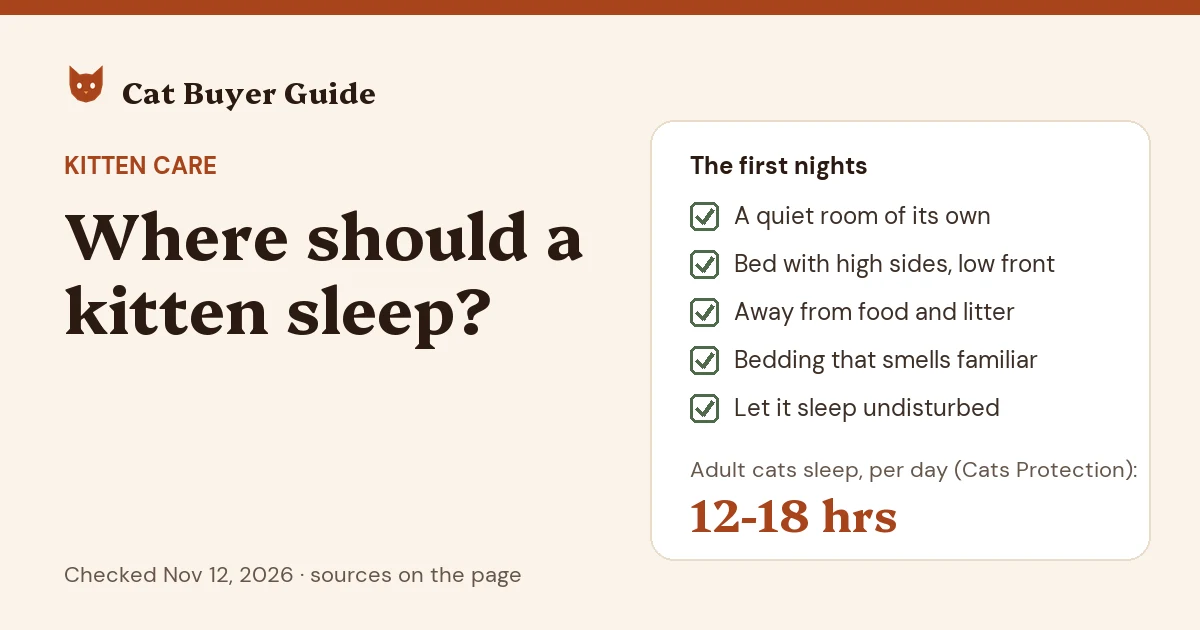
On the first night, a kitten should sleep in its own quiet room, with a bed, food, water and a litter box all within reach. That is the advice of both Cats Protection and International Cat Care (iCatCare), two cat welfare charities. Once the kitten has settled into your home, where it sleeps is mostly up to the kitten and to you: a bed with sides in a warm, quiet spot, a perch up high, or your own bedroom.
This guide is built from those two charities’ published advice, checked on November 16, 2026. We don’t own a cat, so nothing here is first-hand experience.
The short answer
- First night: in its own quiet room with everything it needs, door closed (Cats Protection, iCatCare).
- The bed: high sides to keep out drafts, a low front and a thick lining (iCatCare). A cardboard box lined with a blanket also works (Cats Protection).
- Where in the room: a quiet area away from the food, water and litter box (iCatCare).
- Something familiar: bedding that smells of the kitten’s first home, if you can get it (iCatCare).
- In your bedroom? Your choice, but Cats Protection warns it is rarely for one night only.
- Let it sleep. Kittens need a lot of sleep; don’t wake one to play (iCatCare, Cats Protection).
Where a kitten should sleep the first night
Both charities start a new kitten in one room. iCatCare says kittens in particular should be confined to one room at first, and Cats Protection calls it a sanctuary room: a small, quiet, escape-proof room with a door you can close, away from the busy and noisy parts of your home. A spare bedroom or a home office is the kind of room Cats Protection suggests.
Set the room up before you collect the kitten. Cats Protection’s list for it:
- the kitten’s bed;
- food and water bowls, placed apart from each other;
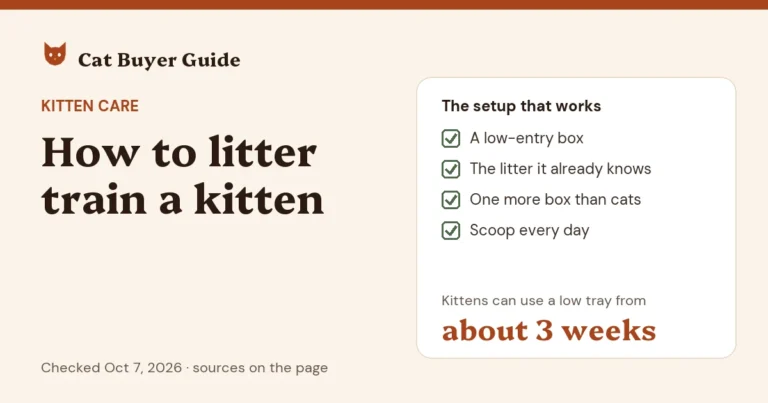
- at least one litter box, away from the food and water;
- several hiding places, and a safe high spot such as a shelf;
- a scratching post, toys and space to play;
- a blanket that smells familiar, if possible.
Then, on the first night, leave the kitten in that room with everything it needs. Cats Protection’s first-night advice, which it wrote for newly adopted cats of any age, is to give it somewhere to sleep, such as a cat bed or a cardboard box lined with a sweater or blanket, and not to be offended if it picks a completely different spot. A new cat will sleep wherever it feels most comfortable.
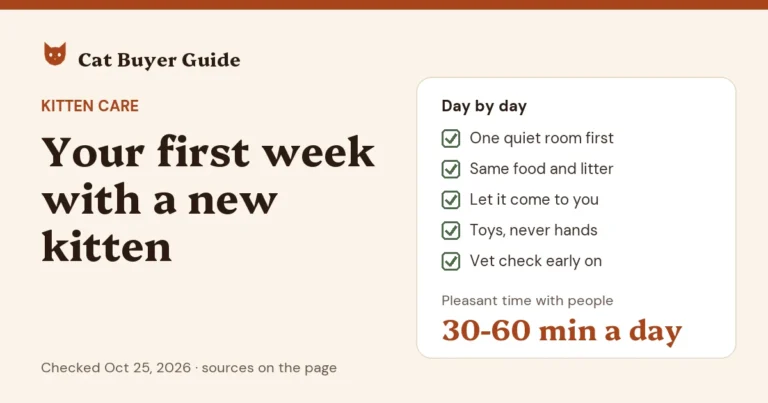
iCatCare adds that the carrier can stay in the room as a safe place to retreat to, and that the first twenty-four hours should be calm and quiet. Our first week with a new kitten guide covers the rest of that first day.
What kind of bed, and where to put it
iCatCare describes the bed that helps a kitten settle at night: high sides to keep out drafts, a low front so the kitten can get in easily, and a thick lining to keep it warm and comfortable. The bed and its bedding should be washable.
| What to do | Why | Source |
|---|---|---|
| High sides, low front, thick lining | Keeps out drafts, easy to get into, warm | iCatCare |
| Quiet area, away from food, water and litter | Cats like to sleep away from where they eat and toilet | iCatCare, Cats Protection |
| Out of drafts, not too close to a heater | Not too cold and not too warm | Cats Protection |
| Away from noisy appliances and busy hallways | So the kitten can rest undisturbed | Cats Protection |
| A place to hide as well | Hiding helps cats feel safe | Cats Protection, iCatCare |
| Bedding from its first home | A familiar smell when everything else is new | iCatCare |
A box counts. Both charities suggest a cardboard box on its side with a thick, soft blanket inside. It gives a kitten a bed and a hiding place in one.
Bring the smell of home. iCatCare recommends bringing the kitten home with some of its bedding, if the breeder or shelter can spare it, and putting it in the kitten’s bed or box. Cats Protection suggests a swap a few days ahead: leave a blanket or a piece of clothing that smells of you with the kitten, and bring home a cloth that smells of the kitten to rub over the things in its room.
Tidy the cords. Cats Protection’s safety list for a kitten’s home includes tidying away or covering loose cables and wires. Keep that in mind for anything plugged in near the bed.
Beds from our cat bed guide

A bed to hide in: the K&H Thermo-Pet Cave is a hooded bed, 17 by 15 by 13 inches, that is machine washable once its warmer is taken out, per K&H. iCatCare says cats love warm beds they can hide away in. More in our cat bed guide.

High walls: the K&H Thermo-Kitty Bed has 6-inch foam walls and a 4-watt heater you can remove, per K&H. With a kitten, keep the cord tidied away, or use the bed without the heater at first. More in our cat bed guide.

No cord: the Best Friends by Sheri Calming Donut, 23 inches across, has a raised rim, and the maker says the whole bed can go in the washer. More in our cat bed guide.
Links to Amazon, chosen from the makers’ specs in our buyer’s guides. We haven’t tested them, and we may earn a commission if you buy.
If your kitten cries at night
Cats Protection’s first-night advice gives three things to check, in this order:
- Can it reach everything? Make sure the kitten can get to its food, water and litter box. It may be telling you it can’t.
- Does it want company? See whether it comes to you for attention. If a little fuss settles it, but it starts again when you leave, you could let it follow you and sleep in your bedroom.
- Is it just unsettled? If neither is the cause, the kitten may be telling you it doesn’t feel at home yet. Cats Protection calls this completely natural and says the meowing should stop once the cat feels more comfortable.
To help a new cat feel calmer, Cats Protection suggests somewhere to hide, something that smells familiar, a predictable routine, and moving quietly and slowly around it. It also lists a plug-in pheromone diffuser as an option.
Should a kitten sleep in your bedroom or your bed?
After the first nights, that is your decision. Neither charity sets a rule against it. iCatCare says many cats are content with their owner’s bed, chairs or sofas, and that you may find your cat’s favorite bed is yours.
The warning from Cats Protection is about habit. If you let a crying kitten into your bedroom, “it’s rarely ‘just for tonight’!” If you don’t want a cat on your bed every night, it advises setting up the kitten’s own bed elsewhere and keeping your bedroom door closed from the start.
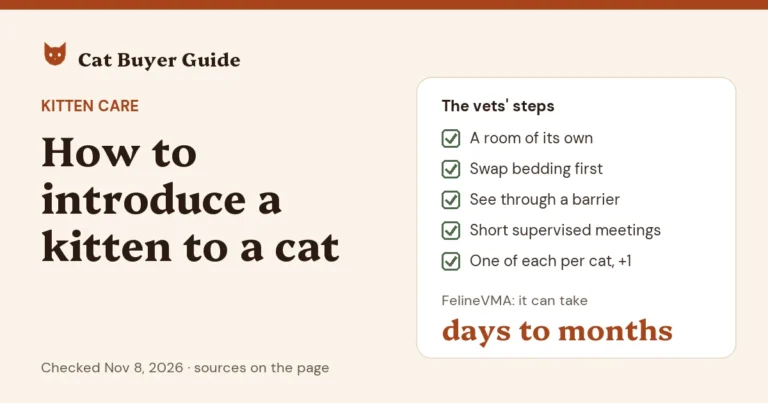
Whichever you choose, the kitten still needs to reach its litter box, food and water during the night. And if you have another cat, the new kitten sleeps in its own room until they have been properly introduced; our guide on how to introduce a kitten to a cat has the steps.
Where a kitten sleeps once it has settled
How long a new cat stays in one room depends on the cat, Cats Protection says: a confident one may be ready within a few hours, and others take several days or a couple of weeks. Once your kitten has the run of more rooms, it will choose its own sleeping places, and it will change them. Cats Protection says cats rotate their sleeping spots, and suggests several beds around the home.
- Up high. iCatCare says cats feel safer higher up, and that where a bed sits can matter more than its shape or fabric. iCatCare suggests beds on shelves or on top of cupboards; a cat tree platform is another raised spot. Cats Protection adds that a high spot should still be easy to reach.
- Warm and quiet. A sunny spot or a place near a heat source in a cool home, out of drafts (iCatCare, Cats Protection).
- Left alone. If you have children, Cats Protection says to give the kitten a room or area where it can go to be left alone.
- Check on it. Kittens may hide or sleep in unexpected places, so Cats Protection suggests checking on them regularly during the day.
How much kittens sleep, and night-time play
Domestic cats sleep about 12 to 18 hours a day, Cats Protection says, and kittens are likely to sleep more than the average adult cat because so much of their energy goes into growing. A kitten may play hard and then suddenly fall asleep.
Don’t wake a sleeping kitten for play or affection; both charities say to let it rest undisturbed. Keeping a cat awake in the day so that it sleeps at night won’t work either, Cats Protection says, and only distresses the cat.
What does help is routine. iCatCare says cats are naturally more active at dawn and dusk, but a kitten can soon learn to fit its sleeping pattern to your household if you set routines from the first day. Our guide on how to play with a kitten covers play sessions.
Talk to your vet
- Sleeping much more than usual, or hiding more. Cats Protection says to check with your vet to make sure there is no underlying medical problem.
- Crying that worries you. If a new kitten’s night-time crying doesn’t ease as it settles, or you are worried, ask your vet for advice (Cats Protection).
- Not eating or using the litter box. iCatCare says a very anxious new cat may do neither in its first twenty-four hours; if that carries on beyond then, speak to your veterinary team.
FAQ
Where should a kitten sleep at night?
For the first nights, in its own quiet room with its bed, food, water and litter box. After it has settled, anywhere warm, quiet and safe that it can reach its litter box from: its own bed, a perch, or your bedroom if you choose.
Should I leave my kitten alone on the first night?
Yes, that is what Cats Protection advises: leave the new cat in its room with everything it needs. If it cries, check that it can reach its essentials, then whether it wants company.
Can my kitten sleep in my bed?
Neither charity sets a rule against it, and iCatCare notes many cats end up preferring their owner’s bed. Cats Protection’s caution is that it rarely stays a one-night arrangement, so decide before you start.
Should a kitten sleep in a crate or pen?
Neither charity recommends a crate for sleeping. iCatCare mentions a large crate only as something that may be useful when introducing a kitten to an adult cat, and recommends getting behavior advice first.
Should I leave a light on for my kitten?
Neither charity’s advice mentions a night light. What they do list for a new kitten’s nights are a warm bed with sides, a place to hide and bedding that smells familiar.
How long should a kitten sleep in one room?
It depends on the kitten. Cats Protection says a confident cat may be ready to explore within a few hours, while others need several days or a couple of weeks.
Sources
- Cats Protection: What to expect on the first night with your new cat (July 6, 2023), checked Nov 16, 2026
- Cats Protection: Bringing a new kitten home, checked Nov 16, 2026
- Cats Protection: Cats and sleep, checked Nov 16, 2026
- Cats Protection: Where do cats sleep? Create the perfect sleeping spot (March 15, 2019), checked Nov 12, 2026
- International Cat Care: Helping your new cat or kitten settle in, checked Nov 16, 2026
- International Cat Care: Preparing for your new cat or kitten, checked Nov 12, 2026
- International Cat Care: Making your home cat friendly, checked Nov 12, 2026