Best Cat Brush: What Vets and Cat Charities Advise, and 3 Picks (2026)

A buyer's guide built from specifications, warranties and return policies, not hands-on testing. Facts and prices checked November 17, 2026. We may earn a commission if you buy through links on this page. It never changes what we recommend. As an Amazon Associate we earn from qualifying purchases. How we research
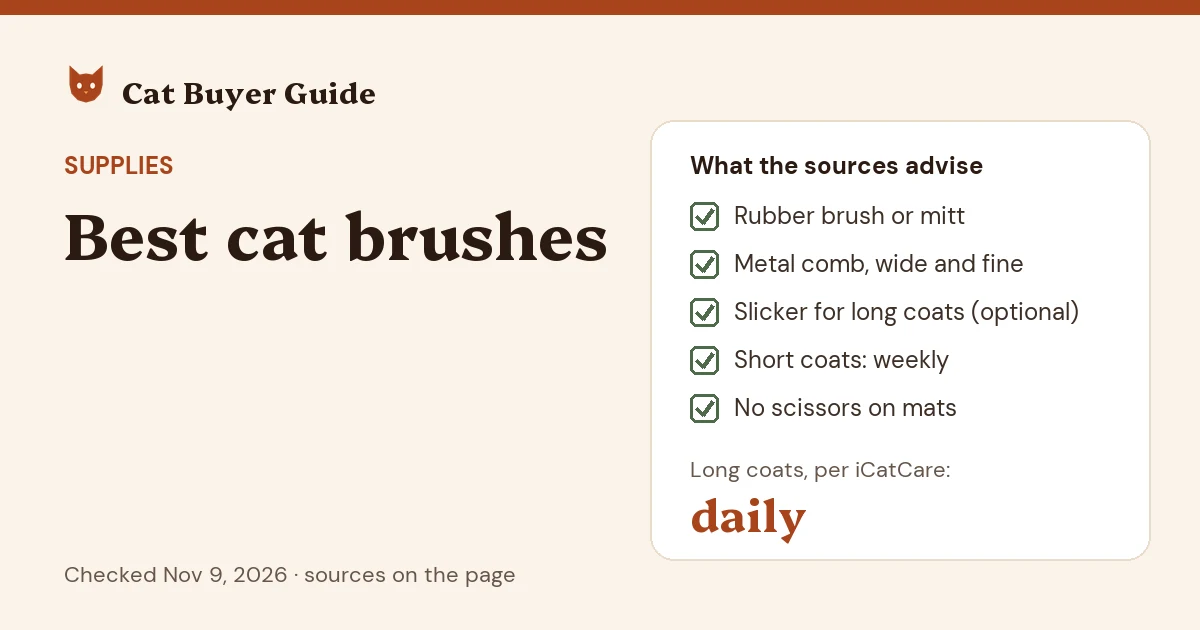
The best cat brush depends on your cat’s coat. For a short-haired cat, International Cat Care (iCatCare) suggests a fine-toothed comb, a bristle brush and a rubber grooming pad or mitt; the ASPCA names a metal comb and a rubber brush. For a long-haired cat, iCatCare’s kit is a wide-toothed comb and a rubber pad, used every day. Slicker brushes and rakes are an option for long coats, iCatCare says: pick whatever your cat accepts with the least stress.
This is a buyer’s guide built from that advice and from the makers’ published specifications and return policies, checked on November 17, 2026. It is not a hands-on test: we don’t own a cat and haven’t bought or tried any of these tools.
The short answer
- Any coat: a rubber brush to lift loose hair, such as KONG’s Cat ZoomGroom (iCatCare, ASPCA).
- A metal comb with wide and fine teeth, such as the Andis 7.5-inch steel comb: wide for long coats, fine for short ones (iCatCare, ASPCA).
- Long coats, if your cat accepts it: a slicker, such as the Safari Cat Soft Slicker Brush (iCatCare lists slickers as an option).
- How often: short coats at least once a week, long coats daily (iCatCare).
- Never cut out mats with scissors (iCatCare).
What vets and cat charities say a cat brush should do
Cats groom themselves for much of the day, but they still swallow loose hair, and that’s where hairballs come from. iCatCare says brushing your cat, especially while it’s shedding, removes most of that hair for it and can prevent hairballs. The ASPCA adds that brushing removes dirt, grease and dead hair and helps the skin, and that it matters more as a cat ages and grooms less well on its own.
| Coat | What to use | How often | Source |
|---|---|---|---|
| Short | Fine-toothed comb, bristle brush, rubber pad or mitt | At least weekly | iCatCare |
| Short | Metal comb; a rubber brush for dead hair | Once or twice a week | ASPCA |
| Long | Wide-toothed comb, rubber pad or mitt | Daily | iCatCare |
| Long | Comb; a mat-splitter for knots fingers can’t undo | Every few days | ASPCA |
Short coats. iCatCare suggests checking for flea dirt with a fine-toothed flea comb first, then brushing head to tail in the direction the hair grows, and finishing with the rubber pad or mitt to lift the loose hair. The ASPCA works a metal comb through the coat from head to tail, and says a rubber brush is especially good at removing dead hair on short-haired cats.
Long coats. iCatCare says to use a wide-toothed comb from head to tail, with extra care under the “armpits” and between the hind legs, where the skin is thin and very sensitive and where mats often form. Then a rubber pad or mitt removes more dead hair. It mentions rakes, slickers and detangling sprays as products some owners use with long coats, and leaves the choice to whatever works for you and your cat with the least stress.
Mats. Tease a mat apart gently with your fingers, from the root to the tip, iCatCare says, and don’t use scissors: in a matted coat it’s very hard to see where the skin ends, and you could cut your cat. The ASPCA suggests a mat-splitter for knots your fingers can’t undo. Severe mats are a job for your vet (see below).
Go at your cat’s pace. iCatCare says a cat should never be groomed by force, and it lists signs to stop: skin rippling, a swishing or thumping tail, turning sharply toward the brush, freezing, ears flicking back, licking lips, growling or hissing. Keep sessions short, end on a good note with treats, and start a new kitten slowly.
Three cat grooming tools that meet the criteria
We picked one tool for each job the sources describe, and left out the rest. Prices change, so we don’t show them; the links go to Amazon and to the makers’ own pages.
| Pick | Type | What the source advice says it’s for | Coats |
|---|---|---|---|
| KONG Cat ZoomGroom | Rubber brush | Lifting loose, dead hair | Short and long |
| Andis 7.5-inch steel comb | Metal comb, coarse and fine teeth | Combing through, checking for knots | Short and long |
| Safari Cat Soft Slicker Brush | Slicker | An optional tool for long coats | Long (and short) |
1. Best rubber brush: KONG Cat ZoomGroom
A soft, flexible rubber brush made of thermoplastic elastomer (TPE), 2.75 x 1.25 x 4.5 inches (KONG). It’s the kind of rubber brush the ASPCA says is especially effective for dead hair on short coats, and iCatCare’s rubber pad step for both coat types. KONG says it works for all cats and coat types and can be used at bath time too.
- Returns (direct orders): KONG takes back undamaged products in their original packaging within 60 days of purchase from KONG; that policy doesn’t cover products bought from other retailers. Check the return terms where you buy.
Best for: a short-haired cat, and the last step of a long-haired cat’s session.
Watch out for: KONG’s own warning to stop using it if it’s damaged and to see a vet if any is swallowed. Put it away after grooming.
 See the KONG Cat ZoomGroom on Amazon · KONG’s own Cat ZoomGroom page
2. Best comb: Andis 7.5-inch stainless-steel comb (65730)
A 7.5-inch stainless-steel comb with coarse teeth at one end and fine teeth at the other, according to its Amazon listing, which also says it’s for knots, mats and loose hair, safe for dogs and cats, and suited to short and long coats. That covers both of the sources’ combs: the wide teeth for iCatCare’s long-coat routine, the fine teeth for the ASPCA’s metal-comb pass on a short coat. We found no product page for this comb on Andis’s own website, so the details come from the Amazon listing.
Best for: any coat, as the one comb to own; and for finding knots early in a long coat.
Watch out for: the fine end is not a flea comb. iCatCare’s short-coat routine starts with a fine-toothed flea comb to check for flea dirt; if you want to check for fleas, add one.
 See the Andis 7.5-inch steel comb on Amazon
3. Best slicker for long coats: Safari Cat Soft Slicker Brush
A slicker brush with stainless-steel pins and a comfort-grip handle, 6.5 x 3.5 inches. Coastal Pet, which makes the Safari line, says it reduces shedding and removes mats and tangles, and Amazon’s listing says it’s for short and long hair. iCatCare lists slickers among the products some owners use on long coats.
Best for: a long-haired cat that’s used to being groomed, between comb sessions.
Watch out for: fine metal pins on thin skin. iCatCare warns that the skin under the legs is very thin and sensitive, so brush gently there, and stop if your cat shows any of the signs above. Coastal’s own site listed this brush as out of stock when we checked; Amazon listed it as in stock.
 See the Safari Cat Soft Slicker Brush on Amazon · Coastal Pet’s own Soft Slicker page
What we left out, and why
- Deshedding blades and “undercoat” tools. Neither iCatCare nor the ASPCA names them, so we had no source advice to judge them against.
- Scissors for mats. iCatCare says not to use them.
- A flea comb. iCatCare recommends one for short coats, but we didn’t find a cat flea comb whose maker page and US Amazon listing we could match on November 9.
- Bathing products. iCatCare says a healthy cat needs no bath, and most cats don’t tolerate it well.
When grooming is a job for your vet
Talk to your vet
- Severe mats: iCatCare says these often need to be shaved off by your veterinary team, frequently under sedation or anesthesia. Don’t try to cut them out.
- Flea dirt: if the comb finds it, iCatCare says to ask your veterinary team about flea control.
- Hairballs that keep coming despite regular brushing: the ASPCA says to ask your vet for a remedy.
- Lumps, wounds, bald patches or skin problems you find while brushing: the ASPCA treats the skin as a sign of overall health, so show your vet.
Cat brush FAQ
What kind of brush is best for a short-haired cat?
A rubber brush, plus a comb. The ASPCA says a rubber brush is especially effective for dead hair on short coats and uses a metal comb; iCatCare adds a fine-toothed flea comb and a bristle brush.
What kind of brush is best for a long-haired cat?
Start with a wide-toothed comb and a rubber pad, daily (iCatCare). Some owners add a slicker or a rake; iCatCare says to use whatever your cat accepts with the least stress.
How often should I brush my cat?
Short coats at least once a week (iCatCare), or once or twice a week (ASPCA). Long coats daily (iCatCare), or every few days (ASPCA).
Does brushing help with hairballs?
Yes, says iCatCare: brushing removes loose hair your cat would otherwise swallow. If hairballs continue despite regular brushing, the ASPCA says to ask your vet.
My cat hates being brushed. What can I do?
Stop at the first sign of discomfort, keep sessions short, reward calm behavior with treats and try again another day (iCatCare). Never hold a cat down to groom it. Starting young helps, so our new kitten checklist puts a brush on the list from day one.
Sources
- International Cat Care: Grooming your cat (updated Sept. 26, 2025), checked Nov 17, 2026
- ASPCA: Cat Grooming Tips, checked Nov 17, 2026
- KONG: Cat ZoomGroom (product page) and Shipping & Returns, checked Nov 17, 2026
- Coastal Pet: Safari Cat Soft Slicker Brush (product page), checked Nov 17, 2026
- Amazon listing: Andis 65730 Stainless-Steel Comb, 7-1/2 inch (no maker product page found), checked Nov 17, 2026