What Does Cat Insurance Cover (and What It Doesn’t)?

Built from dated data and expert sources, not hands-on pet testing. Facts and prices checked October 11, 2026. No affiliate links on this page. How we research
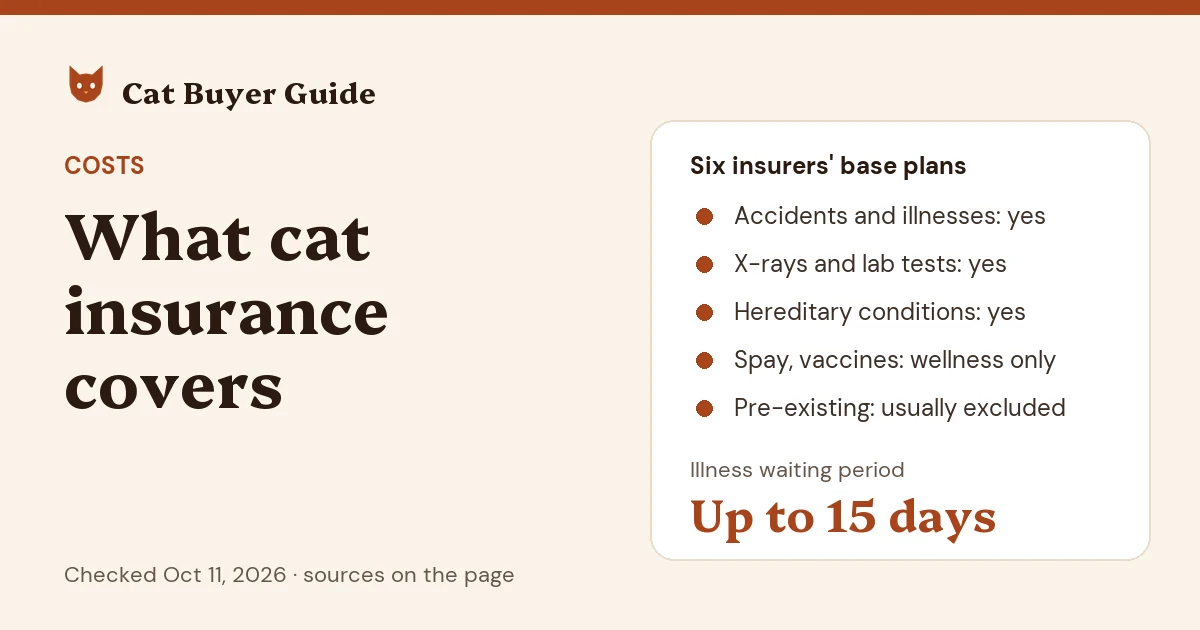
What does cat insurance cover? A standard accident-and-illness policy pays back part of your vet bill when your cat is hurt or gets sick: emergency care, tests such as X-rays and bloodwork, surgery and hospital stays. Most insurers also cover hereditary conditions, prescription drugs and dental disease, though the rules differ. It doesn’t cover anything your cat had before coverage began, or routine care: vaccines, checkups, spaying or neutering and teeth cleaning. Those are paid only through a wellness add-on, where an insurer sells one.
On Oct 11, 2026 we read the coverage pages of six insurers (Embrace, Fetch, Lemonade, Pets Best, Pumpkin and Spot), the sample policies of four of them, and the state regulators’ Pet Insurance Model Act. For prices, see how much cat insurance costs.
The short answer
- Usually covered: accidents, illnesses, hereditary and congenital conditions, X-rays and lab tests, surgery and hospital care. All six insurers include these in the base plan.
- Usually not covered: pre-existing conditions, vaccines, checkups, spaying or neutering, routine dental cleaning, cosmetic procedures and breeding.
- Depends on the insurer: exam fees, prescription drugs, dental illness, behavioral therapy and acupuncture.
- Wellness add-ons pay set amounts toward routine care. Embrace and Pumpkin sell them as separate plans they say aren’t insurance; at Fetch, Lemonade, Pets Best and Spot they’re added to the policy.
We’re not an insurance agent
Cat Buyer Guide isn’t a licensed insurance agent or broker, and we don’t sell insurance. This page is general information, not advice on which policy to buy, and we don’t rank insurers. Terms vary by state and change often: the policy you’re offered is what counts. We have no affiliate links on this page.
On this page
- What six insurers cover for cats
- Dental: illness versus cleaning
- Spaying, neutering and kitten vaccines
- Pre-existing conditions: curable and incurable
- Waiting periods, age limits and the first vet exam
- What the law says: the NAIC Pet Insurance Model Act
- How reimbursement works: one example
- Questions to ask before you buy
- How we checked
- FAQ
What six insurers cover for cats
What each insurer’s own pages and sample policy said on Oct 11, 2026, for its standard accident-and-illness plan:
| Coverage | Embrace | Fetch | Lemonade | Pets Best | Pumpkin | Spot |
|---|---|---|---|---|---|---|
| Accidents | Yes | Yes | Yes | Yes | Yes | Yes |
| Illnesses | Yes | Yes | Yes | Yes | Yes | Yes |
| Hereditary, congenital | Yes | Yes | Yes | Yes | Yes | Yes |
| X-rays and lab tests | Yes | Yes | Yes | Yes | Yes | Yes |
| Prescription drugs | Option | Yes | Yes | Take-home: option | Yes | Yes |
| Sick-visit exam fees | Option | Yes | Add-on | Option | Yes | Yes |
| Dental illness | Yes, to $1,000/yr | Yes | Add-on | Limited | Yes | Yes |
| Behavioral therapy | Yes | Yes, to $1,000/yr | Add-on | Limited | Yes | Yes |
| Acupuncture, rehab | Yes | Yes | Add-on | Option | Yes | Yes |
| Routine dental cleaning | Wellness | Wellness | Wellness or add-on | Wellness | Wellness | Wellness |
| Spay or neuter | Wellness | Wellness | Wellness | Wellness | Wellness | Wellness |
| Vaccines | Wellness | Wellness | Wellness | Wellness | Wellness | Wellness |
| Wellness plan is | Not insurance | Part of policy | Part of policy | Part of policy | Not insurance | Part of policy |
“Yes” means it’s in the base plan. “Option” and “Add-on” mean it’s covered only if you add it. “Wellness” means only a wellness plan pays toward it, at extra cost.
Pets Best’s limits: in its Texas sample policy, gum disease is covered only for extractions and root canal work on the canine and carnassial teeth, and behavioral cover is limited to vet consultations and prescriptions, if you bought those options. Drugs given in the clinic are covered; take-home prescriptions are an option. (Fetch’s behavioral benefit, by contrast, has no deductible.)
Dental: illness versus cleaning
Insurers split dental care in two. Dental illness, such as gum disease, tooth resorption or an abscess, is covered like any other illness by Embrace (up to $1,000 a year), Fetch (all adult teeth and the gums), Pumpkin and Spot, though Spot’s Illinois sample excludes root canals and crowns. Lemonade covers a broken tooth in its base plan, but dental illness needs an add-on with its own $1,000 yearly limit.
A routine cleaning isn’t covered by any of the six base plans. Embrace’s sample policy is blunt: “Dental prophylaxis procedures are not covered by this policy,” even when treating dental illness. Embrace, Fetch and Pets Best also exclude dental disease if signs such as gingivitis or tartar appear before coverage starts or during the waiting period. The exception we found: in some states, Lemonade’s Dental Care add-on covers cleanings and even pre-existing dental conditions.
For cleanings, look at wellness plans: Lemonade’s Preventative+ pays up to $150 a year, and Fetch, Embrace and Pumpkin list cleanings in theirs. Pets Best’s BestWellness and Spot’s Platinum add-on pay from a $150 yearly amount shared with spay or neuter.
Spaying, neutering and kitten vaccines
None of the six covers spaying, neutering or vaccines in its accident-and-illness plan; they class them as routine, preventive or elective care. Only a wellness plan pays toward them:
| Wellness plan | Spay or neuter | Vaccines |
|---|---|---|
| Fetch Wellness | Up to $250 | Yes, FVRCP listed |
| Lemonade Puppy/Kitten | Yes, pets under 2 | Up to 6 |
| Pets Best BestWellness | $150, shared with cleaning | Yes, FVRCP listed |
| Spot Platinum | $150, shared with cleaning | FVRCP up to $25 |
| Embrace Wellness Rewards | From a yearly $300, $500 or $700 | Yes |
| Pumpkin Wellness Club | Spay/neuter or a cleaning | Yes |
At Spot and Pets Best, a kitten’s spay can use up the year’s cleaning money. And a spay done for medical reasons isn’t automatic: Pets Best’s Texas sample excludes it unless your vet recommends it after a condition damaged the reproductive organs, and both Pets Best’s and Embrace’s samples exclude surgery for a retained testicle (cryptorchidism).
Insurance won’t pay for shots, but skipping them can cost you coverage. Fetch’s Texas sample won’t pay for feline viral rhinotracheitis, calicivirus, panleukopenia or feline leukemia if a vaccine your vet recommended would have prevented it. Pets Best’s asks you to keep cats vaccinated against leukemia, panleukopenia and rabies or risk denied claims, and Embrace’s excludes illnesses whose recommended vaccine you declined.
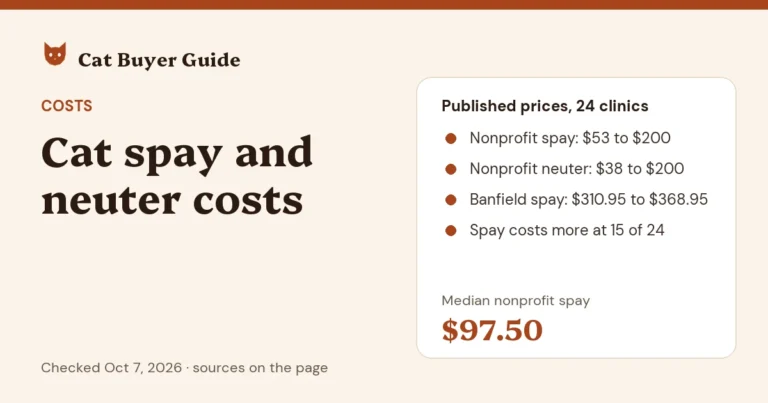
For costs and timing, see what a spay or neuter costs, when to spay or neuter a cat and the kitten vaccination schedule.
Talk to your vet
- Ask which vaccines your kitten needs and when. Some policies won’t pay for a disease a recommended vaccine would have prevented.
- Ask about spay or neuter timing, and whether your kitten’s teeth or gums show any problem now. Anything noted before coverage starts can be excluded later.
- Your vet decides your cat’s treatment, not the insurer. Keep copies of every record.
Pre-existing conditions: curable and incurable
All six insurers exclude pre-existing conditions. The model act’s definition, which Embrace, Fetch, Pets Best and Spot use in their samples, covers any condition your cat got vet advice or treatment for, or showed signs of, before the policy started or during a waiting period.
Some will cover a curable condition later if it stays away:
- Embrace: after 12 consecutive months with no symptoms or treatment. Its incurable list includes urinary crystals or blockages, diabetes, thyroid disease, cancer and allergies.
- Fetch: after a year symptom-free, for conditions such as urinary tract infections and upper respiratory infections. Its Texas sample also requires a vet exam after that year.
- Pumpkin and Spot: after 180 days with no symptoms or treatment, except knee and hind-leg ligament problems at Pumpkin, and knee, ligament and chronic conditions at Spot.
- Pets Best: a healed or cured condition is no longer pre-existing; no time period is stated.
- Lemonade: only in some states, for example after 12 consecutive months.
Bilateral conditions, which can affect both sides of the body, are a trap: if one side, such as one knee, shows signs before coverage starts (at Embrace, also in the first 180 days), Embrace, Fetch, Lemonade and Spot won’t cover the other side either. Embrace, Fetch and Lemonade give the same advice: enroll while your kitten is young and healthy.
Waiting periods, age limits and the first vet exam
| Insurer | Accidents | Illnesses | Knee or orthopedic | Kittens from |
|---|---|---|---|---|
| Embrace | None | 14 days | Varies by state | 6 weeks |
| Fetch | None | Up to 15 days | 6 months | 6 weeks |
| Lemonade | None | 14 days | 30 days | 2 months |
| Pets Best | 3 days (TX) | 14 days (TX) | 6 months, cruciate (TX) | 7 weeks |
| Pumpkin | Up to 14 days | Up to 14 days | Up to 14 days | 8 weeks |
| Spot | 14 days (IL) | 14 days (IL) | 14 days (IL) | Not stated |
“(TX)” and “(IL)” mark figures from Texas and Illinois sample policies; Pets Best says its waiting periods vary by state. Embrace, Fetch, Pets Best, Pumpkin and Spot set no upper age limit; the Lemonade pages we read don’t say. Fetch covers knees sooner if a vet exam within 180 days finds no knee problem, and Embrace’s sample drops the illness wait after a clean vet exam.
Some insurers need a recent vet record, which matters for a new kitten:
- Embrace: an exam in the 12 months before the start date or within 14 days after, or the policy becomes accident-only until there is one.
- Fetch (Texas sample): a first exam within 12 months before or 30 days after the start, at your expense. Anything noted at it is excluded.
- Lemonade: no exam before you buy, but it asks for records from the last 12 months if you have them, or from the first 14 days after you buy the policy if you don’t.
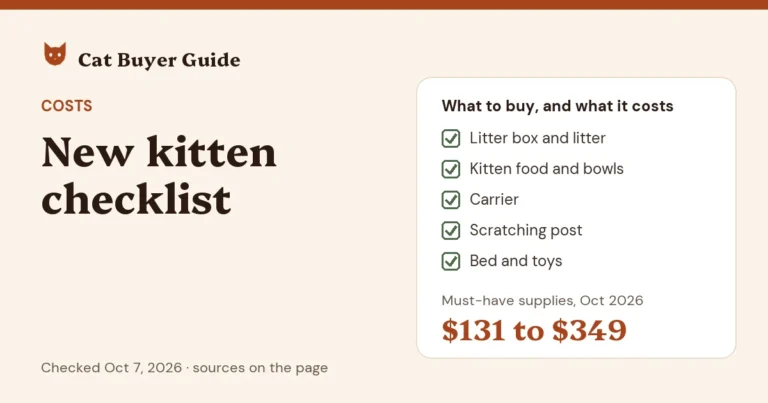
Fetch’s Texas sample has one kitten-friendly extra: for a cat you got within 30 days before the policy, it covers a short list of conditions that showed up in those 30 days, such as upper respiratory infection, conjunctivitis, feline herpesvirus, ear mites and ringworm, with no waiting period, if they’re noted at the first exam. Our new kitten checklist covers that first visit, and what age to adopt a kitten the first vaccines.
What the law says: the NAIC Pet Insurance Model Act
The National Association of Insurance Commissioners (NAIC), the group of state insurance regulators, adopted a Pet Insurance Model Act in 2022. It becomes law only where a state passes it. NAIC’s implementation report counted 16 jurisdictions that had adopted it as of March 9, 2026; your state insurance department can tell you whether yours is one. Where it applies, the act:
- defines pre-existing, chronic, hereditary, congenital and orthopedic conditions, and says a covered condition can’t become pre-existing at renewal;
- caps illness and orthopedic waiting periods at 30 days, says “Waiting periods for accidents are prohibited,” and lets a vet exam waive them;
- bars a vet exam as a condition of renewal, and gives you 15 days to return a new policy for a refund if you haven’t claimed;
- requires a separate short summary of the important policy terms, linked from the insurer’s website;
- says a separate wellness program must be disclosed as not insurance and can’t be required.
Not every sample we read meets those limits: Pets Best’s Texas sample has a 3-day accident wait and 6 months for cruciate ligament problems, and Fetch’s excludes orthopedic conditions that start in the first 180 days.
How reimbursement works: one example
Three settings decide what you get back: the deductible (what you pay before the insurer pays; a yearly amount at five of the six, and per policy period at Fetch), the reimbursement percentage and the annual limit (the most the policy pays in a year).
Pets Best’s Texas sample policy works through this example: a $2,000 vet bill, $100 of it not covered, 80% back, a $250 deductible not yet met.
- Covered charges: $2,000 − $100 = $1,900.
- 80% of $1,900 = $1,520.
- Minus the $250 deductible: $1,270 back. You pay $730.
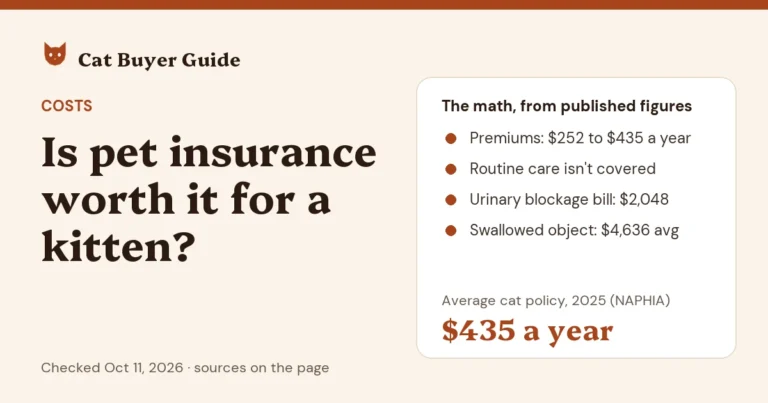
The order matters. Pets Best and Fetch apply the percentage first, then the deductible. Embrace’s and Spot’s samples take the deductible off first: ($1,900 − $250) × 80% = $1,320, $50 more on the same bill (our arithmetic). Anything not covered, such as an exam fee without exam-fee cover, or tax at Fetch and Spot, is yours. How these settings change the premium is in how much cat insurance costs; whether a policy makes sense is in is pet insurance worth it for a kitten.
Questions to ask before you buy
- Is this accident-and-illness, or accident-only?
- Are sick-visit exam fees and take-home prescriptions included, or extra?
- Which dental illness is covered, for which teeth, and up to what yearly amount?
- Is behavioral therapy covered, and is there a cap?
- What are the waiting periods for accidents, illnesses and knee problems, and can a vet exam shorten them?
- How do you define a pre-existing condition, and will you ever cover a cured one?
- Do you need a vet exam or records to start coverage, and by when?
- Which vaccines must my cat have to keep coverage for those diseases?
- Is the percentage applied before or after the deductible?
- Is the wellness plan insurance or a separate membership, and does spay/neuter share a limit with cleanings?
- How long do I have to file a claim? Fetch allows 90 days; Spot’s Illinois sample allows 270.
Read the sample policy before you buy. Most insurers link one by state in their site’s footer. Marketing pages are summaries; Fetch’s own pages say that in a conflict, “the provisions of the policy shall prevail.” Read the definitions, waiting periods, exclusions and deductible sections. If you change your mind, Embrace’s sample gives 15 days to return the policy, and Pets Best’s and Spot’s give a full refund within 30 days if no claim has been paid (at Spot, nor counted toward the deductible).
How we checked
- On Oct 11, 2026 we read six insurers’ own pages on coverage, dental care, wellness and waiting periods, and these sample policies: Embrace’s V6 terms (linked for every state but Kansas, New Mexico and South Carolina), Fetch’s and Pets Best’s Texas samples, Spot’s Illinois sample, and Fetch’s and Spot’s wellness endorsements. We filled in no quote forms.
- Trupanion, Healthy Paws and ASPCA Pet Health Insurance blocked automated access, so they aren’t here. Pumpkin’s sample policies sit behind a state menu we couldn’t open; its cells come from its cat page.
- Every cell, with its source’s exact wording, is in our data file.
Limits of this data
- Sample policies are written for one state and change over time. Yours may differ.
- Web pages and policies don’t always match: Pets Best’s site says most plans include exam fees, while its Texas sample sells them as an option. The table follows the policy where we had one.
- We plan to re-check this page about every 60 days.
FAQ
Does pet insurance cover spaying or neutering?
Not in an accident-and-illness plan. All six insurers we checked pay toward it only through a wellness plan: up to $150 at Spot and Pets Best (shared with teeth cleaning) and up to $250 at Fetch, for example.
Does pet insurance cover vaccines for kittens?
Only with a wellness plan. Lemonade’s kitten package covers up to six vaccines; Spot’s Platinum add-on pays up to $25 for FVRCP. At Fetch, Pets Best and Embrace, skipping a vaccine your vet recommends can cost you coverage for that disease.
Does pet insurance cover pre-existing conditions?
No. Some insurers will cover a curable condition after it stays clear: 180 days at Pumpkin and Spot, a year at Embrace and Fetch. Chronic conditions stay excluded.
Does pet insurance cover dental cleaning?
Not in the base plans we read. Wellness plans pay toward cleanings, such as up to $150 a year in Lemonade’s Preventative+, and Lemonade’s Dental Care add-on covers them in some states.
Is there cat insurance that covers dental?
Yes. Embrace (up to $1,000 a year), Fetch, Pumpkin and Spot cover dental illness in the base plan. At Lemonade it’s an add-on, and Pets Best’s Texas sample limits it.
Does cat insurance cover X-rays?
Yes, to diagnose or treat a covered accident or illness: all six insurers cover X-rays and lab tests in the base plan. Screening X-rays count as preventive care; Lemonade’s Routine Vet Care Plus, sold in some states, pays toward them.
Sources
- Our coverage data (what 6 insurers’ pages and sample policies say, with each source’s wording, collected Oct 11, 2026)
- NAIC: Pet Insurance Model Act (#633, adopted Summer 2022, PDF), checked Oct 11, 2026
- NAIC: State Implementation Report of NAIC-Adopted Model Laws, as of March 9, 2026 (PDF), checked Oct 11, 2026
- Embrace: Cat Insurance, checked Oct 11, 2026
- Embrace: Full Coverage Pet Insurance, checked Oct 11, 2026
- Embrace: Pet Health Insurance V6, sample policy terms, checked Oct 11, 2026
- Embrace: Pet Dental Insurance Coverage, checked Oct 20, 2026
- Embrace: Pet Insurance and Pre-existing Conditions, checked Oct 11, 2026
- Embrace: Wellness Rewards, checked Oct 11, 2026
- Embrace: Pet Insurance Waiting Periods, checked Oct 20, 2026
- Fetch: Pet insurance coverage, checked Oct 20, 2026
- Fetch: Cat insurance, checked Oct 11, 2026
- Fetch: Dental coverage, checked Oct 11, 2026
- Fetch: Pre-existing conditions, checked Oct 11, 2026
- Fetch: What is a waiting period for pet insurance?, checked Oct 20, 2026
- Fetch: Texas sample policy, form GPTM 050 1125 A (PDF), checked Oct 11, 2026
- Fetch: Texas sample Wellness endorsement, form GPTM 406 0125 A (PDF), checked Oct 11, 2026
- Lemonade: What is Pet Insurance Coverage and How Does It Work? (updated Aug 24, 2026), checked Oct 11, 2026
- Lemonade: Pet insurance waiting periods (updated Oct 13, 2026), checked Oct 20, 2026
- Lemonade: Preventative care options explained (updated Aug 19, 2026), checked Oct 20, 2026
- Lemonade: Pet insurance and pre-existing conditions (updated Jun 3, 2026), checked Oct 11, 2026
- Lemonade: How Much Does it Cost to Spay or Neuter a Cat? (updated Jun 3, 2026), checked Oct 11, 2026
- Pets Best: What Does Pet Insurance Help Cover?, checked Oct 11, 2026
- Pets Best: Cat Insurance, checked Oct 11, 2026
- Pets Best: Pre-existing conditions, checked Oct 11, 2026
- Pets Best: Routine care coverage, checked Oct 11, 2026
- Pets Best: Texas sample Accident and Illness policy, form IAIC-PB10001-ILL (PDF), checked Oct 11, 2026
- Pumpkin: Cat Insurance, checked Oct 11, 2026
- Pumpkin: Sample Plan (disclosures), checked Oct 11, 2026
- Pumpkin Wellness Club, checked Oct 11, 2026
- Spot: Cat Insurance, checked Oct 11, 2026
- Spot: Wellness, checked Oct 11, 2026
- Spot: Illinois sample Accident and Illness policy, form PET-P-20000-IL-1024 (PDF), checked Oct 11, 2026
- Spot: Platinum Preventive Care sample endorsement (PDF), checked Oct 11, 2026