Is Pet Insurance Worth It for a Kitten? The Math, the Fine Print and the Alternative

Built from dated data and expert sources, not hands-on pet testing. Facts and prices checked October 11, 2026. No affiliate links on this page. How we research
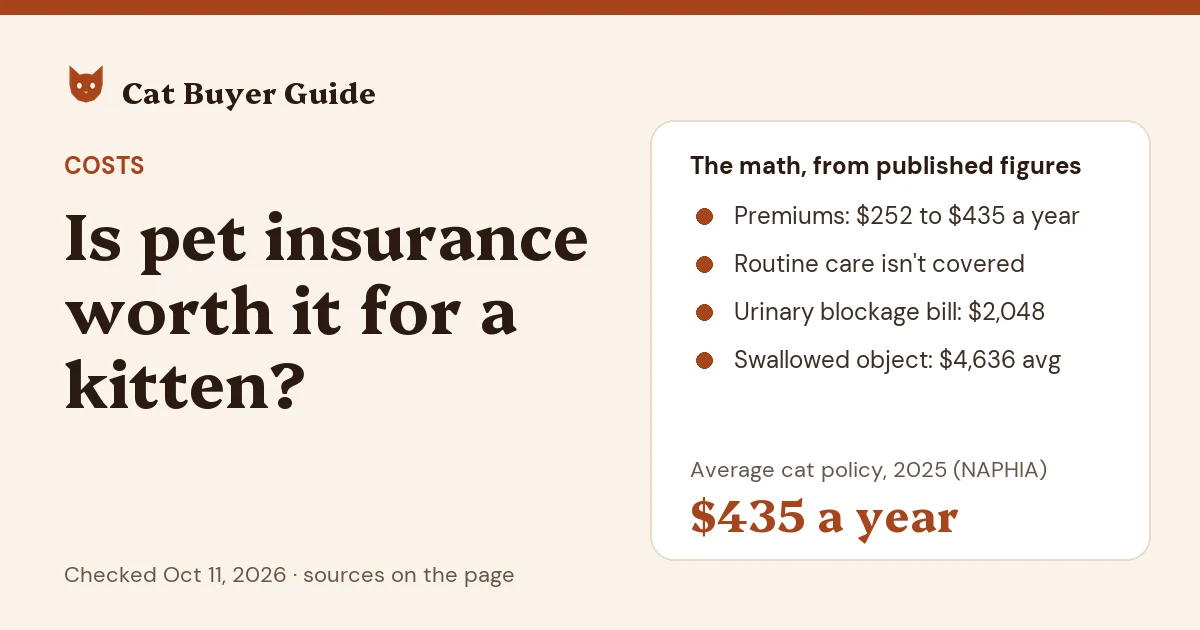
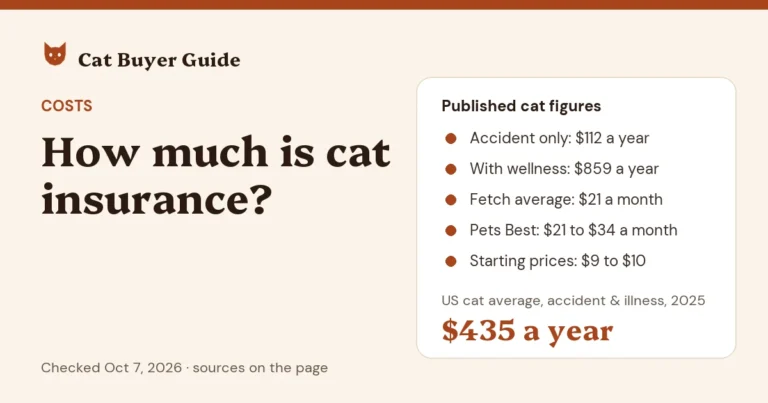
Is pet insurance worth it for a kitten? It depends on three things: whether you could pay a surprise vet bill of a few thousand dollars, what the policy leaves out, and when you buy. Published averages for a cat’s accident-and-illness policy run from $252 to $435 a year. A policy won’t pay for shots or spaying, and it won’t cover a problem that showed signs before coverage started. That last rule is why the question matters most while your kitten is young.
The short answer
- Insurance may be worth it if a bill of a few thousand dollars would be hard to pay. Insurers’ published cat figures for a urinary blockage, a broken bone or a swallowed object run from $2,048 to $5,648.
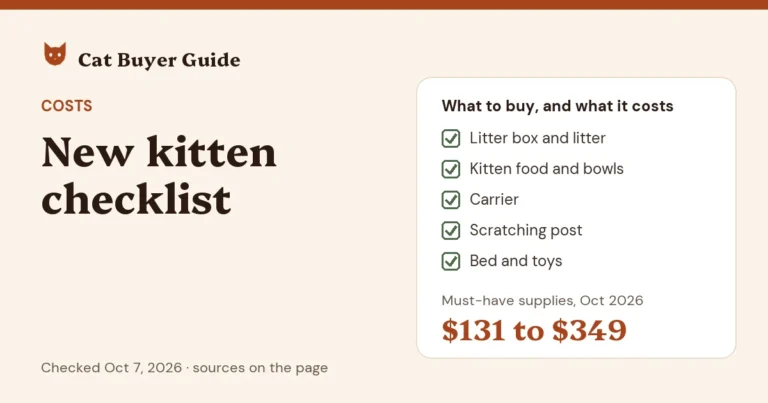
- It doesn’t pay for routine kitten care. The first round of shots, tests, microchip and spay or neuter cost $308 to $1,158 at the published prices we checked, insured or not.
- Timing matters. A problem a vet notes, or that shows symptoms, before coverage starts or during the waiting period is a pre-existing condition, and policies exclude it.
- Savings can do the same job if you already have enough set aside to cover a large bill.
We’re not an insurance agent
Cat Buyer Guide isn’t a licensed insurance agent or broker. This page is general information, not advice about whether to buy a policy or which one. Before you buy, read the policy and the insurer’s sample policy. We don’t rank insurers, and there are no affiliate links on this page.
On this page
- What a year of cat insurance costs
- What vet care costs, and what insurance pays for
- The math: one worked example
- Why buying while your kitten is young matters
- Wellness plans are a separate product
- Indoor cats: lower risk isn’t no risk
- The alternative: a savings fund
- Insurance or savings: how to decide
- How we put this together
- FAQ
What a year of cat insurance costs
Published figures, re-checked on Oct 11, 2026. Our guide to how much cat insurance costs explains what each one is based on.
| Source | Per month | Per year |
|---|---|---|
| NAPHIA, all insured US cats, 2025 | $36.25 | $435 |
| Fetch, average cat policy | $21 | $252 |
| Lemonade, average cat policy | About $27 | About $324 |
| Pets Best, fullest plans | $21 to $34 | $252 to $408 |
| Embrace, 6-month-old cat | $13.95 | $167.40 |
| Embrace, 10-month-old cat | $19.38 | $232.56 |
| NAPHIA, accident-only, 2025 | $9.33 | $112 |
Sources: NAPHIA’s industry averages, Fetch, Lemonade, Pets Best and Embrace, whose kitten quotes (a Russian Blue and a Bengal) use 70% back and a $5,000 yearly limit. The first year’s price isn’t the lifetime price: Embrace’s policy disclosure says the premium may rise with the cat’s age, your claims or a move, and NAPHIA’s average cat premium rose 12.6% in 2025.
What vet care costs, and what insurance pays for
Routine care: on you either way
For a kitten adopted at about 8 weeks, the first round of vet care (three exam visits, the vaccine series, FeLV/FIV and fecal tests, deworming, a microchip and a spay or neuter) costs $308 at the lowest published prices in our new kitten checklist data and $1,158 at the highest. At Emancipet, a nonprofit clinic group, the whole list came to $316. In our check of 24 clinics, the median price to spay a cat was $97.50 at nonprofit and shelter clinics and $324.95 at private and chain hospitals.
A standard accident-and-illness policy pays none of that. Embrace lists routine wellness care as excluded, Fetch says its plan doesn’t include preventive care, and Pets Best excludes routine care and vaccinations unless you add a wellness plan.
Accidents, illness and emergencies: what insurance is for
These are the bills a policy is built for:
| What happened | Published cost | Source |
|---|---|---|
| Urinary blockage | $2,048.17 bill | Embrace, one paid claim |
| Diabetes | $4,130.91 bill | Embrace, one paid claim |
| Swallowed ribbon | $5,648.44 bill | Embrace, one paid claim |
| Swallowed object | $4,636 average | Pets Best, 2023 claims |
| Broken bone | $2,772 average | Pets Best, 2023 claims |
| Dislocated joint | $2,076 average | Pets Best, 2023 claims |
| Vet-school ER visit | $250 before tests | Ohio State, 2025 fees |
The three Embrace bills are paid claims shown, undated, on its cat insurance page. The averages come from Pets Best’s 2023 claim data. Ohio State’s veterinary hospital lists a $160 emergency fee on top of a $90 exam fee. Its emergency guide says an unstable patient may need an extra $450 deposit, and that once you agree a treatment plan you pay a deposit of 75% of the high end of the written estimate.
At the far end, the ten largest cat claims paid in North America in 2025 ran from about $24,500 to $51,600, NAPHIA reports. Four of those ten cats were 3 or 4 years old. Bills vary by region and clinic, and insurers choose which claims to show, so treat these as examples, not a price list.
The math: one worked example
Fetch publishes every piece of this example. Its average cat premium was $21 a month from July 2024 to June 2025, for its most common setup: a $300 yearly deductible, 80% back and a $10,000 yearly limit. Its reimbursement page works through a $2,000 vet bill, about the size of Embrace’s urinary-blockage claim. Fetch takes 80% of the covered bill first, then subtracts the deductible.
- Premiums for the year: $21 × 12 = $252.
- What Fetch pays on a $2,000 covered bill: $2,000 × 80% = $1,600, minus the $300 deductible = $1,300.
- What you pay the vet: $2,000 − $1,300 = $700. With premiums, $952 for the year, against $2,000 uninsured.
- A year with no claims: $252 paid, nothing back.
| Covered bills in a year | Fetch pays | You pay, with premiums | No insurance |
|---|---|---|---|
| $0 | $0 | $252 | $0 |
| $375 | $0 | $627 | $375 |
| $690 | $252 | $690 | $690 |
| $2,000 | $1,300 | $952 | $2,000 |
| $5,648.44 | $4,218.75 | $1,681.69 | $5,648.44 |
On these terms the policy pays nothing until covered bills pass $375 in a year, and pays back more than its premiums once they pass $690. The last row runs Embrace’s published swallowed-ribbon bill through Fetch’s terms, as arithmetic only. Fetch’s $21 is an average for cats on that setup, so a kitten’s own quote will differ.
Watch out for: the order of the math. Embrace subtracts the deductible first: the example in its disclosure is $1,200 − $100 = $1,100, then × 90% = $990. Fetch and Pets Best apply the percentage first. On the same $2,000 bill and settings, deductible-first would pay $1,360, or $60 more. The policy says which method applies.
Why buying while your kitten is young matters
The NAIC’s Pet Insurance Model Act defines a pre-existing condition as one where, before the policy starts or during a waiting period, a vet gave advice about it, the pet was treated for it, or there were signs or symptoms of it. Embrace’s disclosure uses the same definition. In practice:
- Whatever shows up first is excluded. Fetch notes that if you buy a policy right before a surgery, that surgery won’t be covered.
- Urinary and dental problems are among the common pre-existing conditions in cats, Pets Best says, along with feline upper respiratory infection.
- Some come back covered, some don’t. Pets Best treats cured conditions, such as an upper respiratory infection or a broken bone, as no longer pre-existing. Incurable ones, such as diabetes, bladder crystals or kidney disease, stay excluded. Embrace may cover a curable condition after 12 months free of symptoms and treatment, and Pumpkin after 180 days, except knee and hind-leg ligament problems.
- Some insurers want a vet exam. Embrace requires one in the 12 months before the start date or the 14 days after; without it, the policy becomes accident-only. Keep your kitten’s first vet records.
Then there’s the waiting period, before some coverage starts:
| Insurer | Illness | Accidents | Orthopedic |
|---|---|---|---|
| Embrace | 14 days | From the start date | Varies by state |
| Fetch | Up to 15 days | No wait | 6 months |
| Pumpkin | 14 days or less | 14 days or less | 14 days or less |
| Pets Best | Varies by state | Varies by state | Varies by state |
From Embrace, Fetch’s cat page and FAQ, Pumpkin (one figure for all covered conditions) and the Pets Best FAQ.
The NAIC model caps waiting periods for illness and orthopedic problems at 30 days, bans them for accidents, requires a way to waive them with a vet exam, and gives you 15 days to return a new policy for a refund if you haven’t claimed. It applies only where a state has adopted it: 16 jurisdictions had by March 2026. The trade-off of enrolling young: more years of premiums, which tend to rise as the cat ages.
Wellness plans are a separate product
Under the NAIC model act, a wellness program sold apart from a policy isn’t insurance: an insurer that sells one must say so, can’t require it for buying a policy, and must price it separately. Wellness benefits written into the policy itself do count as insurance.
- Embrace says its Wellness Rewards isn’t an insurance policy. You pick a yearly amount of $300, $500 or $700.
- Pumpkin labels its Preventive Essentials as not insurance on its sample plan page.
- Spot’s Platinum Preventative Care add-on costs $24.95 a month, or $299.40 a year, and pays back up to $450 a year, including up to $150 toward a spay or neuter.
- In NAPHIA’s figures, insurance with wellness built in averaged $859 a year for a cat in 2025, $424 more than the accident-and-illness average.
A wellness plan mostly spreads routine costs across the year, so compare its yearly price and caps with your clinic’s prices.
Indoor cats: lower risk isn’t no risk
The three most common conditions in cat claims in NAPHIA’s 2025 data were digestive problems, dental disease and urinary tract infections. None is an outdoor injury, though NAPHIA doesn’t split claims by indoor and outdoor cats.
Cornell’s Feline Health Center says lower urinary tract problems show up most often in middle-aged, overweight cats that get little exercise, use an indoor litter box, have limited outdoor access and drink less water, and that male cats may be at higher risk. “A urethral obstruction is an absolute emergency,” Cornell warns, and hospital stays for one run from a few days to several weeks.
Insurers, who sell the policies, make the indoor case too: Spot says indoor cats may face lower risk of some conditions but can still get sick or hurt, and Embrace notes that kittens swallow things and catch respiratory infections. We found no published claims data comparing indoor and outdoor cats.
Talk to your vet
- Ask what an emergency visit, a urinary blockage or surgery for a swallowed object would cost at your clinic and at the nearest emergency hospital.
- Book a first exam soon after your kitten comes home, and keep the records.
- Ask whether your kitten’s breed has known health problems.
- A cat straining to urinate and passing little or no urine needs a vet right away, Cornell advises. Your vet, not the insurer, decides on treatment.
The alternative: a savings fund
- What saving does well. Money you don’t use stays yours, with no exclusions, waiting periods or claim forms, and it can pay for routine care too. Even Embrace’s guide to how pet insurance works warns that “the cost of premiums may outweigh the benefits” for a pet that stays healthy.
- Where it falls short. A big bill can come before the fund is big. Saving $21 a month, Fetch’s average premium, would take about 18 years to reach Pets Best’s $4,636 average for a swallowed object; at NAPHIA’s $435 a year, about 11.
- Either way, you need money on the day. With insurance you pay the vet first and claim afterward, as Embrace and Fetch explain, and an emergency hospital such as Ohio State’s wants a deposit before treatment.
- There are middle paths. Accident-only policies averaged $112 a year for cats in 2025. A higher deductible lowers the premium, Embrace says (its $9.17 starting price has a $1,000 deductible), and savings can cover the deductible.
The ASPCA suggests considering insurance while your pet is healthy if an emergency visit or serious illness would be a financial strain, and reading the fine print. The ASPCA lists ASPCA Pet Health Insurance among its partnerships. In an ASPCA survey released in March 2026, 6 in 10 US pet owners said they weren’t confident they could afford a pet’s medical emergency.
Insurance or savings: how to decide
| Insurance may suit you if… | Saving may suit you if… |
|---|---|
| A bill of a few thousand dollars would be hard to pay | You already have savings that could cover a bill that size |
| Your kitten has no health problems on record yet | You’d rather keep any money you don’t spend |
| You prefer a fixed monthly cost | You can keep the fund for vet bills only |
| You can keep paying as premiums rise with age | Your main worry is routine care, which insurance doesn’t cover |
| You don’t want the bill to limit treatment choices | You accept the risk of a big bill before the fund grows |
How we put this together
- We read every source listed below on Oct 11, 2026. Premiums come from our cat insurance data (collected Oct 7, re-checked Oct 11), routine vet prices from our Oct 7 lists for five clinic groups and 24 spay and neuter clinics.
- We didn’t fill in any quote form or enter any details about a cat or an owner.
- We left out cost ranges that an insurer took from third-party websites.
- The worked example uses Fetch’s terms because Fetch publishes all the pieces. That isn’t a recommendation of Fetch.
FAQ
Is cat insurance worth it?
It can be, if a bill of a few thousand dollars would be hard to pay. On Fetch’s published average terms ($252 a year, $300 deductible, 80% back), a policy pays back more than its premiums only in a year with over $690 of covered bills.
Is kitten insurance worth it?
The kitten months are when the pre-existing condition rules favor you: there’s little on record to exclude. Embrace’s published 2026 quotes for a 6-month-old and a 10-month-old cat were $13.95 and $19.38 a month. Premiums usually rise as the cat ages.
Do kittens need insurance?
Most cats aren’t insured: NAPHIA puts the share of insured US cats at 2.29% at the end of 2025. What every kitten does need is routine vet care, which insurance doesn’t cover, and a plan for a large bill, whether that’s insurance or savings.
Is it worth getting pet insurance for indoor cats?
Indoor cats still get the illnesses at the top of NAPHIA’s 2025 claims list: digestive problems, dental disease and urinary tract infections. Cornell links an indoor litter box and limited outdoor access with urinary problems. Whether the premium is worth it still depends on your savings.
Do I need pet insurance for my cat?
You need a way to pay a large vet bill. If $2,000 at short notice would be hard, insurance is one way; if you already have the savings, you may not need a policy.
Does pet insurance cover a kitten’s shots and spay?
A standard accident-and-illness policy doesn’t. Wellness add-ons pay toward them for an extra price: Spot’s costs $24.95 a month and pays up to $150 toward a spay or neuter. More in what cat insurance covers.
Sources
- Our price data (published cat insurance figures from 6 insurers and NAPHIA, collected Oct 7, 2026, re-checked Oct 11)
- Our vet fee data (published kitten vet prices from 5 clinic groups, and spay/neuter prices from 24 clinics, collected Oct 7, 2026)
- Our data for this page (published claim examples, emergency fees and policy terms, collected Oct 11, 2026)
- NAPHIA: 2026 State of the Industry Report Highlights (2025 data, June 2026, PDF), checked Oct 11, 2026
- NAIC: Pet Insurance Model Act (#633), adopted Summer 2022 (PDF), checked Oct 11, 2026
- NAIC: State Implementation Report of NAIC-Adopted Model Laws, as of March 9, 2026 (PDF), checked Oct 11, 2026
- Embrace Pet Insurance: Cat Insurance, checked Oct 19, 2026
- Embrace Pet Insurance: Insurer Disclosure of Important Policy Provisions (form INDPP 01/23, PDF), checked Oct 11, 2026
- Embrace Pet Insurance: Pet Insurance Waiting Periods, checked Oct 11, 2026
- Embrace Pet Insurance: How Does Pet Insurance Work?, checked Oct 11, 2026
- Embrace Pet Insurance: Wellness Rewards, checked Oct 11, 2026
- Fetch: Cat insurance, checked Oct 11, 2026
- Fetch: Is Fetch Pet Insurance expensive? (FAQ), checked Oct 19, 2026
- Fetch: Pet insurance reimbursement, checked Oct 19, 2026
- Fetch: What is a waiting period for pet insurance? (FAQ), checked Oct 11, 2026
- Pets Best: Cat Insurance, checked Oct 11, 2026
- Pets Best: How Are Claim Payments Calculated? (FAQ), checked Oct 11, 2026
- Pets Best: Does Pet Insurance Cover Pre-Existing Conditions?, checked Oct 11, 2026
- Pets Best: Frequently Asked Questions (waiting periods), checked Oct 11, 2026
- Pets Best: Is Pet Insurance Worth It for an Indoor Cat? (Sept. 25, 2024; 2023 claim data), checked Oct 19, 2026
- Pumpkin: Cat Insurance, checked Oct 11, 2026
- Pumpkin: Sample plan and Preventive Essentials, checked Oct 11, 2026
- Spot Pet Insurance: Cat Insurance, checked Oct 11, 2026
- Lemonade: How Much Is Pet Insurance?, checked Oct 11, 2026
- Emancipet: Healthy Pet Services prices, checked Oct 11, 2026
- Emancipet: Spay & Neuter prices, checked Oct 11, 2026
- ASPCA: Cutting Pet Care Costs (cost table, 2021 update), checked Oct 11, 2026
- ASPCA: Majority of America’s Pet Owners Unprepared for Costly Medical Emergencies (press release, March 11, 2026), checked Oct 11, 2026
- Cornell Feline Health Center: Feline Lower Urinary Tract Disease, checked Oct 11, 2026
- Ohio State University Veterinary Medical Center: What to Expect When Your Pet Needs Emergency Care (2026, PDF), checked Oct 11, 2026
- Ohio State University Veterinary Medical Center: Emergency Exam Fee Waiver (2025, PDF), checked Oct 11, 2026