Best Litter Boxes for Kittens: A Buyer’s Guide (2026)

A buyer's guide built from specifications, warranties and return policies, not hands-on testing. Facts and prices checked October 7, 2026. We may earn a commission if you buy through links on this page. It never changes what we recommend. As an Amazon Associate we earn from qualifying purchases. How we research
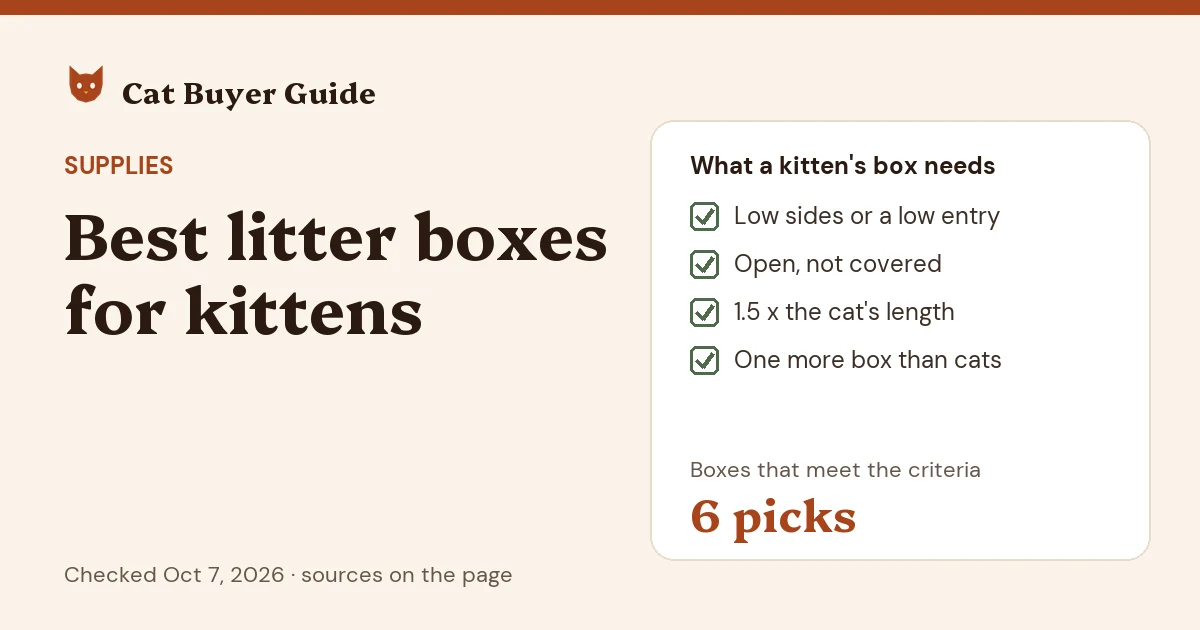
The best litter box for kittens is an open one with low sides or a low entry, big enough to turn around and dig in. Vet guidelines say a box should be at least 1.5 times the cat’s length, so plan to size up as your kitten grows. Fill it with 1 to 2 inches of unscented, fine-textured litter, scoop it every day, and keep one more box than you have cats: two for one kitten, three for two.
This is a buyer’s guide built from manufacturers’ specifications, warranties and return policies, not a hands-on test: we haven’t used any of these boxes. For what a full kitten setup costs, see our new kitten checklist.
What a kitten’s litter box needs
Low sides or a low entry
Young kittens need boxes with low sides, says the Cornell Feline Health Center. The AAHA/AAFP Feline Life Stage Guidelines, written by vets for the American Animal Hospital Association and the American Association of Feline Practitioners (now the Feline Veterinary Medical Association), say the same: a box’s edges shouldn’t be so high that a kitten can’t get in and out easily. The ASPCA adds that very young cats can struggle with high sides or a top opening.
Open, not covered
Most cats prefer an uncovered box that lets odors escape and gives them a 360-degree view, according to Cornell. People like covers because they contain smells and stray litter, but “from your cat’s point of view, covers hold odors in.” International Cat Care says many cats adapt to covered trays, but some feel vulnerable in a small space with only one way out, especially with other cats around. Keeping the smell in for us also makes prompt scooping harder, and cats are less likely to use a soiled tray.
Big enough, with room to grow
The AAHA/AAFP guidelines recommend a box at least 1.5 times the cat’s length, from nose to tail tip, and add that “most manufactured boxes are not large enough”; a larger storage container is one way around that. International Cat Care measures from the nose to the base of the tail instead, says many standard trays are too small, and prefers rectangular trays, which give more room than corner or oval ones. Either way, measure your kitten and multiply by 1.5: a kitten that measures 12 inches needs a box at least 18 inches long. A smaller tray is fine for a kitten, International Cat Care says, as long as you replace it with a bigger one as the kitten grows.
One more box than you have cats
Cornell, the AAHA/AAFP guidelines, the ASPCA and International Cat Care give the same rule: one box per cat, plus one. Cornell says this cuts competition and gives each cat a box of its own.
The right litter
Most cats prefer unscented, finer-textured litter about 1 to 2 inches deep, says Cornell, and the ASPCA adds that most prefer clumping litter. Litter preferences form early in kittenhood, says International Cat Care, so start with the litter your kitten already knows. Kittens learn where to toilet from their mother (AAHA/AAFP), one reason the age a kitten comes home matters.
The criteria at a glance
| Criterion | Why it matters | Source |
|---|---|---|
| Open top | Covers hold odors in; some cats feel vulnerable | Cornell, International Cat Care, ASPCA |
| Low sides or entry | Kittens must get in and out easily | Cornell, AAHA/AAFP, ASPCA |
| 1.5 × the cat’s length | Room to move around and dig | AAHA/AAFP, International Cat Care |
| Rectangular | More room than corner or oval shapes | International Cat Care |
| Easy to clean | Daily scooping, regular washing, no liner | Cornell, AAHA/AAFP, International Cat Care |
| Cats plus one | Less competition; a box for each cat | All four |
Six boxes that meet the criteria
All six are open, rectangular and have low sides or a lowered entry. Sizes are the makers’ own, in inches (length × width × height), checked on Oct 7, 2026.
| Box | Size (inches) | Way in | Best for |
|---|---|---|---|
| IRIS Box with Scoop | 19 × 15 × 5.7 | Low entry | A small kitten now |
| Petmate Basic | 14.05 × 10.5 × 3.5 (small) to 22.05 × 16.55 × 6.5 (jumbo) | Low sides all round | The basic choice |
| IRIS Large Open Top | 23.5 × 16.13 × 5.56 | Low all round | Growing with your kitten |
| PetFusion BetterBox | 22.6 × 18.1 × 8 | Lowered front | A growing kitten |
| Petmate Giant | 25.56 × 18.3 × 10.02 | Sloped entry | The grown-up box |
| IRIS XX-Large | 30 × 20 × 14 | 6.5-inch side entrance | Big cats, multi-cat homes |
Neither maker lists a warranty for these boxes (Petmate shows one on the product page when it offers one). Bought from the makers’ own online stores, both take returns within 30 days of delivery: IRIS for unused items in the original packaging, with the buyer paying return shipping unless the item arrived wrong, damaged or defective; Petmate with replacement or credit for damaged or defective items. On Amazon, the return terms shown on the listing apply.
1. IRIS USA Cat Litter Box with Scoop: for a small kitten now
IRIS describes this open pan as a low-entry box for kittens, senior cats and cats with mobility problems. It measures 19 by 15 inches and stands 5.7 inches tall, with smooth plastic walls, rounded corners and a removable raised rim that curves inward to keep litter in. A scoop is included and rests on the rim (IRIS product page).
Best for: a kitten’s first box, or a small space.
Watch out for: IRIS doesn’t publish the entry height, and at 19 inches long this is a kitten-size box: measure your cat as it grows and move up when it needs more room.
See the IRIS Cat Litter Box with Scoop on Amazon
2. Petmate Basic Litter Box: the basic option
A plain open pan in four sizes. Petmate describes low, rimmed sides and easy access from any side, and lists the small at 14.05 by 10.5 inches and 3.5 inches tall, the medium at 16.05 by 12.05 by 4, the large at 18.55 by 15.35 by 5 and the jumbo at 22.05 by 16.55 by 6.5. It’s made in the USA from Petmate’s own EcoTech resin (Petmate product page).
Best for: a simple low pan: small or medium for a young kitten, jumbo once it’s bigger, or as the extra box in a second room.
Watch out for: low sides hold less litter in; the makers add high walls to their bigger boxes to stop scatter. Petmate itself recommends replacing a litter box every 12 months, because odors work into the plastic and scratching wears it down.
See the small Petmate Basic Litter Box on Amazon
3. IRIS USA Large Open Top Cat Litter Tray: grows with your kitten
A long, plain open tub that IRIS describes as low-entry, for kittens, elderly cats and cats with mobility problems. IRIS lists it at 23.5 by 16.13 inches and 5.56 inches tall, and its size diagram shows 24 by 16.25 by 6, so no side is higher than about 6 inches (IRIS product page).
Best for: a kitten that should keep one box for longer: low enough to step into, and the longest of the low boxes in this guide.
Watch out for: the walls are low all round, with no shield, so it holds less litter in than a high-sided box. IRIS’s description doesn’t say what it’s made of.
Amazon listed this tray as currently unavailable when we checked on Oct 10, 2026, so here’s IRIS’s own product page instead.
4. PetFusion BetterBox: a bigger box with a lowered front
PetFusion’s open box, sold by Petmate, has high walls and a low entry that the maker says suits older cats. It measures 22.6 by 18.1 inches and 8 inches tall. It’s made of ABS plastic, which the maker says is more rigid than the polypropylene of standard boxes, with a non-stick coating it says reduces litter sticking by up to 70% (Petmate product page).
Best for: a kitten that’s ready for a bigger box, and owners who want easier scooping.
Watch out for: the entry height isn’t published, and the rest of the box is up to 8 inches tall, so make sure a young kitten can climb in. The non-stick figure is the maker’s claim; we couldn’t check it.
See the PetFusion BetterBox on Amazon
5. Petmate Giant Litter Box: the grown-up box
A big open pan with high sides and a sloped entry that, Petmate says, gives older cats and kittens easy access. It measures 25.56 by 18.3 inches and 10.02 inches tall, and holds over 30 pounds of litter. It’s made in the USA from odor-resistant plastic, 95% of it pre-consumer recycled (Petmate product page).
Best for: the box your kitten grows into, and the large cats and multi-cat homes Petmate made it for.
Watch out for: Petmate doesn’t publish the entry height, and the box takes a lot of floor space and litter. Petmate makes no liners for it, which is no loss: Cornell says many cats don’t like liners.
Amazon listed this box as currently unavailable when we checked on Oct 10, 2026, so here’s Petmate’s own product page instead.
6. IRIS USA XX-Large Side Entry Cat Litter Box: the largest
The biggest box here: 30 by 20 inches, with 14-inch walls and a curved side entrance that IRIS’s text puts at 6.5 inches (a photo on the same page shows 6). IRIS made it for large breeds such as Maine Coons and Ragdolls, multi-cat homes and older cats, with a smooth interior and few crevices for easier cleaning (IRIS product page).
Best for: the long-term box for a grown cat, a big breed, or kittens growing up together (plus the extra boxes they still need).
Watch out for: an entrance of 6 to 6.5 inches may be a big step for a small kitten, so this is a box to grow into. It also needs a 30-by-20-inch space, and IRIS’s description doesn’t name the material.
See the IRIS XX-Large Side Entry Cat Litter Box on Amazon
Boxes we left out, and why
- Hooded or covered boxes. Cornell says most cats prefer an open box, and the ASPCA puts it plainly: “Most cats don’t like box liners or lids on their boxes.” Some cats feel vulnerable with only one way out (International Cat Care).
- Top-entry boxes. A kitten would have to climb in and out through the lid. The ASPCA says very young cats may have trouble with high sides or a top opening, and advises low sides instead.
- Self-cleaning boxes. International Cat Care says their movements and noises can startle cats, and many are small. The ASPCA notes that many cats accept them, but advises a regular box if a cat starts going elsewhere.
- Corner and oval boxes. Rectangular trays give more room, says International Cat Care.
- Liners and scented litter. Claws catch in plastic liners, and strong scents can put cats off the box (International Cat Care).
Setting up the box
Kitten litter box training starts with where the box goes and what’s in it.
Where. International Cat Care advises keeping a new kitten in one room at first, with its bowls, bed, toys, scratching post and litter tray. Put the box somewhere quiet that the kitten can reach day and night, away from its food (Cornell) and water (International Cat Care). Cats like to see who’s coming and to have more than one way out, says the ASPCA, so avoid busy, loud spots such as next to the washer and dryer. Later, spread the boxes, one more than you have cats, around the house rather than side by side (Cornell, International Cat Care), with one on each floor of a multistory home (ASPCA).
Litter. Use 1 to 2 inches of unscented, fine-textured litter (Cornell, ASPCA), and for the first week or two, the same litter the kitten used in its previous home (International Cat Care). If you switch brands later, mix the new one in gradually (Cornell).
Cleaning. Scoop at least once a day (Cornell, AAHA/AAFP, ASPCA); International Cat Care says twice. Wash the whole box weekly (ASPCA), or every 2 to 4 weeks with clumping litter (International Cat Care). Hot water is best, say the AAHA/AAFP guidelines; the ASPCA also allows unscented soap. Skip strong chemicals and scented cleaners, and never use disinfectants that turn cloudy in water, which International Cat Care says are toxic to cats. Replace a box that smells or cracks (Cornell).
First lessons. Kittens usually learn to use a litter tray by copying their mother, says International Cat Care. If yours hasn’t found the box, put it in when it wakes up, after meals, and when it sniffs, scratches or crouches. Never punish accidents or carry a kitten to the box as punishment (AAHA/AAFP); Cornell warns punishment can make soiling worse. Our guide to litter training a kitten goes further.
Talk to your vet
- If your kitten keeps going outside the box, tell your vet. The AAHA/AAFP guidelines say a kitten that soils the house should be checked for medical causes, such as parasites or problems present from birth.
- Call promptly if your kitten keeps visiting the box but passes little urine, or seems to strain. The ASPCA says to see a vet, and the AAHA/AAFP guidelines warn that a urinary blockage can be life-threatening.
FAQ
How many litter boxes does a kitten need?
Two for one kitten: one per cat, plus one, say Cornell, the AAHA/AAFP guidelines, the ASPCA and International Cat Care. Put them in different spots.
What size litter box does a kitten need?
At least 1.5 times its length, measured nose to tail tip (AAHA/AAFP) or nose to the base of the tail (International Cat Care). Measure again as it grows.
Should a kitten’s litter box be covered?
No. Start with an open box: Cornell says most cats prefer one, and the ASPCA says most cats dislike lids.
What’s the best litter box for multiple kittens?
Several boxes, not one big one: the number of kittens plus one, spread around the house so one kitten can’t block another’s way (International Cat Care). A large box such as the IRIS XX-Large or the Petmate Giant can be one of them once the kittens are bigger.
When should I switch to a bigger box?
When the box is shorter than 1.5 times your kitten’s length, or your kitten steps over taller sides easily. Petmate suggests leaving the old box out for a short while so your cat can adjust.
Sources
- Cornell Feline Health Center: Feline Behavior Problems: House Soiling (updated January 2015), checked Oct 7, 2026
- AAHA and AAFP: 2021 Feline Life Stage Guidelines: General Litter Box Considerations, checked Oct 7, 2026
- AAHA and AAFP: 2021 Feline Life Stage Guidelines: Behavior and Environmental Needs: Kittens, checked Oct 7, 2026
- Feline Veterinary Medical Association: Introducing the FelineVMA (the AAFP’s new name, Sept. 2024), checked Oct 7, 2026
- International Cat Care: Choosing a litter tray for your cat (updated Dec. 10, 2025), checked Oct 7, 2026
- International Cat Care: Helping your new cat or kitten settle in (updated Sept. 26, 2025), checked Oct 7, 2026
- ASPCA: Litter Box Problems, checked Oct 7, 2026
- IRIS USA: Cat Litter Box with Scoop (product page), checked Oct 7, 2026
- IRIS USA: Large Open Top Cat Litter Tray (product page), checked Oct 7, 2026
- IRIS USA: XX-Large Side Entry Cat Litter Box, Navy (product page), checked Oct 7, 2026
- IRIS USA: Return Policy, checked Oct 7, 2026
- Petmate: Petmate Basic Litter Box (product page), checked Oct 7, 2026
- Petmate: PetFusion BetterBox Cat Litter Box (product page), checked Oct 7, 2026
- Petmate: Petmate Giant Litter Box (product page), checked Oct 7, 2026
- Petmate: Refund policy, checked Oct 7, 2026
- Petmate: FAQs (warranties), checked Oct 7, 2026