When to Spay or Neuter a Kitten: What Vets Recommend

Built from dated data and expert sources, not hands-on pet testing. Facts and prices checked October 7, 2026. No affiliate links on this page. How we research
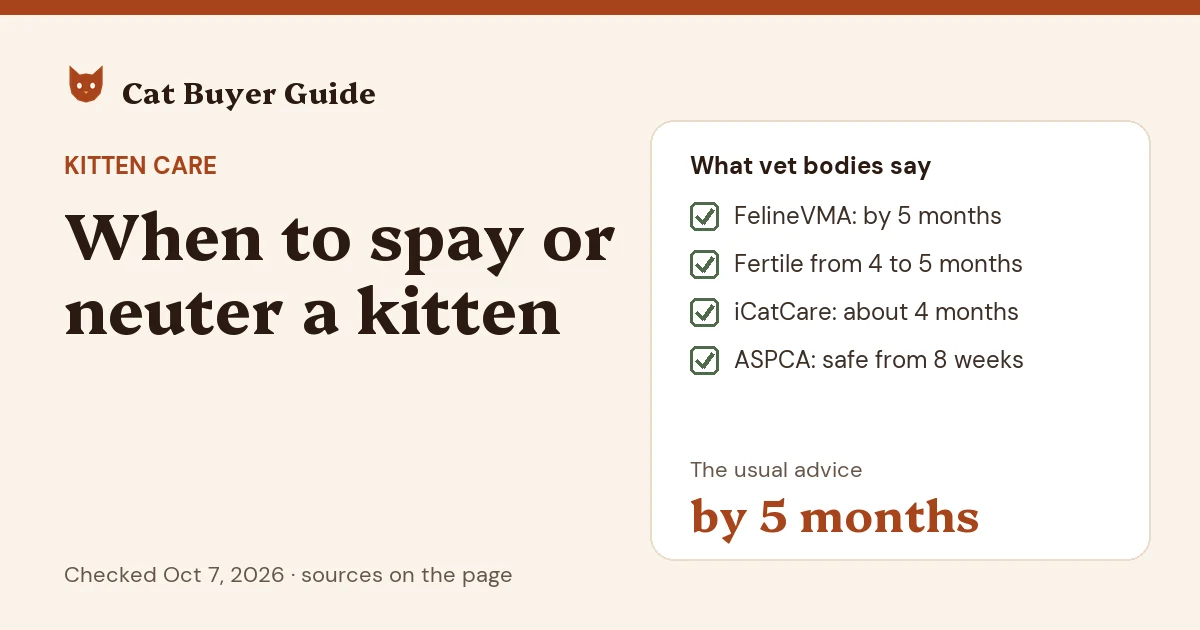
Spay or neuter your kitten by the time it’s 5 months old. That’s the advice of the Feline Veterinary Medical Association (FelineVMA, formerly the American Association of Feline Practitioners, or AAFP), because cats can breed as early as 4 to 5 months. The American Veterinary Medical Association (AVMA) says it, the FelineVMA and the Association of Shelter Veterinarians all support that 5-month mark. International Cat Care, a UK charity, recommends around 4 months. Shelters often operate much younger, from about 6 to 8 weeks, so kittens are fixed before adoption. Your vet sets the exact date.
We read the current advice of US and UK veterinary bodies, shelter guidelines and the key studies on Oct 7, 2026. Here’s what each says about the best age to spay or neuter a cat, how a spay differs from a neuter, and what to expect on surgery day.
When to spay or neuter a kitten: what each source says
| Source | Age | Notes |
|---|---|---|
| FelineVMA (2020) | By 5 months | Cats not meant for breeding; the vet picks the age |
| AVMA | By 5 months | Its policy calls early surgery safe |
| Shelter vets (ASV) | From 6 weeks in shelters | Owned kittens: 4 months or older may suit vaccines better |
| ASPCA | Before 5 months | Safe from 8 weeks; its policy minimum is 2 months and 2 pounds |
| International Cat Care | Around 4 months | Before sexual maturity |
| Cat Group (UK) | Around 4 months | 2006 policy, instead of the traditional 6 months |
| Cornell | Before the first heat | Spay as young as 3 to 4 months; neuter at 3 to 6 |
| TICA breeder code | Before it leaves, or by 12 months | Voluntary code for pedigree breeders |
None of these sources advises waiting until after the first heat. The AVMA says “there is no known benefit to delaying the spay procedure” until then.
Our reading of the evidence
- Plan on about 4 to 5 months, around the end of the kitten vaccines, unless your vet advises otherwise.
- Until then, keep a female kitten away from unneutered males, her brothers included.
- Adopting from a shelter? The surgery is often done already. Check the record.
- Buying from a breeder? Ask whether the kitten is already done, and look for a deadline in the contract (see our questions to ask a cat breeder).
Why by 5 months? Kittens mature early
The FelineVMA’s 2020 position statement warns that a cat can be reproductively active as early as 4 to 5 months, “without necessarily demonstrating obvious physical signs.” International Cat Care says kittens reach sexual maturity from around 4 months. A female’s first heat usually comes at about 6 months but can be earlier, she can have up to three litters a year, and brothers and sisters will mate.
The old habit was to wait. The UK’s Cat Group, a group of professional cat welfare organizations, notes that cats were traditionally neutered at 6 months. A Cornell Feline Health Center Q&A says many vets have operated at 5 to 7 months, an age set when anesthesia and surgery were perhaps less safe, with very little evidence that it’s best. In 2016 a US veterinary task force, whose advice the AAFP endorsed, called on vets to recommend sterilization by 5 months and suggested scheduling it at the end of the kitten vaccine series.
Heat, spraying and roaming
A female in season is usually in heat for four to five days every three weeks, and she yowls and urinates more, says the ASPCA. Unneutered males roam, fight and mark territory with strong-smelling urine, sometimes indoors (International Cat Care). Spaying ends heat cycles, and neutered males roam and urine-mark less, says the AVMA. The ASPCA advises surgery before 5 months to help keep spraying from starting.
It’s not a guaranteed fix. The AAHA/AAFP Feline Life Stage Guidelines cite a study in which about 10% of sterilized cats still marked with urine, and say “neutering will not eliminate or prevent spraying in all cats.”
Shelter and breeder kittens
Shelters often spay or neuter kittens before adoption. The Association of Shelter Veterinarians (ASV) says that’s best, “as early as 6 weeks of age,” because it makes sure the surgery happens, and being unneutered is the leading risk factor for a pet being given up. Its guidelines leave the minimum age and weight to the surgeon, and say owned kittens may be better served by surgery at 4 months or older, to give their vaccines time to build immunity. The ASPCA’s policy supports early spay/neuter once a kitten is at least 2 months old and weighs 2 pounds. So a shelter kitten that’s already been fixed at 8 weeks is normal; see what age to adopt a kitten.
Pedigree breeders vary (see how to choose a cat breeder). Breeders who sign TICA’s voluntary Outstanding Cattery code promise to try to spay or neuter every kitten before it leaves; if they can’t, they require it by 12 months, and they hand over the registration papers only once a vet confirms it’s done. The Cat Group suggests letting a new pedigree kitten settle in for two to three weeks first, which puts surgery at about 4 months.
Is early spay or neuter safe?
The major vet bodies say yes. The AVMA’s policy, revised in July 2025, says modern pediatric anesthesia and surgery “have been shown to be safe, effective, and have low rates of surgical complications.” It still leaves the timing for each animal to the vet.
A 2004 study by Cornell researchers followed 1,660 cats adopted from a shelter for up to 11 years. Surgery before 5.5 months wasn’t linked to more deaths, more cats given up, or any serious medical or behavior problem. Males neutered early had fewer abscesses and less urine spraying but hid more. Early-neutered cats of both sexes had less asthma and gum disease, but were shyer.
Kittens also bounce back fast. Cornell says complications appear no more often at this age, and kittens are often up and playing within two hours. International Cat Care says younger cats are likely to recover more quickly and feel less pain than older ones. Very young kittens can get cold, and their blood sugar can drop, under anesthesia; the Cat Group notes that vets now know these risks and how to manage them. For a very large breed, such as a Maine Coon, International Cat Care suggests discussing the timing with your vet.
Benefits and risks
Health benefits
- Less mammary cancer. In a 2005 study comparing cats with and without mammary cancer, cats spayed before 6 months had a 91% lower risk than unspayed cats, and those spayed before 1 year an 86% lower risk. Mammary tumors are the third most common cancer in cats, and most are malignant, says Cornell.
- No uterine infection. Spaying rules out pyometra, a potentially fatal infection of the uterus (Cornell; International Cat Care).
- No testicular cancer in neutered males (AVMA).
- Fewer fight wounds. Unneutered toms are more likely to get bite abscesses and to spread FIV and FeLV, viruses passed on through bites (International Cat Care).
- A longer life, on average. Studies have repeatedly found that spayed and neutered cats live longer, says the AVMA.
Risks
- Surgery and anesthesia. A spay or neuter is major surgery, but it’s among the most common operations vets do on cats, and the AVMA calls the risks typically low. Your vet will examine your kitten first.
- Weight gain. Neutering is a risk factor for obesity, especially in males, and fewer calories may be needed to prevent it, say the AAHA/AAFP guidelines. An evidence summary from Cat-Kind, a group of UK cat charities, found no evidence that neutering at 4 months raises that risk compared with 6 months. The ASPCA puts weight gain down to overfeeding and too little exercise rather than the surgery. Either way, ask your vet how much to feed afterward, and watch your cat’s waistline.
- Spraying may not stop in every cat (see above).
Spaying vs neutering: what’s different
When to spay a female kitten
Before her first heat, and by 5 months; Cornell suggests as young as 3 to 4 months to cut her mammary cancer risk. A spay removes the ovaries and usually the uterus; some vets remove only the ovaries, with a similar effect (AVMA). It’s done under general anesthesia through a cut in the belly, or sometimes the side, with the fur shaved around it. Most cats go home the same day, though some clinics keep them overnight. Skin stitches, if used, may need to come out after 7 to 10 days (International Cat Care). Cornell advises keeping a spayed cat as quiet as possible for a week or so while the belly wound heals.
When to neuter a male kitten
Also by 5 months, ideally before he starts spraying; Cornell prefers 3 to 6 months. A neuter, or castration, removes both testicles through small cuts in the scrotum. It’s quicker and simpler than a spay (Cornell), the cuts are so small that stitches aren’t needed, and he’ll usually go home the same day (International Cat Care).
Spays cost more, too. In our price check, a spay cost $5 to $112 more than a neuter at 15 of 24 clinics (a median of $45 more), and the other nine charged the same for both.
Before and after surgery
Before the surgery:
- Your vet will examine your kitten to make sure it’s healthy enough (AVMA).
- Follow the clinic’s fasting instructions exactly. They differ by age: kittens need steady nutrition, so they usually go without food for less time than adult cats, and the ASPCA notes your vet may advise not withholding a kitten’s food at all.
- Keep your cat indoors beforehand (International Cat Care).
After the surgery, the ASPCA suggests:
- a quiet place indoors, away from other animals;
- no running or jumping for up to two weeks, or as long as your vet says;
- a well-fitted cone (Elizabethan collar) to stop licking at the wound;
- no bath for at least 10 days;
- a look at the incision every day.
Most cats are drowsy at first and back to normal by the next day, says International Cat Care, which is when keeping them quiet gets hard. Never give your cat human pain relievers or other over-the-counter medicines without your vet’s approval; Cornell warns they may be toxic to cats.
Talk to your vet
Call your vet if the incision is red, swollen, has discharge or opens, or if your cat is lethargic or unusually quiet, is eating less, vomits or has diarrhea after surgery (ASPCA; International Cat Care). Before booking, ask:
- when your vet would schedule the surgery for your kitten, and why;
- whether your kitten’s breed, size or health changes the timing;
- how your kitten will be monitored under anesthesia, and how its pain will be controlled (AVMA);
- what the price includes, such as the exam, bloodwork, pain relief, a cone and follow-up checks.
What it costs
In the published price lists of 24 clinics in 17 states that we checked on Oct 7, 2026 (our own data), a cat spay cost $53 to $200 at 18 nonprofit and shelter clinics, with a median of $97.50, and a neuter cost $38 to $200 (median $90). At five Banfield Pet Hospital locations, the spay package for a cat under 6 months was $310.95 to $368.95, plus a required office visit fee of $67.95 to $95.95, and $55 to $65 more for a cat over 6 months. The ASPCA’s 2021 estimate is $150. Prices depend on the region and on what’s included. Every clinic and price is in our guide to how much it costs to spay a cat, and first-year vet costs are in our new kitten checklist.
Lower-cost options. Shelters, humane societies and nonprofit clinics often charge much less, and some set prices by income. The ASPCA’s own low-cost surgery serves only parts of New York City, Los Angeles and Asheville, N.C. Elsewhere, two national nonprofit directories can point you to a clinic: SpayUSA, North Shore Animal League America’s referral network, and United Spay Alliance‘s state-by-state directory. The AVMA notes that low-cost clinics may provide less follow-up care, so ask what aftercare is included.
FAQ
Is 8 weeks too young to spay or neuter a kitten?
Not for a healthy kitten that’s big enough. The ASPCA calls it generally safe from 8 weeks, and shelter vets may operate from 6 weeks. For a kitten already living with you, the guidelines point to about 4 to 5 months, after its vaccines.
Should a female cat have one heat or one litter first?
No. The AVMA says there’s no known benefit to waiting until after the first heat, and the UK charities behind the Kitten Neutering Database call the “one litter” idea a myth. The ASPCA says spaying before the first heat gives the best protection against uterine infections and mammary tumors.
Can a cat be spayed while she’s in heat?
Yes. The ASPCA says it’s possible, and the ASV’s guidelines report that cats in heat can be spayed safely. Ask your vet whether to go ahead or wait.
Do indoor cats need to be spayed or neutered?
Yes, unless you plan to breed: Cornell sees no sound reason not to. An indoor female still comes into heat and yowls, and unneutered cats are more likely to spray urine around the house (ASPCA).
How long does recovery take?
Most kittens are back to normal the next day (International Cat Care), but keep them calm: the ASPCA advises no running or jumping for up to two weeks, or as your vet says. Spay stitches, if any, may come out after 7 to 10 days.
Sources
- FelineVMA (formerly AAFP): 2020 Pediatric Sterilization in Cats, position statement (JFMS 2020;22:870), checked Oct 16, 2026
- Feline Veterinary Medical Association: Introducing the FelineVMA (the AAFP’s new name, Sept. 2024), checked Oct 7, 2026
- Veterinary Task Force on Feline Sterilization: Recommendations for Age of Spay and Neuter Surgery (July 2016), endorsed by the AAFP, checked Oct 7, 2026
- AVMA policy: Pediatric sterilization of dogs, cats and rabbits, checked Oct 7, 2026
- AVMA News: Discussion precedes HOD actions on cat declawing, animal pain, other resolutions (Aug. 2025), checked Oct 7, 2026
- AVMA: Spaying and neutering (for pet owners), checked Oct 16, 2026
- AVMA: Low-cost spay or neuter, checked Oct 7, 2026
- AAHA and AAFP: 2021 Feline Life Stage Guidelines (Quimby et al., JFMS and JAAHA), checked Oct 7, 2026
- Association of Shelter Veterinarians: 2016 Veterinary Medical Care Guidelines for Spay-Neuter Programs (JAVMA), checked Oct 7, 2026
- ASPCA: Spay/Neuter Your Pet, checked Oct 7, 2026
- ASPCA: Companion Animal Birth Control (position statement), checked Oct 7, 2026
- ASPCA: Spay/Neuter Services, checked Oct 7, 2026
- ASPCA: Cutting Pet Care Costs (cost table, 2021 update), checked Oct 7, 2026
- International Cat Care: Neutering your cat, checked Oct 16, 2026
- The Cat Group (UK): Policy Statement 1, Timing of neutering (updated May 2006), checked Oct 7, 2026
- Cat-Kind (Cats Protection and partners): Kitten Neutering Database, checked Oct 7, 2026
- Cat-Kind: A summary of evidence: neutering kittens at four months (PDF), checked Oct 7, 2026
- Cornell Feline Health Center: Spaying and Neutering, checked Oct 7, 2026
- Cornell Feline Health Center: Mammary Tumors, checked Oct 7, 2026
- Cornell Feline Health Center: Ask Elizabeth: Should I Consider a Pediatric Spay or Neuter?, checked Oct 7, 2026
- Overley et al.: Association between ovarihysterectomy and feline mammary carcinoma (J Vet Intern Med, 2005), checked Oct 7, 2026
- Spain, Scarlett and Houpt: Long-term risks and benefits of early-age gonadectomy in cats (JAVMA, 2004), checked Oct 7, 2026
- TICA: Outstanding Cattery Voluntary Code of Ethics (revised 2018), checked Oct 7, 2026
- SpayUSA (North Shore Animal League America): low-cost spay/neuter referrals, checked Oct 7, 2026
- United Spay Alliance: Spay/Neuter Referral Directory, checked Oct 7, 2026
- Our price data (published cat spay and neuter prices of 24 clinics in 17 states, collected Oct 7, 2026; every clinic is listed in our spay cost guide)