What Age Should a Kitten Be When You Bring It Home?

Built from dated data and expert sources, not hands-on pet testing. Facts and prices checked October 7, 2026. No affiliate links on this page. How we research
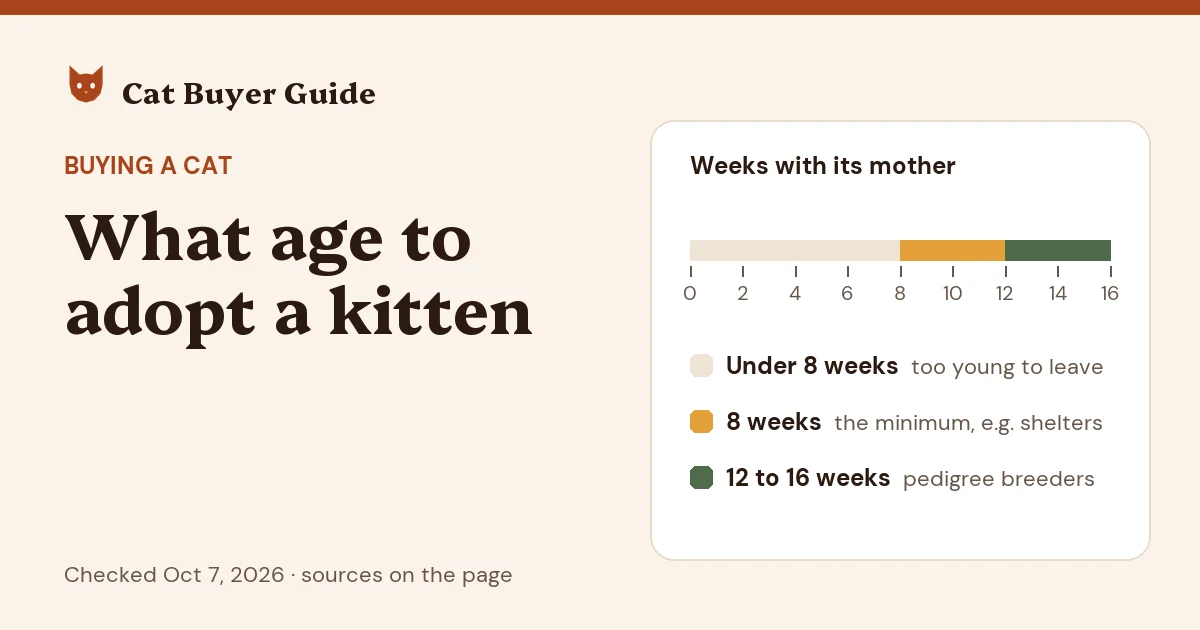
A kitten should be at least 8 weeks old before it leaves its mother, and older is usually better. Cat registries say pedigree kittens usually go home at 12 to 16 weeks, while shelters often adopt kittens out at about 8 weeks, once they’re weaned, vaccinated and spayed or neutered. In a large 2017 study of 5,726 cats, those separated from their mother before 8 weeks were more likely to be aggressive, and those who stayed past 14 weeks were less likely to be aggressive toward strangers.
We checked the CFA and TICA rules, veterinary guidelines, welfare charities’ advice and state laws on Oct 7, 2026. Here’s what each one says, and why breeders and shelters differ.
Quick answer: what each source says
| Source | Age | Notes |
|---|---|---|
| CFA (US registry) | 12–16 weeks | Advice in CFA’s magazine; its ethics code ties placement to immunity |
| TICA (US registry) | 14 weeks or older | TICA’s buyer leaflet; at least two vaccinations first |
| GCCF (UK registry) | 13 weeks or older | And a week after the full vaccine course |
| World Cat Congress | 12 weeks or older | Group of nine big registries, CFA and TICA included |
| International Cat Care | From 8 weeks; pedigree 12+ | Only once fully weaned |
| Cats Protection (UK) | 8–9 weeks | With its mother until then |
| Shelters and rescues | About 8 weeks or 2 lb | After vaccines and spay/neuter (ASPCA, Best Friends) |
| AAHA/AAFP vet guidelines | No set age | Weaning starts at 3–5 weeks; vaccines from 6 weeks |
| US laws | Usually 8 weeks | Virginia: 7 weeks; rules vary by state |
| Finnish study (2017) | Avoid under 8 weeks | Fewer problems after 14 weeks |
None of the sources we checked recommends bringing a kitten home before 8 weeks. The vet guidelines don’t name one best age; they describe what a kitten needs.
Our reading of the evidence
- Pedigree kitten from a breeder: 12 weeks or older; many good breeders wait until 14 to 16.
- Kitten from a home litter or a shelter: 8 weeks at the earliest. If it’s still with its mother and handled every day, a few more weeks there is a bonus.
- Kitten under 8 weeks already in your care: see a vet first.
Why the age matters
Weaning
Kittens can start on kitten food at 3 to 5 weeks, according to the 2021 AAHA/AAFP Feline Life Stage Guidelines, written by vets for the American Animal Hospital Association and the American Association of Feline Practitioners (now the Feline Veterinary Medical Association). International Cat Care says kittens should be fully weaned by about 6 to 8 weeks. RSPCA Australia gives two reasons for its 8-week minimum: enough of the mother’s milk, and time for behavior to develop.
Socialization
Kittens learn whether people, noises and other animals are safe during a short “sensitive period.” The AAHA/AAFP guidelines say it opens as early as 2 to 3 weeks and may be closing by 9 to 10 weeks. The Cornell Feline Health Center puts it at the first 7 to 9 weeks, and International Cat Care at 2 to 8 weeks. Either way, most of it happens before you meet the kitten, so how the litter was raised matters as much as the week you take it home.
The guidelines suggest 30 to 60 minutes a day of gentle, pleasant contact with people. International Cat Care cites research that kittens handled by four or five different people before 7 weeks grow up more sociable with people than kittens handled by just one.
Learning from mother and littermates
Kittens learn by watching their mother: what to eat, where to toilet, and how to react to people and dogs (AAHA/AAFP). Play with other kittens peaks at around 12 weeks. Cornell notes that biting, chasing and rough play are normal social learning from about 4 to 14 weeks.
Vaccines
Core kitten vaccines start no earlier than 6 weeks and are repeated every 3 to 4 weeks until 16 to 20 weeks, with a booster at 6 months, according to the 2020 AAHA/AAFP Feline Vaccination Guidelines. So a kitten leaving at 8 weeks has had one dose at most, while one leaving at 12 to 14 weeks has usually had two or more. International Cat Care advises keeping a kitten indoors until at least a week after its second vaccination. Ask your vet when it’s safe to meet other cats.
What the research shows
The largest study on timing we found is a 2017 paper in Scientific Reports from the University of Helsinki (Ahola, Vapalahti and Lohi). Owners of 5,726 cats of 40 breeds in Finland reported the age each cat was permanently separated from its mother (the study calls this weaning) and how it behaved.
- Cats weaned before 8 weeks were more likely to be aggressive, though not more fearful.
- Cats weaned after 14 weeks were less likely than early-weaned cats to be aggressive toward strangers, and less likely than cats weaned at 12 weeks to groom excessively.
The study relied on owners’ answers and had many pedigree cats, and the authors note it can’t prove cause. Still, the team proposed raising the usual recommended weaning age of 12 weeks by at least two weeks.
Breeder, shelter or rescue: why the ages differ
Pedigree breeders: 12 to 16 weeks
Neither big US registry sets a minimum age for selling a kitten in the codes we read. The CFA Breeder Code of Ethics says breeders won’t place kittens “prior to their attaining a proper level of immunity” against common diseases. TICA’s voluntary Outstanding Cattery code says a kitten isn’t released until it has had at least two core vaccinations.
The advice is clearer. TICA’s buyer leaflet says most responsible breeders let kittens go home at 14 weeks or older, when they’re weaned, litter trained and vaccinated at least twice. An article in CFA’s magazine says CFA advocates 16 weeks, or at least 12, partly so kittens can learn from their mother and littermates, and another advises against kittens younger than 14 weeks. CFA’s show rules keep kittens under 4 months out of show halls, including kittens offered for sale. In the UK, the GCCF asks for at least 13 weeks.
A breeder who sends pedigree kittens home at 8 weeks is well outside these norms. If you’re thinking of breeding a litter yourself, our guide to becoming a cat breeder covers the vet care, vaccines and costs before kittens leave.
Shelters and rescues: often about 8 weeks
Shelter kittens usually go home younger. The ASPCA’s kitten nursery takes nursing mothers and orphaned kittens up to 8 weeks old, and its kittens become available for adoption after they’re spayed or neutered. The ASPCA has said they’re ready at 8 weeks. Best Friends Animal Society spays or neuters foster kittens and puts them up for adoption once they weigh 2 pounds (900 grams).
Many shelter kittens arrive without a mother. And shelters spay or neuter before adoption so it actually happens: the Association of Shelter Veterinarians says this can be done as early as 6 weeks, and many vets wait until a kitten weighs about 1 kg, or 2.2 pounds, according to the AAFP’s 2010 statement on early spay (its 2020 position recommends spay or neuter by 5 months).
If you adopt an 8-week-old from a shelter, that’s normal. Plan to keep up the gentle handling and the vaccine visits yourself.
What the law says
There’s a federal rule. Under the Animal Welfare Act regulations, a cat can’t be handed to a carrier or transported in commerce unless it’s at least 8 weeks old and weaned (9 CFR 2.130).
Many states also set an age, usually 8 weeks, for selling kittens. Who the law covers, and whether the mother can go too, varies. Six examples:
| State | Rule | Who it covers |
|---|---|---|
| Connecticut | No sale, adoption or transfer under 8 weeks | Anyone |
| Florida | No sale, or bringing in for sale, under 8 weeks | Anyone |
| Illinois | No separating from the mother for sale before 8 weeks | Dealers and cat breeders covered by the state’s Animal Welfare Act |
| Maryland | No sale or distribution under 8 weeks unless the mother goes too | Anyone |
| New York | No sale under 8 weeks | Pet dealers, not small home breeders |
| Virginia | No sale or giveaway under 7 weeks without the mother | Anyone |
New York’s definition of a pet dealer leaves out breeders who sell fewer than 25 home-raised animals a year.
Laws change, and not every state has one, so check your own state’s current law. The Animal Legal & Historical Center at Michigan State University keeps a state-by-state table; it’s written for puppies, but many of the laws also cover cats.
Outside the US, licensed sellers in England may not sell kittens under 8 weeks, or kittens they didn’t breed themselves (GOV.UK). In Australia, rules differ by state: New South Wales, Victoria and the ACT set 8 weeks, while Tasmania and Western Australia set no minimum (RSPCA Australia).
Signs a seller is rushing a kitten out
A kitten that’s too young is often the first clue to a careless seller. Be wary if:
- The kitten is under 8 weeks, or the ad says kittens are “ready” at 5 or 6 weeks.
- A pedigree breeder wants to send the kitten home well before 12 weeks, with no vaccination record.
- You can’t see the mother and littermates, or the kittens live somewhere dirty and crowded (International Cat Care).
- There’s no paperwork for vaccinations, worming or a vet check (Cats Protection).
- The kitten isn’t eating solid food on its own.
- The seller pushes you to take the kitten early or to pay a deposit fast.
Pressure to pay quickly is also a common scam tactic. See how to spot a kitten scam before you send money. Once you’ve found the right kitten, use our new kitten checklist to get your home ready.
If your kitten is already very young
Sometimes a kitten arrives too early: a stray litter, a “free kitten,” or a seller who didn’t wait.
- Found kittens outside? The mother may be nearby. The ASPCA suggests checking back over a few hours before moving them. Kittens that are dirty, thin and crying a lot may be orphaned. Take sick or injured kittens to a vet, shelter or rescue right away.
- Under about 4 weeks: kittens need warmth, because newborns can’t control their body temperature; a kitten milk replacer, never cow’s or goat’s milk; and, in the first weeks, help to pee and poop. International Cat Care advises asking your vet team before you try to hand-rear. Shelters and rescues often have foster volunteers for this.
- From about 4 to 5 weeks: most kittens can start eating wet food on their own (ASPCA).
- At 6 to 8 weeks: book a vet visit now. Handle the kitten gently every day, play with toys rather than hands (AAHA/AAFP), and introduce new people and sounds slowly. Kittens keep learning after the sensitive period, says International Cat Care, but hand-reared kittens can be more nervous, so go at the kitten’s pace.
Talk to your vet
Very young kittens can get sick fast. Cornell warns that for a kitten under 6 weeks, going just 12 hours without food can be life-threatening. Call a vet the same day if a young kitten won’t eat, feels cold or weak, or isn’t peeing or pooping. Ask before giving any food, formula or medicine.
Your vet can also estimate the kitten’s age and plan its vaccines and deworming. Cornell advises keeping a new cat apart from resident cats until a vet has examined it.
Older kittens and adult cats are good choices too
There’s no upper age limit. A kitten of 5 or 6 months has usually finished its first vaccine series and is still very much a kitten. An adult cat’s personality is already set, so it’s easier to judge how it will fit your home, and healthy adults need less supervision than kittens, says Cornell. Cornell adds that adult cats can still be socialized, though it may take more patience.
FAQ
Is 8 weeks too young to bring a kitten home?
Eight weeks is the accepted minimum, not the ideal. It’s normal for shelter kittens that are weaned, vaccinated and spayed or neutered. For a kitten still living with its mother and littermates, waiting until 12 weeks or later gives it more time to learn from them and to get its vaccines.
Can a kitten leave its mother at 6 weeks?
Not if it can be avoided. At 6 weeks most kittens are still weaning, and none of the guidance we checked supports rehoming that young. Several states ban selling kittens under 8 weeks, and a federal rule bars shipping them. If you already have a 6-week-old, see a vet soon.
Why do breeders keep kittens until 12 to 16 weeks?
So the kitten can finish more of its vaccine series and keep learning from its mother and littermates. TICA’s leaflet says 14 weeks or older, the GCCF 13 or older, and CFA’s magazine 16, or at least 12.
Do I need to see the mother cat?
Yes, if the kitten comes from a breeder or a home litter. International Cat Care says to see the mother and littermates and check that they look healthy. Cats Protection adds: ask for vaccination and worming records. A relaxed, friendly mother is a good sign, because kittens copy her reactions to people.
When should a new kitten see the vet?
As soon as possible after it comes home, says Cornell. Under the AAHA/AAFP guidelines, vaccines are repeated every 3 to 4 weeks until 16 to 20 weeks, plus a booster at 6 months, so expect several visits.
Sources
- AAHA and AAFP: 2021 Feline Life Stage Guidelines (Quimby et al., JFMS and JAAHA), checked Oct 7, 2026
- AAHA and AAFP: 2020 Feline Vaccination Guidelines (Stone et al., JFMS), checked Oct 7, 2026
- Feline Veterinary Medical Association: Introducing the FelineVMA (the AAFP’s new name, Sept. 2024), checked Oct 7, 2026
- Cornell Feline Health Center: What to Expect When Adopting a Feline Friend (brochure), checked Oct 7, 2026
- Cornell Feline Health Center: Choosing and Caring for Your New Cat, checked Oct 7, 2026
- Cornell Feline Health Center: Anorexia, checked Oct 7, 2026
- CFA: Breeder Code of Ethics, checked Oct 7, 2026
- CFA: Show Rules, 2026-2027 show season (rules 10.12 and 10.24), checked Oct 7, 2026
- CFA Cat Talk: Good Things Come To Those Who Wait (Preston and Giddings, 2024), checked Oct 7, 2026
- CFA Cat Talk: So You Want to Get a New Pedigreed Cat (Coughlan, 2025), checked Oct 7, 2026
- TICA: Finding the Purrfect Pedigreed Kitten (buyer leaflet), checked Oct 7, 2026
- TICA: Outstanding Cattery Voluntary Code of Ethics (revised 2018), checked Oct 7, 2026
- World Cat Congress: Advice about Purchasing a Kitten, checked Oct 7, 2026
- GCCF (UK): Choosing a Kitten, checked Oct 7, 2026
- International Cat Care: Choosing a kitten, checked Oct 7, 2026
- International Cat Care: Exploring the relationship between kittens and their mothers, checked Oct 7, 2026
- International Cat Care: Bringing up a litter of kittens: health considerations, checked Oct 7, 2026
- International Cat Care: Life stage guide to caring for your new kitten (booklet), checked Oct 7, 2026
- International Cat Care: Hand-rearing kittens, checked Oct 7, 2026
- International Cat Care: Cat Friendly decision-making: outcomes for kittens born to free-roaming cats, checked Oct 7, 2026
- Cats Protection (UK): Buying a cat? Why not adopt from us instead?, checked Oct 7, 2026
- RSPCA Australia: How old should a kitten be before they are adopted/purchased?, checked Oct 7, 2026
- ASPCA: I Found Kittens Outside, What Do I Do?, checked Oct 7, 2026
- ASPCA: Kitten Nursery, checked Oct 7, 2026
- ASPCA: Happy Graduation Day: ASPCA Hosts Kittergarten Commencement (2014), checked Oct 7, 2026
- Best Friends Animal Society: Kitten Foster Manual, checked Oct 7, 2026
- Association of Shelter Veterinarians: 2016 Veterinary Medical Care Guidelines for Spay-Neuter Programs (JAVMA), checked Oct 7, 2026
- AAFP: Early Spay and Castration, position statement (2010), checked Oct 7, 2026
- Ahola, Vapalahti and Lohi: Early weaning increases aggression and stereotypic behaviour in cats (Scientific Reports, 2017), checked Oct 7, 2026
- University of Helsinki: Delayed weaning reduces behavioural problems in cats (2017), checked Oct 7, 2026
- 9 CFR 2.130, Minimum age requirements (Animal Welfare Act regulations), via Cornell LII, checked Oct 7, 2026
- Animal Legal & Historical Center: Table of State Laws Concerning Minimum Age for Sale of Puppies (2025), checked Oct 7, 2026
- Connecticut Gen. Stat. 22-354 (Animal Legal & Historical Center copy), checked Oct 7, 2026
- Florida Stat. 828.29 (Animal Legal & Historical Center copy), checked Oct 7, 2026
- Illinois 225 ILCS 605/2.2 (Animal Legal & Historical Center copy), checked Oct 7, 2026
- Maryland Criminal Law 10-613, checked Oct 7, 2026
- New York Agriculture and Markets Law 402, checked Oct 7, 2026
- New York Agriculture and Markets Law 400 (definition of pet dealer), checked Oct 7, 2026
- Code of Virginia 3.2-6510, checked Oct 7, 2026
- GOV.UK: Selling animals as pets licence (England), checked Oct 7, 2026