How to Get a Cat Used to a Carrier: 6 Steps Vets Recommend

A buyer's guide built from specifications, warranties and return policies, not hands-on testing. Facts and prices checked November 2, 2026. We may earn a commission if you buy through links on this page. It never changes what we recommend. As an Amazon Associate we earn from qualifying purchases. How we research
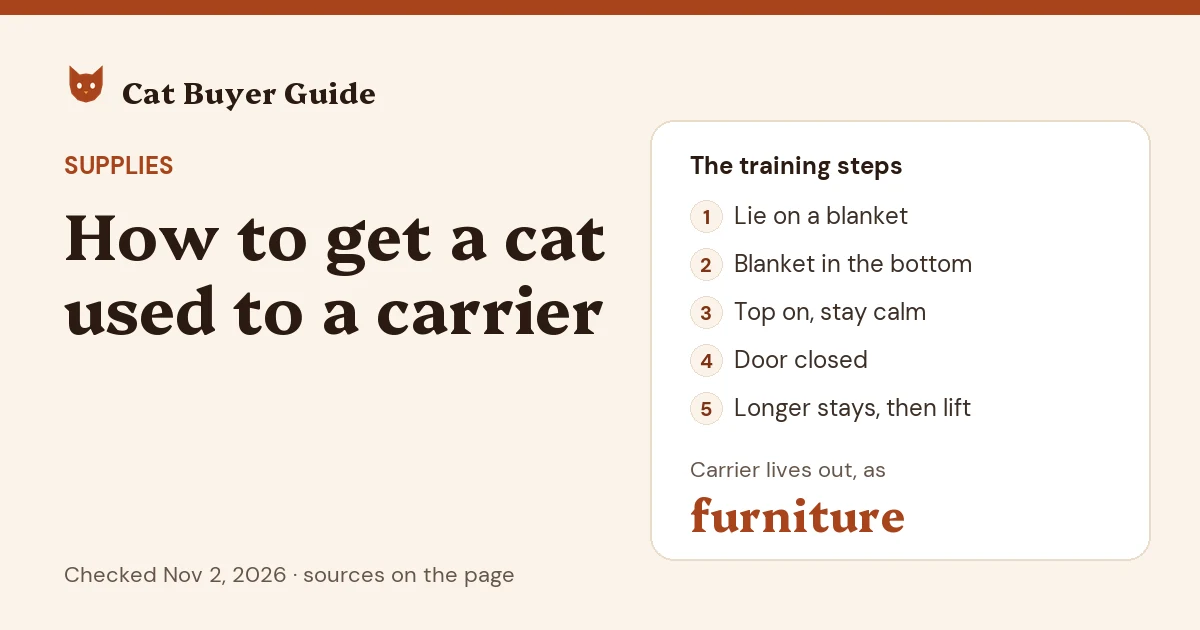
How do you get a cat used to a carrier? Stop storing it away. Leave the carrier out where your cat likes to rest, with soft bedding that smells of home and a few treats inside, so it becomes a familiar bed rather than a sign of the vet. Then train in small steps: from lying on a blanket, to resting in the bottom half, to staying calmly in the closed carrier while you lift it. Move on only when your cat is relaxed at each step.
That is the advice of the feline vets’ associations and International Cat Care (iCatCare), and it works for adult cats too, not only kittens. Below are the six training steps, what to do if a vet visit comes before your cat is ready, and how to keep the trip itself calm in the car, on a train or on foot. We don’t own a cat and haven’t trained one: every step here comes from the sources listed at the end.
The short answer
- Make it furniture: keep the carrier out in a room your cat likes, door open, with familiar bedding and treats.
- Train in six small steps: blanket, blanket in the bottom half, top on, door closed, longer stays, then lifting from underneath.
- Go at your cat’s pace: move to the next step only when your cat is calm at this one.
- On the day: cover the carrier, carry it from underneath, and put it on the car floor behind a front seat.
- If your cat stays very frightened, talk to your vet.
On this page
- Why carrier training is worth the effort
- Start with the right carrier
- Step 0: make the carrier part of the furniture
- The six training steps
- Kittens and older cats
- If the vet visit comes before your cat is ready
- On the day: carrying and the car
- Traveling by train, bus or on foot
- After the visit
- How to get a cat used to a carrier: FAQ
- How we wrote this guide
Why carrier training is worth the effort
Many cats learn that the carrier comes out only for the vet, so they hide when they see it. That fear matters for their health. FelineVMA’s 2025 position statement on transporting cats says poor welfare around vet visits, the journey included, is a major reason owners don’t take their cats for care (FelineVMA). Both FelineVMA and iCatCare warn that avoiding the vet to spare your cat stress could harm its health (FelineVMA; iCatCare guide).
The 2022 AAFP/ISFM Cat Friendly Veterinary Interaction Guidelines call reward-based training before the visit “the gold standard”. They report that trained cats searched more for food rewards during the visit and had significantly shorter exams, citing a 2018 study of carrier-trained cats (Rodan et al., 2022). A carrier that stays out at home is also ready at once if there’s an emergency, iCatCare adds.
Start with the right carrier
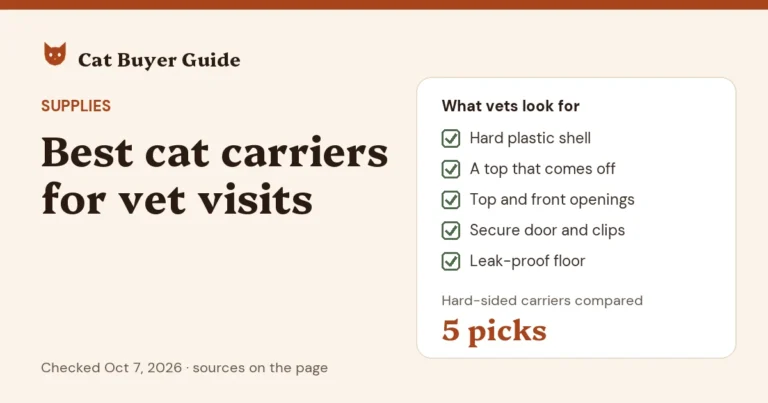
Training is easier in a carrier your cat can step into from more than one side and that the vet can open from the top. FelineVMA and iCatCare both favor a sturdy hard plastic carrier with a top half that comes off, so your cat can stay in the bottom during the checkup. They advise against soft fabric carriers that collapse and backpack carriers that swing the cat around. The 2011 AAFP/ISFM handling guidelines add that a carrier should be stable, easy to carry and quiet to open (Rodan et al., 2011).
Bigger isn’t better. iCatCare notes that cats like a small space and are less likely to move around in one (iCatCare). If you have more than one cat, each needs its own carrier: even cats that get along can behave differently when stressed and confined together.
Our guide to the best cat carriers for vet visits compares five that meet these points. Two that open at the top and the front and have a removable top are the Petmate Two Door Top Load Kennel (19-inch, for pets up to 10 lb, per Petmate) and, for a bigger cat, the Ferplast Atlas 30 Open.
Step 0: make the carrier part of the furniture
Most carriers live in a garage, a basement or a closet until the day they’re needed. Both FelineVMA and iCatCare say it’s much better to keep it in a part of the home where your cat likes to spend time and sleep.
- Put it somewhere quiet that your cat already uses, with the door open or taken off.
- Add a soft blanket or bed your cat has slept on, so it smells familiar.
- Leave treats, catnip or a favorite toy inside now and then, if your cat likes them (Rodan et al., 2011).
- Let your cat go in and out on its own and sleep there if it wants to (iCatCare).
Don’t push your cat in at this stage. The aim, in the 2011 guidelines’ words, is for the cat to link the carrier with good experiences and enter it by choice.
The six training steps
FelineVMA’s brochure sets out carrier training in six simple steps, and iCatCare’s carer guide shows the same progression. Spend as long as your cat needs on each step before moving on.
| Step | What you do | Move on when your cat… |
|---|---|---|
| 1. A security blanket | Encourage your cat to lie or sleep on one blanket | Rests on it readily |
| 2. Blanket in the bottom | Put that blanket in the bottom half of the carrier (top off) | Settles in the bottom half |
| 3. Top on | Add the top and help your cat stay calm | Stays relaxed with the top on |
| 4. Door closed | Encourage your cat to stay inside with the door closed | Stays calm for a short time |
| 5. Longer stays | Slowly increase the time in the closed carrier | Rests in the closed carrier |
| 6. Lift and carry | Pick the carrier up from underneath, never by the handle alone | Is comfortable being carried |
A few things make the steps go better:
- Reward with what your cat likes. The 2011 guidelines mention treats, catnip and toys, and say some owners use a word or a clicker as a cue to enter. Cats differ, they add, so use treats only if they help your cat.
- Short sessions, often. iCatCare and FelineVMA both say training takes time and patience. Neither gives a number of days, and no step has a deadline.
- Stay longer at a step if your cat isn’t comfortable yet: both guides say to allow time at each step before moving on.
- Practice the car before you need it. The 2011 guidelines suggest lifting the carrier in and out of the car, first empty and then with your cat inside, and taking kittens and cats on occasional short car rides, from an early age if possible.
Watch out for: shutting the door the first time your cat walks in. In FelineVMA’s steps the closed door comes at step 4, after your cat is relaxed in the carrier with the top on.
Kittens and older cats
It’s easiest to start with a kitten, FelineVMA says, but every cat can learn to travel calmly in its carrier. iCatCare agrees that adult and older cats still benefit. The 2022 guidelines describe a fearful 12-year-old cat that was carrier-trained successfully after a bad experience at a clinic as a kitten.
With a new kitten, the carrier can be part of the setup from day one: put it in the kitten’s room with its bed and toys. Our first week with a new kitten guide covers that room and the first vet check.
If the vet visit comes before your cat is ready
Sometimes there’s no time to train. The 2011 handling guidelines give a plan for an unwilling cat:
- Find your cat well before you need to leave, so you aren’t rushed.
- Put the carrier in a small room with few hiding places, which may encourage your cat to choose it.
- Put familiar bedding, a toy or a treat inside, and give your cat the chance to walk in.
- Don’t chase your cat.
- If it won’t go in, take the top off, encourage your cat into the bottom tray, and calmly put the top back on.
If your cat panics at the sight of the carrier, iCatCare suggests staying calm, keeping the carrier close but out of sight, then wrapping your cat in a thick, familiar-smelling towel and placing cat and towel in quickly but gently. A top-opening carrier makes this much easier (iCatCare).
Many owners also use a synthetic feline pheromone spray on the bedding. The sources differ on timing: about 15 minutes before travel (iCatCare’s carer guide and the 2022 guidelines), at least 15 to 20 minutes because the spray first smells of alcohol (iCatCare’s travel page), up to 4 hours (FelineVMA), and at least 30 minutes (the 2011 guidelines). Spray the bedding while your cat isn’t nearby.
On the day: carrying and the car
- Cover the carrier with a blanket or thick towel before you go out to the car, so your cat can hide from sights and sounds (FelineVMA).
- Carry it from underneath, keeping it level, not by the handle alone (FelineVMA; iCatCare).
- Put it on the floor behind the driver’s or passenger’s seat. FelineVMA’s 2025 position statement says to use a seat belt only with a carrier that is crash-test certified by the Center for Pet Safety, because a belt can crush other carriers.
- Keep the car calm: good ventilation, a comfortable temperature, the radio off or low, quiet voices (FelineVMA).
- Never open the carrier on the way, even if your cat is meowing (FelineVMA).
Traveling by train, bus or on foot
iCatCare’s guide covers trips that aren’t by car, too: the motion and the new noises, sights and smells can unsettle a cat however you travel. Its tips are to cover the carrier, keep it secure, and use a buggy or trolley if you’re walking, so the carrier doesn’t swing. It also suggests putting the carrier on plastic sheets or bags in case of soiling, and taking spare blankets and absorbent tissues on a longer journey.
For a flight, iCatCare says to find out what carrier the airline prefers or specifies; for a train or bus, check the operator’s own pet rules before you go. The training steps above are the same for any trip.
After the visit
Your cat may smell different to your other cats when it comes home, especially after an operation, and they may hiss or avoid each other. FelineVMA and iCatCare suggest keeping the returning cat in its own room with food, water, a litter box and a bed for a while, then letting the cats meet again gradually. iCatCare also suggests washing the carrier’s bedding to remove the clinic smells. Then put the carrier back in its usual spot, door open, so the training keeps going.
Talk to your vet
- If your cat stays very frightened despite training, or drools or vomits on every trip, ask your vet about medicine for travel or travel sickness. FelineVMA and iCatCare both say prescribed medicine can help some cats. Only give what your vet prescribes, and iCatCare suggests trying it before the appointment day.
- Ask your vet whether you can offer a treat in the carrier on the day of a visit.
- Tell the clinic if your cat is easily upset, so the team can prepare (2011 handling guidelines).
How to get a cat used to a carrier: FAQ
How long does it take to get a cat used to a carrier?
There’s no set time. FelineVMA and iCatCare say carrier training takes time and patience, and that you should spend as long as your cat needs on each step. FelineVMA notes that trips that went badly in the past can keep a cat stressed, so such a cat may need longer. Start well before the next vet visit.
Should I leave the cat carrier out all the time?
Yes. Both FelineVMA and iCatCare recommend keeping it out in a place your cat likes, with familiar bedding, rather than storing it away. That way the carrier smells of home, and it’s ready if there’s an emergency.
Can you carrier train an older cat?
Yes. FelineVMA says all cats can learn to be content in their carrier, and iCatCare says adult and older cats still benefit. The 2022 vet guidelines describe a fearful senior cat that was trained successfully.
My cat hides when the carrier comes out. What now?
That usually means the carrier predicts the vet. Leave it out every day as furniture, with bedding and treats, and start again from step 1. If you need to go before your cat is ready, use the small-room method above, and ask your vet about other help if your cat stays very scared.
What’s the best cat carrier for training?
One with a top and a front opening and a top half that comes off, in sturdy plastic, as FelineVMA and iCatCare advise. Our cat carrier buyer’s guide lists five carriers that meet those points. For cars, the Center for Pet Safety lists carriers that passed its crash tests.
How we wrote this guide
We read the client guides of FelineVMA and International Cat Care, iCatCare’s travel and vet-visit pages, the AAFP/ISFM handling guidelines of 2011 and 2022, and FelineVMA’s 2025 transport position statement, and re-opened each one on November 2, 2026. The study on carrier training (Pratsch and colleagues, 2018) is described here only as the 2022 guidelines report it. We don’t own a cat and haven’t tested these steps or the carriers we link: the carrier picks come from our buyer’s guide, which compares makers’ specifications, not hands-on use.
Sources
- FelineVMA: Visiting Your Veterinarian, Getting Your Cat to the Veterinary Practice (client brochure, 2024), checked Nov 2, 2026
- International Cat Care: Taking your cat to the veterinary clinic, a guide for cat carers (2022), checked Nov 2, 2026
- International Cat Care: Travelling with your cat (updated Sept. 26, 2025), checked Nov 2, 2026
- International Cat Care: Taking your cat to the vet (updated Sept. 26, 2025), checked Nov 2, 2026
- Rodan et al.: 2022 AAFP/ISFM Cat Friendly Veterinary Interaction Guidelines (JFMS), checked Nov 2, 2026
- Rodan et al.: AAFP and ISFM Feline-Friendly Handling Guidelines (2011, endorsed by AAHA), checked Nov 2, 2026
- FelineVMA: 2025 Transportation of Cats in Motor Vehicles (position statement), checked Nov 2, 2026