Best Automatic Cat Feeders: A Buyer’s Guide (2026)

A buyer's guide built from specifications, warranties and return policies, not hands-on testing. Facts and prices checked November 6, 2026. We may earn a commission if you buy through links on this page. It never changes what we recommend. As an Amazon Associate we earn from qualifying purchases. How we research
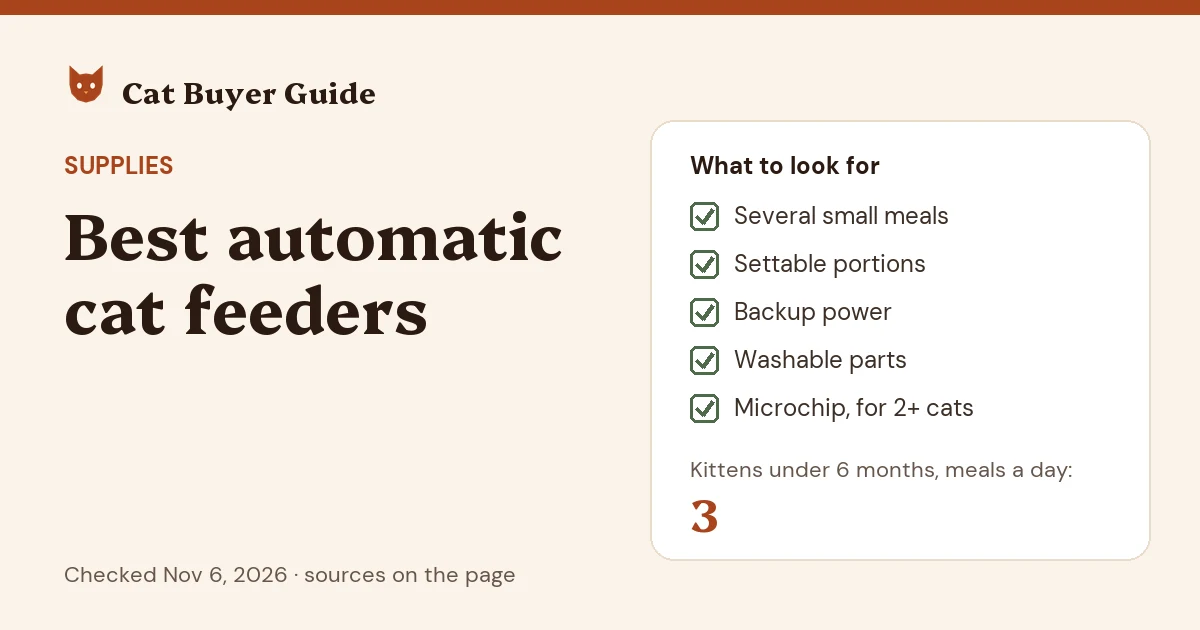
The best automatic cat feeder serves several small meals a day on a timer, in portions you can set, and keeps working through a power cut. That fits what vets advise: the AAFP and ISFM feeding consensus says to split a cat’s daily food into multiple small meals spread over 24 hours, and names automatic feeders as one way to do it. But a feeder is a helper, not a babysitter. The same vets say you still need to check that your cat actually eats and keeps a healthy weight, and that puzzle feeders, where you can use them, also let a cat forage.
This is a buyer’s guide built from the makers’ published specifications, warranty pages and return policies, checked on November 6, 2026. It is not a hands-on test: we don’t own a cat, and we didn’t buy, handle or try any of these feeders.
The short answer
- Best overall (dry food, no app): PetSafe Healthy Pet Simply Feed: up to 12 meals a day, runs on batteries, dishwasher-safe bowl.
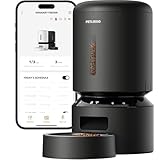
- With an app and feeding log: PETLIBRO Granary (Wi-Fi): up to 10 meals a day, battery backup, dry food only.
- For wet food: Cat Mate C500: five compartments with ice packs under the lid.
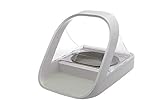
- For two or more cats: SureFeed Microchip Pet Feeder: opens only for the cat it knows. It’s not a timer.
- Whatever you buy: watch your cat eat from it for a few days, and weigh it regularly.
What vets say about automatic feeders
Small, frequent meals. Cats are solitary hunters of small prey and prefer to eat often and alone, says the AAFP/ISFM feeding consensus. It advises splitting the daily food allowance into multiple small meals over the 24-hour day, with puzzle feeders when possible. Automatic feeders can also help, it says, though they don’t usually let a cat forage or “hunt” for its food.
Kittens eat more often. Until six months old, kittens usually do best on three meals a day, then twice a day until about a year, says Cornell’s Feline Health Center. Cornell also says to pick a schedule and keep it consistent, which is what a timer is good at. Our guide to what to feed a kitten has the meal plan by age.
Check that your cat eats. The consensus says owners must make sure the cat is actually eating the right amount and can reach the food, and that weight and body condition should be checked regularly.
Several cats need separate stations. In multi-cat homes, the consensus advises several feeding stations out of sight of each other. It notes that meals can be served through programmable feeders, some of which read a cat’s microchip. Cornell adds that when food is left out in a multi-cat home, some cats can overeat while others miss out.
Where to put it. Feed your cat where it feels safe, and not close to a litter box, says the consensus.
What to look for in an automatic cat feeder
| What to look for | Why | Source |
|---|---|---|
| Several meals a day | Cats do best on small, frequent meals | AAFP/ISFM, Cornell |
| Small, settable portions | Splits the daily amount without overfeeding | AAFP/ISFM |
| Backup power | Keeps meals coming in a power cut | Makers’ specs |
| Parts you can wash | Makers say which parts go in the dishwasher | Makers’ specs |
| The food you use | Some feeders take dry food only | Makers’ specs |
| Microchip access, for several cats | Stops one cat eating another’s food | AAFP/ISFM |
Four automatic cat feeders that meet the criteria
Every detail below comes from the maker’s own page. We don’t list prices, and we didn’t test any of these.
| Feeder | Food | Meals a day | Power | Warranty |
|---|---|---|---|---|
| PetSafe Healthy Pet Simply Feed | Dry or semi-moist | Up to 12 | 4 D batteries, or adapter sold separately | 1 year |
| PETLIBRO Granary (Wi-Fi) | Dry only | Up to 10 | Adapter plus battery backup | 24 months |
| Cat Mate C500 | Wet, dry | 4 on the timer, plus 1 at setup | 3 AA batteries | 3 years |
| SureFeed Microchip Pet Feeder | Wet, dry | Not a timer | 4 C batteries | 3 years |
1. Best overall: PetSafe Healthy Pet Simply Feed
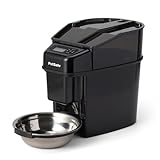
The Simply Feed schedules up to 12 meals a day, from 1/8 cup to 4 cups each, from a hopper that holds 24 cups of dry or semi-moist food, PetSafe says. A conveyor serves kibble up to 3/4 inch across, and a pet-proof dispenser is meant to stop cats from getting at the food between meals. A slow-feed setting is there for cats that eat too fast. It runs on four D-cell batteries (not included), or on a wall adapter sold separately, so it doesn’t need a socket or Wi-Fi.
For cleaning, the stainless steel bowl, bowl holder, lid and hopper go in the top rack of the dishwasher; the conveyor is washed by hand. It measures 19 x 9 x 12.5 inches. PetSafe gives a one-year limited warranty, and takes returns of items bought from PetSafe within 45 days.
Best for: one cat on dry food, and owners who’d rather not use an app. Twelve meals a day covers a kitten’s three-plus meals with room to spare.
Watch out for: the smallest portion is 1/8 cup, so check that this matches your cat’s daily amount split into meals. There’s no feeding log, so watch your cat eat.
 See the PetSafe Healthy Pet Simply Feed on Amazon
2. With an app: PETLIBRO Granary Automatic Cat Feeder (Wi-Fi)
The Granary schedules up to 10 meals or snacks a day from the PETLIBRO app, with 1 to 50 portions per meal, each about 20 ml, PETLIBRO says. The hopper holds 5 liters and takes kibble 2 to 15 mm across. It runs on a USB adapter with a battery backup, so it keeps feeding in a power cut, and the app logs each meal and warns of low food, low battery or a blockage. The maker’s FAQ says it works with dry food only.
It measures 13.4 x 7.5 x 7.5 inches. PETLIBRO gives a 24-month warranty on feeders and takes undamaged returns within 30 days.
Best for: owners who are out a lot and want a feeding log on their phone, and kittens that need several small meals.
Watch out for: dry food only. We couldn’t find the bowl’s material or a dishwasher statement on the product page, so check the manual before you buy. A log shows that food was served, not that your cat ate it.
 See the PETLIBRO Granary on Amazon
3. For wet food: Cat Mate C500
The two feeders above take dry or semi-moist food. The Cat Mate C500 is a round feeder with five compartments that each hold 330 g (about 11.5 ounces) of wet or dry food, with twin ice packs that fit under the lid, says its maker, Closer Pets. The lid and bowl are dishwasher safe, and it runs on 3 AA batteries, which the maker says last about 12 months. It comes with a 3-year warranty.
How many timed meals? The maker’s page says “schedule 5 meals”, while the Amazon listing says you program up to four mealtimes, with one bowl available straight away. Plan on four timed meals plus one you serve at setup.
Best for: a cat on wet food, or one meal of wet food in an otherwise dry-food day.
Watch out for: the maker’s page we found is its UK store; the Amazon listing is the US version. The maker also lists raw food, but our kitten feeding guide explains why vets and the FDA advise against raw diets.
See the Cat Mate C500 on Amazon
4. For two or more cats: SureFeed Microchip Pet Feeder
The SureFeed isn’t a timer. It is a covered bowl whose lid opens only when a registered cat comes close, reading its microchip or the SureFlap RFID collar tag that comes in the box, Sure Petcare says. It remembers up to 32 pets, holds 400 ml of wet or dry food (or two pouches of wet food) in a sealed bowl, runs on four C batteries for about six months, and has a 3-year warranty.
It is the kind of feeder the AAFP/ISFM consensus mentions for multi-cat homes: a programmable feeder that uses individual microchips, so a cat on a diet or a special food gets its own.
Best for: homes with two or more cats where one eats another’s food, or a cat on a prescription diet.
Watch out for: it serves no meals by itself; you fill it, and the cat eats when it likes. Pair it with set mealtimes if your cat needs portions. The “Connect” version needs a hub sold separately.
 See the SureFeed Microchip Pet Feeder on Amazon
How we chose, and what we left out
We started from the AAFP/ISFM feeding consensus and Cornell’s feeding advice, set the criteria above, then read each maker’s own product page and warranty or return policy on November 6, 2026. We opened each Amazon listing in a normal browser view to check it was the same product (by model number) and in stock. We left out:
- Gravity feeders, which refill the bowl as the cat eats: they don’t portion meals, so they don’t meet the small-meals criterion.
- Camera feeders: a camera adds nothing our sources ask for.
- PetSafe’s Wi-Fi Smart Feed, which meets the criteria too; the Granary already covers the app-and-backup-power case.
A feeder isn’t on this list because it sells well, and no maker paid to be here. We earn a small commission if you buy through our Amazon links.
Setting it up
- Start while you’re home. Run the feeder for a few days and watch your cat eat from it, as the consensus asks owners to check that the cat is eating.
- Split the daily amount. Take your cat’s daily food amount (on the food label or from your vet) and divide it by the number of meals.
- Keep a schedule. Cornell says to find a schedule that works for you and your cat, then keep it consistent.
- Place it well: somewhere quiet where your cat feels safe, and away from the litter box (AAFP/ISFM). A water fountain or bowl nearby, but not right beside the food, is worth adding.
- Clean it as the maker says, and change the batteries before they run out.
Talk to your vet
- Ask your vet how much your kitten or cat should eat a day, and weigh your cat regularly. A sudden change in appetite or weight is a reason to call.
- If your cat stops eating or eats much less, call your vet, whatever the feeder’s log shows.
- Cats on prescription diets or with diabetes: ask your vet before changing meal times.
Best automatic cat feeder: FAQ
Are automatic feeders good for cats?
They can help. The AAFP/ISFM feeding consensus says cats do best on several small meals a day and lists automatic feeders as one way to serve them, though puzzle feeders also let a cat forage. Check that your cat eats from it and keeps a healthy weight.
Can I use an automatic feeder for a kitten?
Yes, if it serves small portions several times a day: Cornell says kittens usually do best on three meals a day until six months old. Watch your kitten use it while you’re home first, and ask your vet how much to feed.
What’s the best automatic feeder for two cats?
If one cat eats the other’s food, a microchip feeder such as the SureFeed, one for each cat, keeps their food apart. The AAFP/ISFM consensus also advises separate feeding stations out of each other’s sight.
Can an automatic feeder hold wet food?
Not all of them: the PETLIBRO Granary takes dry food only, and the Simply Feed dry or semi-moist. The Cat Mate C500 holds wet food in compartments with ice packs, and the SureFeed takes wet food in a sealed bowl.
Can I leave my cat alone with an automatic feeder?
A feeder serves food; it can’t tell you whether your cat ate, or notice that it’s unwell. The AAFP/ISFM consensus says owners need to make sure their cat is actually eating. So when you’re away, someone still needs to check that your cat is eating.
Sources
- AAFP and ISFM: Feline feeding programs, consensus statement (Sadek et al., J Feline Med Surg 2018, PMC copy), checked Nov 6, 2026
- Cornell Feline Health Center: How often should you feed your cat?, checked Nov 6, 2026
- PetSafe: Healthy Pet Simply Feed (PFD00-14574), checked Nov 6, 2026
- PetSafe: Return and warranty information, checked Nov 6, 2026
- PETLIBRO: Granary Automatic Cat Feeder with WiFi App Control, checked Nov 6, 2026
- PETLIBRO: Return and refund policy (warranty periods), checked Nov 6, 2026
- Closer Pets: Cat Mate C500 Five-meal Automatic Pet Feeder with Digital Timer (UK maker page), checked Nov 6, 2026
- Sure Petcare: SureFeed Microchip Pet Feeder, checked Nov 6, 2026