Cat Breeder Red Flags: 15 Signs to Walk Away

Built from dated data and expert sources, not hands-on pet testing. Facts and prices checked October 7, 2026. No affiliate links on this page. How we research
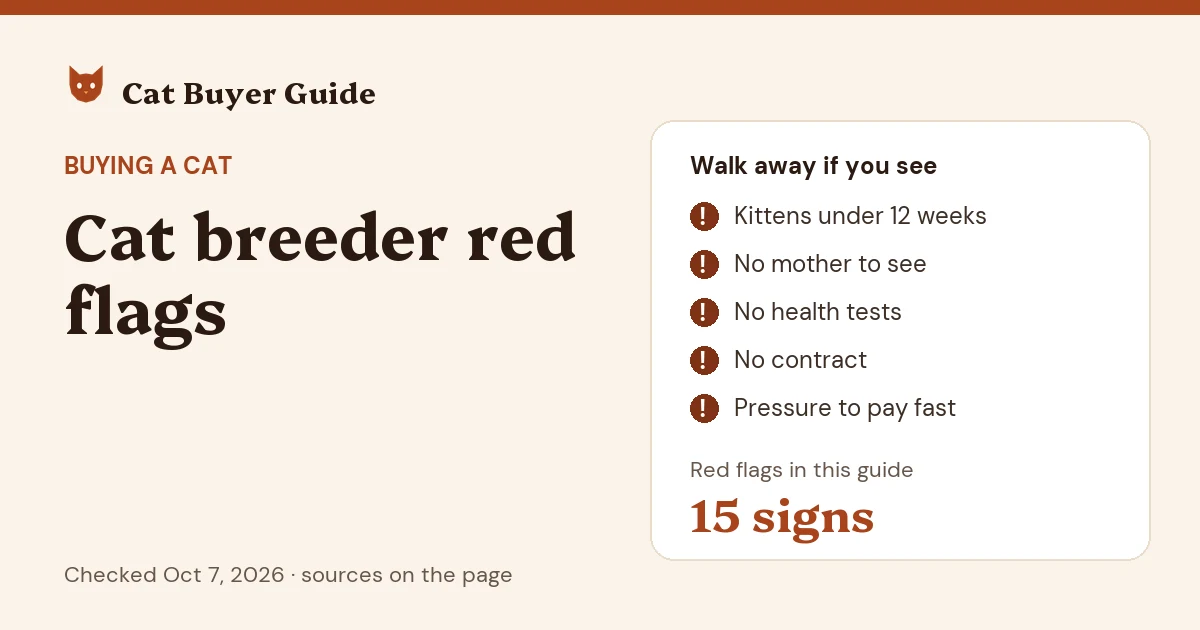
A good cat breeder is easy to check and in no hurry to sell. A bad one rushes you, hides things or cuts corners. One red flag is a reason to slow down and ask questions; several together are a reason to walk away, however cute the kitten.
The short answer
These are the most serious cat breeder red flags. Walk away from a breeder who:
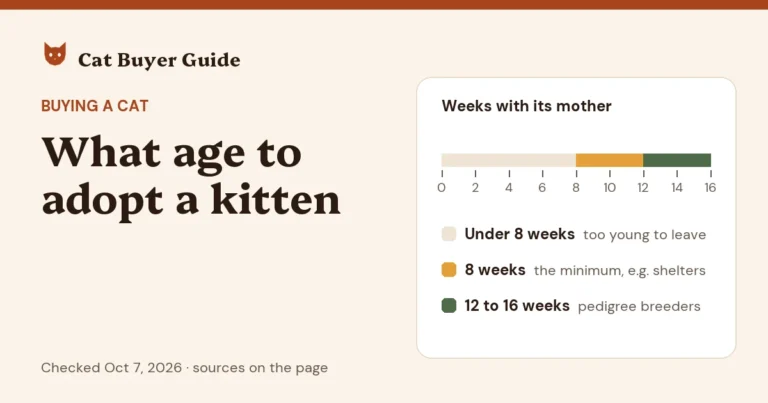
- Lets kittens go before 12 weeks. Most good breeders wait until 12 to 16 weeks.
- Won’t show you the kitten with its mother, in person or on a live video call.
- Has no health tests or vet records for the parents and the kitten.
- Won’t give you a written contract with a health guarantee.
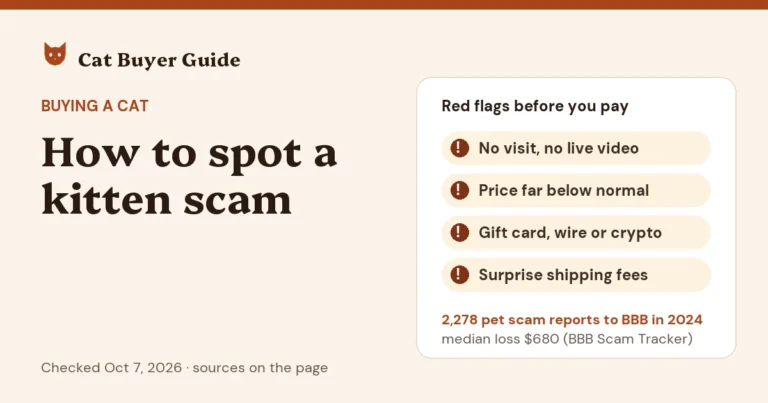
- Pushes you to pay fast, especially by gift card, wire transfer, crypto or a payment app.
We checked each sign below against CFA’s and TICA’s codes and buyer guides, International Cat Care, veterinary guidelines, UC Davis’s genetic tests and FTC and BBB scam advice on Oct 7, 2026.
Bad cat breeder signs come in two kinds. A scammer sells a kitten that may not exist; for that, see how to spot a kitten scam. A careless or “backyard” breeder has real kittens but cuts corners on health, age and care. Many of the 15 signs fit both.
On this page
- Red flags about the kittens
- Red flags about the cattery and the parents
- Red flags in health tests and paperwork
- Red flags about money and pressure
- Online red flags
- Cat breeder red flags at a glance
- Green flags: how to tell if a cat breeder is legit
- What to do if you spot a red flag
- Cat breeder red flags FAQ
Red flags about the kittens
1. Kittens offered before 12 weeks
“Kittens allowed to leave very young are a red flag,” says CFA. Most breeders wait until 12 to 16 weeks, and TICA’s buyer leaflet says 14 weeks or older. By then a kitten has had more of its core vaccines, given every 3 to 4 weeks from 6 weeks until 16 to 20 weeks (AAHA/AAFP), and more time to learn from its mother and littermates (CFA). Under 8 weeks, shipping a kitten breaks federal rules (9 CFR 2.130) and selling one breaks some state laws, such as Florida’s. See what age to bring a kitten home.
2. Kittens that look sick or very scared
A healthy kitten has clean eyes, nose and ears, a clean coat with no bald patches, a clean bottom, and moves easily (International Cat Care; TICA). A runny nose or eyes or a dirty bottom are signs of ill health and a clue to the litter’s care, says the Kitten Checklist from UK vet and welfare groups, and a kitten still hiding or hissing after a calm visit may never become a confident pet. CFA’s advice: don’t buy a kitten that looks ill, however much you love it.
Red flags about the cattery and the parents
3. You can’t see the kitten with its mother
Seeing the kitten with its mother shows it was really bred there, not brought in from a kitten farm, says the Kitten Checklist, which calls this vital. Many breeders no longer accept home visits, CFA notes, but they should offer photos and FaceTime or Zoom calls, and CFA calls a breeder who can’t a big warning sign. TICA says to see the parents in person, or by video if you can’t visit.
4. The handover happens somewhere else
A seller who wants to meet in a parking lot or at another house, or to deliver the kitten, may be hiding how the cats really live: kitten farms and careless breeders may use a different house as a “shop front,” RSPCA Australia warns. CFA advises picking a kitten up in person, and its breeder code commits breeders to placing cats directly with the new owner, or at least staying in touch with them.
5. Too many cats or litters
Many good breeders have only one or two litters a year, and some breed only when people are on their waiting list (CFA). Where many cats and litters share a home, disease spreads more easily and each kitten gets less attention (Kitten Checklist; International Cat Care). CFA’s minimum cattery standard calls for clean quarters, litter scooped at least daily and prompt vet care for sick cats. A dirty, smelly, crowded home is a reason to be wary, says International Cat Care.
6. Won’t answer your questions, or asks you none
TICA lists “lack of knowledge about the breed or reluctance to answer questions” as a red flag (TICA). A good breeder also has questions for you: about your home, your hours, children, other pets and your vet (CFA; TICA). A seller who asks nothing isn’t checking where the kitten will live.
Red flags in health tests and paperwork
7. No health tests on the parents
Many breeds carry inherited diseases that DNA tests can screen for. The UC Davis Veterinary Genetics Laboratory, for example, tests for PKD1, a kidney disease common in Persians and related breeds, and for heart disease (HCM) mutations in Maine Coons and Ragdolls. Cornell says a cat that may carry PKD, especially a Persian, must be tested, and a carrier must not be bred. Ask for both parents’ health and genetic records, as TICA advises, and see the lab reports: “parents DNA tested” means little without proof, says RSPCA Australia. A DNA test isn’t everything: for diagnosing HCM, Cornell calls a heart ultrasound the gold standard.
8. No vaccination or vet records
You should get the kitten’s health and vaccination record when you take it home (TICA). Under TICA’s voluntary Outstanding Cattery code, a kitten isn’t released until it has been vaccinated at least twice against panleukopenia, rhinotracheitis and calicivirus, and CFA’s code says kittens aren’t placed before they have proper immunity. Ask about worming and a vet check too (CFA). Without records, you can’t tell what the kitten has had.
9. No written contract or health guarantee
TICA’s leaflet says a responsible breeder sells kittens only with a written contract that includes a health guarantee, and its buyer’s guide says the contract should cover returns too. No breeder can promise perfect health, CFA notes, so ask how problems are handled: a refund or a replacement. Good breeders will take a cat back if serious problems arise (International Cat Care), and many offer a rehoming guarantee or first refusal (CFA).
10. Registration you can’t check
A pedigree breeder should register litters correctly (CFA code) and give you the kitten’s pedigree (TICA). Look the cattery up yourself, for example in CFA’s Find a Breeder (TICA has a breeder list too), and contact it using the registry’s details, as our scam guide explains. A registry listing isn’t an endorsement, though, and held-back papers can be normal (see the FAQ).
Red flags about money and pressure
11. Pressure to pay fast, or a big deposit
TICA says not to rush a purchase even if you’re told demand is high, and the FTC says honest businesses give you time to decide. A small deposit to reserve a kitten is reasonable, and most breeders will refund it under some conditions; scams are more likely when large, nonrefundable deposits are required (CFA). TICA also warns against paying in full before you’ve chosen a specific kitten.
12. Payment by gift card, wire, crypto or app
No legitimate seller requires gift cards, wire transfers or cryptocurrency, the FTC says, and payment apps like Venmo make money hard to recover. Pay by credit card if you can. Our kitten scam guide covers safer ways to pay and what to do if you’ve already paid.
13. A price far below the usual
Learn the breed’s usual price range first. TICA says unusually low or high prices can signal a scam, and that a supposedly free kitten needing a shipping fee is a red flag. BBB lists popular breeds at very low prices among its pet scam red flags.
Online red flags
14. A website full of kittens, or copied photos
Most breeders don’t have many kittens at once, so a website filled with available kittens is a warning sign, and such sites often steal photos from real breeders (CFA). A real breeder’s site should show its adult cats and cattery and give contact details. Put the kitten photos into a reverse image search: if they’re stock photos or copied, move on (FTC).
15. Contact by text or email only
TICA says to avoid breeders who only communicate by email or text, and warns that scam operations hide their physical address and real contact details. CFA adds that you won’t find reliable breeders on Craigslist or other sites that aren’t just for cats. A brand-new website is another warning sign (RSPCA Australia).
Cat breeder red flags at a glance
| Red flag | Why it matters |
|---|---|
| Kitten under 12 weeks | Fewer vaccines, less time with its mother |
| Sick or scared kitten | Poor care; problems may last |
| No mother in sight | The kitten may not have been bred there |
| Handover elsewhere | Hides how the cats live |
| Too many cats | More disease, less handling |
| No answers, no questions | No breed knowledge, no check on your home |
| No health tests | Inherited disease can pass to kittens |
| No vet records | No proof of vaccines or worming |
| No contract | No health guarantee or return terms |
| Registration unclear | Pedigree claims can’t be checked |
| Rush or big deposit | Common in scams |
| Gift card, wire, crypto | No legitimate seller requires them |
| Bargain price | A classic scam lure |
| Site full of kittens | Often stolen photos |
| Text-only contact | Scammers hide their address |
Green flags: how to tell if a cat breeder is legit
Look for a breeder who:
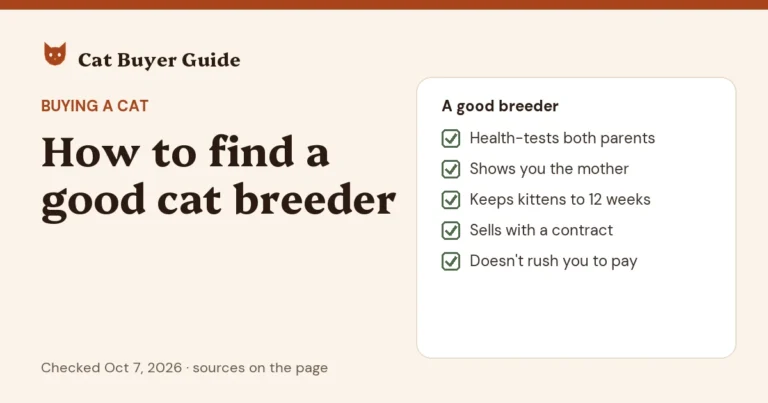
- has few litters, and often a waiting list;
- shows you the kitten with its mother, at home or on a live video call;
- shows you lab reports for the parents’ breed-specific health tests;
- sends kittens home at 12 to 16 weeks, vaccinated at least twice, with records;
- gives you a written contract with a health guarantee, and will take the cat back if serious problems arise;
- asks you questions, and stays available for advice for the life of the cat (CFA; TICA).
Our guide to choosing a cat breeder covers the questions to ask and how to check a cattery.
What to do if you spot a red flag
- Ask about it. Some flags have innocent answers, such as no home visits but a video call instead. A good breeder will explain without getting annoyed.
- Don’t pay anything until you’re satisfied, and keep any deposit small and in writing.
- Walk away from a sick or frightened kitten rather than buy it out of pity, as International Cat Care advises.
- Suspect a scam? Stop paying, and follow the steps in how to spot a kitten scam, including reporting it to the FTC and BBB.
- See neglect or cruelty? Report it to local animal control, the police or a humane society, as the ASPCA advises.
- Already bought a sick kitten? Check the contract and your state’s law. Florida’s, for example, lets you return a kitten from a seller it covers for a refund or exchange, or keep it and recover vet costs, if a vet certifies within 14 days that it was sick when sold.
Talk to your vet
Have any new kitten checked by your own vet within a few days, as TICA’s leaflet advises, and call sooner if it stops eating, has diarrhea, or has discharge from its eyes or nose. Ask your vet, too, which inherited diseases and health tests matter for the breed you want.
Cat breeder red flags FAQ
What is a backyard cat breeder?
RSPCA Australia describes backyard breeding as irresponsible breeding in poor conditions with too little care, often by people with little experience; on a large scale, it’s called kitten farming. Poor nutrition, infections, parasites, and behavior and genetic problems are common results. Backyard cat breeder signs are the red flags above.
Is it a red flag if a breeder won’t let me visit?
Not on its own. Many breeders stopped home visits after COVID, partly because some visits were covers for crime, CFA says. But you should see the kitten with its mother on a live video call, and collect it in person. A seller who offers neither is a red flag.
Is it normal for a breeder to hold back the registration papers?
Yes, for a pet kitten. Many breeders send the registration papers only after you send a vet’s proof of spay or neuter (TICA; CFA). You should still get the health and vaccination record, the sales agreement and the pedigree.
Does a CFA or TICA listing mean a breeder is good?
No. It shows the cattery is on the registry’s records. CFA and TICA both say they make no representations about the breeding or business practices of the breeders they list, and both advise the care you’d give any important business deal. Check every breeder against the red flags above.
Sources
- CFA: Code of Ethics for CFA Breeders, checked Oct 7, 2026
- CFA: Cattery Standard Minimum Requirements, checked Oct 7, 2026
- CFA Cat Talk: Could This Kitten Be A Scam? (Hoos, 2025), checked Oct 11, 2026
- CFA Cat Talk: Good Things Come To Those Who Wait (Preston and Giddings, 2024), checked Oct 7, 2026
- CFA Cat Talk: So You Want to Get a New Pedigreed Cat (Coughlan, 2025), checked Oct 7, 2026
- CFA: Find a Breeder, checked Oct 7, 2026
- TICA: Finding the Purrfect Pedigreed Kitten (buyer leaflet), checked Oct 7, 2026
- TICA: Pet Buyer’s Guide, checked Oct 7, 2026
- TICA: Outstanding Cattery Voluntary Code of Ethics (revised 2018), checked Oct 7, 2026
- TICA: Disclaimers, checked Oct 7, 2026
- International Cat Care: Choosing a kitten (2025), checked Oct 7, 2026
- The Cat Group: The Kitten Checklist (via International Cat Care), checked Oct 7, 2026
- AAHA and AAFP: 2020 Feline Vaccination Guidelines (Stone et al., JFMS), checked Oct 7, 2026
- UC Davis Veterinary Genetics Laboratory: Cat DNA tests, checked Oct 7, 2026
- UC Davis Veterinary Genetics Laboratory: Polycystic Kidney Disease (PKD1), checked Oct 7, 2026
- UC Davis Veterinary Genetics Laboratory: Hypertrophic Cardiomyopathy (HCM) in Maine Coons, checked Oct 7, 2026
- UC Davis Veterinary Genetics Laboratory: Hypertrophic Cardiomyopathy (HCM) in Ragdolls, checked Oct 7, 2026
- Cornell Feline Health Center: Polycystic Kidney Disease, checked Oct 7, 2026
- Cornell Feline Health Center: Hypertrophic Cardiomyopathy (updated May 2025), checked Oct 7, 2026
- RSPCA Australia: The Smart Kitten and Cat Buyer’s Guide (2024), checked Oct 7, 2026
- RSPCA Australia: What are some red flags when looking for a dog or cat online? (2024), checked Oct 7, 2026
- RSPCA Australia: What is a ‘backyard breeder’? (2024), checked Oct 7, 2026
- FTC: Get the dog or cat instead of the scam (consumer alert, 2023), checked Oct 11, 2026
- FTC: How To Avoid a Scam (2023), checked Oct 7, 2026
- BBB: Puppy Scams 2025 Study Update, checked Oct 7, 2026
- 9 CFR 2.130, Minimum age requirements (Animal Welfare Act regulations), via Cornell LII, checked Oct 11, 2026
- Florida Stat. 828.29 (Animal Legal & Historical Center copy), checked Oct 11, 2026
- ASPCA: Recognizing and Reporting Animal Abuse and Neglect, checked Oct 7, 2026