What to Feed a Kitten: Food, Meals per Day and Milk, by Age

Built from dated data and expert sources, not hands-on pet testing. Facts and prices checked October 31, 2026. We may earn a commission if you buy through links on this page. It never changes what we recommend. As an Amazon Associate we earn from qualifying purchases. How we research
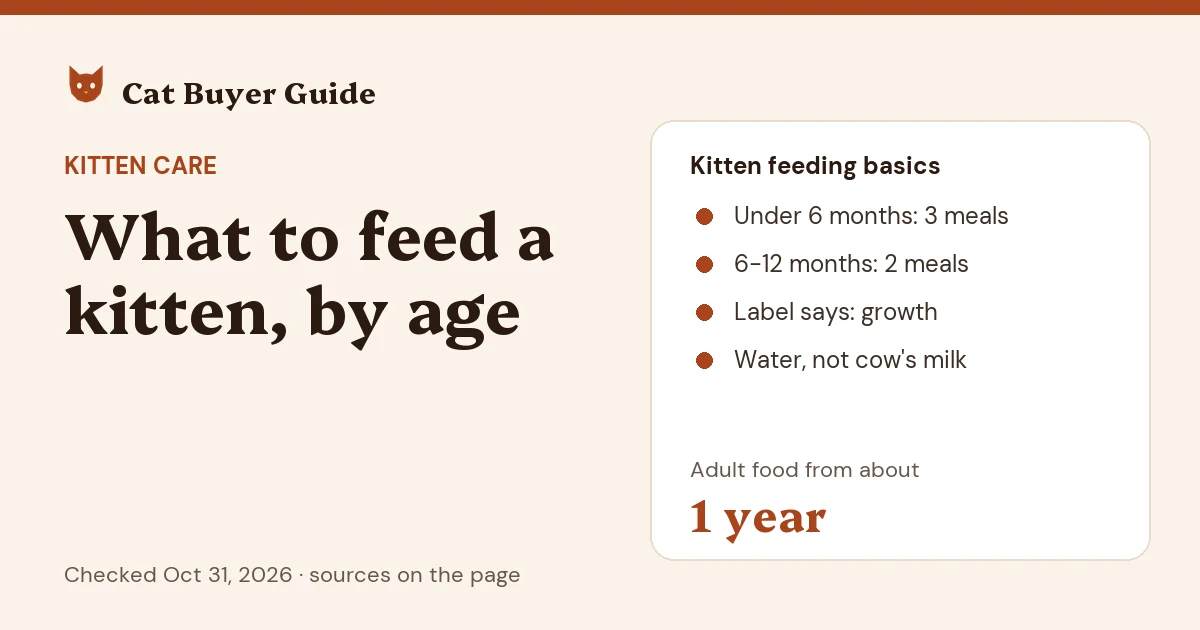
Feed a kitten a commercial kitten food whose label says it is “complete and balanced” for growth (or for all life stages), plus fresh water at all times. Give it small meals often: Cornell’s feline health center says kittens usually do best on three meals a day until six months old, then two a day until about one year, when it can move to adult food. Wet, dry or both is fine if the food is complete. Skip cow’s milk, and skip raw diets: the FDA advises against them.
We built this guide from the advice of the Cornell Feline Health Center, the 2021 feline life stage guidelines from the American Animal Hospital Association and the American Association of Feline Practitioners (AAHA/AAFP), the ASPCA, the FDA, AAFCO (the body whose nutrient profiles appear on US pet food labels), Cats Protection and International Cat Care, checked on October 31, 2026. It’s general guidance. Your vet knows your kitten, so ask them about its food at the first visit.
Kitten feeding by age at a glance
| Age | What the kitten eats |
|---|---|
| 0 to 4 weeks | Its mother’s milk only |
| 3 to 5 weeks | Weaning starts: first tastes of kitten food |
| 6 to 9 weeks | Fully weaned onto kitten food and water |
| 8 weeks to 6 months | Kitten food, three or more meals a day |
| 6 to 12 months | Kitten food, two meals a day |
| About 1 year | Move slowly to adult food |
The sources give slightly different weaning ages. Cats Protection says weaning can begin at three to four weeks, and the AAHA/AAFP guidelines say kittens can start on kitten food at three to five weeks. Cats Protection puts full weaning at six to eight weeks on one page and around nine weeks on another. The ASPCA says that by about eight weeks, 80 to 90% of what a kitten eats should be kitten food. Most kittens you bring home have already been weaned, which is one reason not to take one home before eight weeks (see what age to adopt a kitten).
Choose a complete and balanced kitten food
Kittens grow fast and burn a lot of energy. The ASPCA says they need about two to three times the energy of an adult cat, with about 30% of it from protein. The AAHA/AAFP guidelines give an example: a 10-week-old kitten needs about 200 kcal per kilogram of body weight a day, and a 10-month-old about 80. That’s why the food matters more now than later.
Look for the nutritional adequacy statement on the bag or can. It’s usually in small print on the back or side. The FDA explains that AAFCO has two nutrient profiles for cats: one for growth and reproduction, which covers growing kittens, and one for adult maintenance. Adult food has lower levels of some nutrients. So the statement should say the food is complete and balanced for growth or for all life stages (which includes growth). The FDA adds that the statement should refer to an AAFCO nutrient profile or an AAFCO feeding trial, and that other seals and endorsements aren’t a guarantee.
A few more things to check:
- It’s cat food. AAFCO notes that cats need nutrients, such as taurine and pre-formed vitamin A, that dogs don’t. Dog food isn’t a substitute, and the ASPCA warns to keep a dog away from the kitten’s bowl.
- Meat comes first. Cats are obligate carnivores, Cornell explains: they rely on nutrients found only in animal products. Cornell suggests looking for meat, meat byproducts or seafood among the first few ingredients.
- “Complete,” not “complementary.” Cats Protection says a complete food holds everything the cat needs. Complementary foods, such as treats, need other food alongside.
- All life stages feeding directions. A food sold for all life stages should give separate feeding amounts for growth, AAFCO says. Use those, not the adult amounts.
Beyond these basics, Cornell’s view is that once a food is complete and balanced, choosing between types can come down to what your cat prefers.
How many times a day to feed a kitten
Kittens have small stomachs, so they eat little and often.
- Under six months: three meals a day, says Cornell. Cats Protection’s advice for kittens is to check and replace their food four times a day.
- Six months to one year: twice a day is generally best, according to Cornell.
- From about one year: an adult cat can eat once or twice a day in most cases, Cornell says.
Pick times that fit your day and keep them steady. Cornell suggests finding a schedule that works for you and the cat, then keeping it consistent.
Should you leave food out all day?
The sources don’t fully agree on free feeding (leaving food out so the kitten eats whenever it likes). The ASPCA says kittens can be fed free-choice and that it works best with dry food, which won’t spoil. Cornell says free feeding dry food may be fine for some cats but leads others to overeat and gain weight, and that any food left out should be replaced with fresh food every day. The AAHA/AAFP guidelines say free-choice feeding can lead to overeating, and that obesity prevention starts in kittenhood. If you leave food out, keep it to dry food, refresh it daily and watch your kitten’s shape. Wet food shouldn’t sit out: Cats Protection says to change it at least twice a day.
How much to feed a kitten
Start with the feeding directions on the label for your kitten’s age or weight. Cats Protection says to follow the packaging and check the cat’s weight from time to time. Cornell adds that label amounts are based on the average cat, so an active kitten may need more and a quiet one less.
Your vet is the best judge of the right amount. The AAHA/AAFP guidelines call body condition scoring an important part of the exam at every life stage, with the amount fed adjusted to keep a cat at its ideal condition. Two moments matter most:
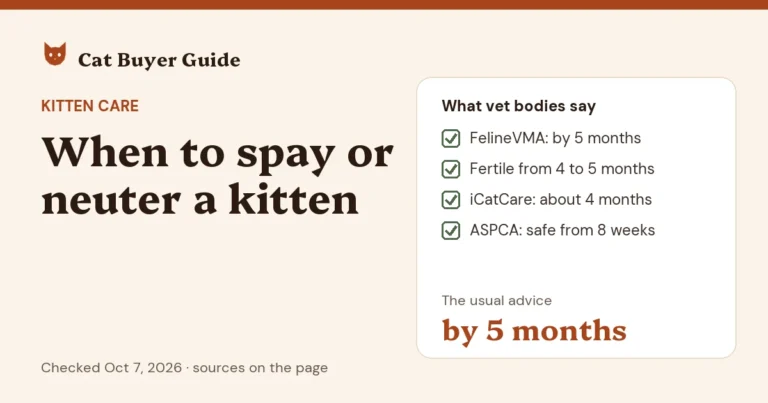
- After spay or neuter. Cats Protection says neutered cats typically need less energy and suggests cutting the daily amount. The AAHA/AAFP guidelines note neutering is linked to weight gain and call it a good time to review the diet. Our guide on when to spay or neuter a cat covers the timing.
- At the switch to adult food. AAFCO warns that calorie-rich food for young animals can make a less active adult obese.
Cornell calls obesity the most common nutrition-related problem in cats, so it’s worth getting the habit right early.
Wet food, dry food or both?
Either works, as long as the food is complete and balanced. Cats Protection suggests offering both in separate bowls and seeing what your kitten likes.
| Wet (canned) | Dry | |
|---|---|---|
| Water content | At least 75% (Cornell) | 6 to 10% (Cornell) |
| Leaving it out | Change at least twice a day | Can sit out; refresh daily |
| Storage | Refrigerate once opened | Airtight container; check the date |
| Good for | Extra water in the diet | Convenience, free feeding |
Food with more water adds to what a cat drinks, which Cats Protection says helps cats with urinary problems. If your kitten eats mostly dry food, fresh water matters even more, Cornell notes.
Water, not milk
Your kitten should always have fresh, clean water. Cats Protection says to refresh it at least once a day and keep the water bowl away from the food bowl, with the litter box farther still. If you’re thinking about a fountain, our cat water fountain buyer’s guide covers what the research says.
Milk is a different story. Kittens make the enzyme that digests their mother’s milk, but they lose much of it as they wean. Cats Protection says never to give a cat or kitten cow’s milk or a milk substitute such as oat or nut milk, as they can make it very poorly. Special “cat milk” is safe but fatty: an occasional treat at most, never in place of water. A weaned kitten doesn’t need it.
The exception is a kitten too young to eat food, such as an orphan under four weeks. The ASPCA says such kittens need a commercial kitten milk replacer, and to call your vet for which product and how to feed it.
Treats and human food
Treats are fine in small amounts. Cornell’s rule of thumb is that treats shouldn’t go over 10 to 15% of a cat’s daily calories, and Cats Protection suggests cutting the regular food a little to make room for them. Cats Protection also says a little well-cooked, plain chicken or fish is okay now and then.
Some foods should stay off the menu entirely:
- Raw meat and raw eggs. Cornell doesn’t recommend raw meat as a food or a treat, because it can carry toxoplasmosis and other infections. The ASPCA says not to give raw eggs.
- Canned fish meant for people. Cornell says some cats fed it have developed serious nerve problems.
- Milk and dairy, as above.
- Toxic foods such as onions, garlic, grapes and chocolate. Our guide to things poisonous to cats lists them, with what to do if your kitten eats one.
- Supplements, unless your vet prescribes one. Cornell says they’re usually unnecessary with a complete diet and can be harmful.
Raw, homemade and other diets
Raw diets have fans, but the vet and government sources we checked don’t recommend them.
- The FDA says raw pet food poses significant health risks to pets and the people who handle it, and that the single best way to avoid those infections is not to feed raw.
- In an FDA study of pet food bought in 2010 to 2012, 15 of 196 raw dog and cat food samples tested positive for Salmonella and 32 for Listeria monocytogenes. The FDA found raw food was more likely to carry these germs than the other pet foods it tested.
- Cornell doesn’t recommend raw meat for cats, as above.
- Homemade diets: Cats Protection advises against making your own cat food unless your vet suggests it for a medical reason, because it’s hard to get the balance right, and an unbalanced diet can cause growth problems.
If a breeder sends your kitten home on a raw diet, talk to your vet before you change anything, and switch slowly (see below). If you do handle raw food, the FDA’s advice is to wash your hands for at least 20 seconds afterward, clean and disinfect bowls and surfaces, and thaw it in the fridge, not on the counter.
Your kitten’s first weeks at home
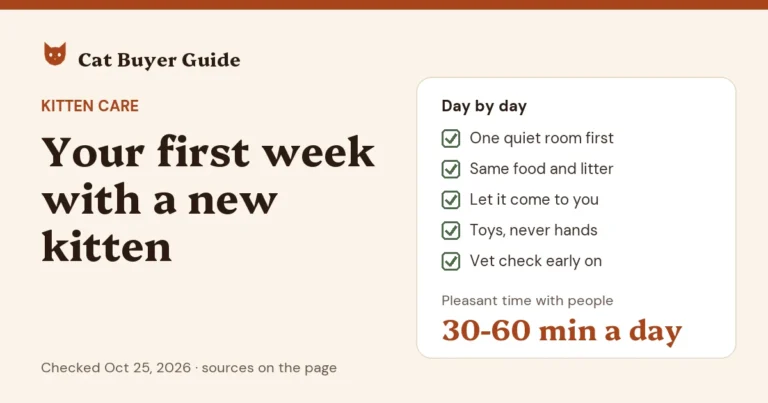
- Keep the same food at first. International Cat Care suggests feeding the diet the kitten already knows for the first one to two weeks. Ask the breeder or shelter what and how often it eats. Our first week with a new kitten guide covers the rest of the settling-in.
- Don’t panic about a small appetite. iCatCare says not to worry if a new kitten shows little interest in food at first. If it doesn’t eat, see the vet box below.
- Change food slowly. The AAHA/AAFP guidelines describe moving a cat to a new diet gradually over 7 to 10 days. Your vet can advise on how to do it.
- Give it a quiet place to eat. The AAHA/AAFP guidelines say cats prefer to eat alone, somewhere quiet where they won’t be startled. They also suggest food puzzles or small amounts of food hidden around the room, starting in kittenhood, if your kitten enjoys them.
- Keep bowls clean. The FDA advises washing bowls and scoops with soap and hot water after each use, and refrigerating or throwing out leftover canned food promptly.
For the full shopping list (bowls, food and the rest), see our new kitten checklist.
When to call your vet about feeding
- Not eating. Cornell says a vet should examine any cat that refuses to eat and is losing weight.
- Vomiting or diarrhea, especially after a food change or after drinking milk. Call your vet if it doesn’t settle quickly.
- A kitten too young to eat food, or one not getting enough milk from its mother: the ASPCA and Cats Protection both say to contact your vet.
- Weight worries either way, and before any special diet, supplement or raw food. Your vet can score your kitten’s body condition and tell you how much to feed.
FAQ
How often should a kitten eat?
Three meals a day until six months old, then twice a day until about one year, according to Cornell. Cats Protection suggests checking and replacing a young kitten’s food four times a day.
When should a kitten switch to adult cat food?
At about one year. The ASPCA says kittens should eat kitten-formula food until they mature at about one year of age, and Cornell treats a cat as an adult at about one year. Make the switch slowly, over 7 to 10 days.
Can kittens drink cow’s milk?
No. Cats Protection says never to give cow’s milk or milk substitutes, which can upset a kitten’s stomach. A weaned kitten needs only water. Orphan kittens too young to eat need a kitten milk replacer, chosen with your vet.
Can a kitten eat adult cat food?
Only if the label says the food is complete and balanced for all life stages, which includes growth. Food made for adult maintenance has lower levels of some nutrients than a growing kitten needs, the FDA explains.
Is wet or dry food better for a kitten?
Neither is better in itself if the food is complete and balanced. Wet food adds water to the diet; dry food can be left out. Cats Protection suggests offering both and letting the kitten show what it prefers.
Can I feed my kitten a raw diet?
The FDA advises against raw pet food because it’s more likely to carry Salmonella and Listeria, a risk to the kitten and to the people handling it. Cornell doesn’t recommend raw meat for cats either. Talk to your vet before you choose a diet that isn’t a complete and balanced commercial food.
Sources
- Cornell Feline Health Center: How often should you feed your cat?, checked Oct 31, 2026
- Cornell Feline Health Center: Feeding your cat, checked Oct 31, 2026
- AAHA/AAFP: 2021 Feline Life Stage Guidelines (Quimby et al., JFMS), checked Oct 31, 2026
- ASPCA: Cat nutrition tips, checked Oct 31, 2026
- FDA: “Complete and Balanced” Pet Food, checked Oct 31, 2026
- AAFCO: Selecting the right pet food, checked Oct 31, 2026
- FDA: Get the Facts! Raw Pet Food Diets can be Dangerous to You and Your Pet, checked Oct 31, 2026
- FDA: Tips for Safe Handling of Pet Food and Treats, checked Oct 31, 2026
- Cats Protection: Feeding your cat, checked Oct 31, 2026
- Cats Protection: Kitten care, checked Oct 31, 2026
- Cats Protection: Cats and drinking, checked Oct 31, 2026
- International Cat Care: Helping your new cat or kitten settle in, checked Oct 31, 2026