Clumping vs Non-Clumping Cat Litter: Which Is Better?

A buyer's guide built from specifications, warranties and return policies, not hands-on testing. Facts and prices checked November 6, 2026. We may earn a commission if you buy through links on this page. It never changes what we recommend. As an Amazon Associate we earn from qualifying purchases. How we research
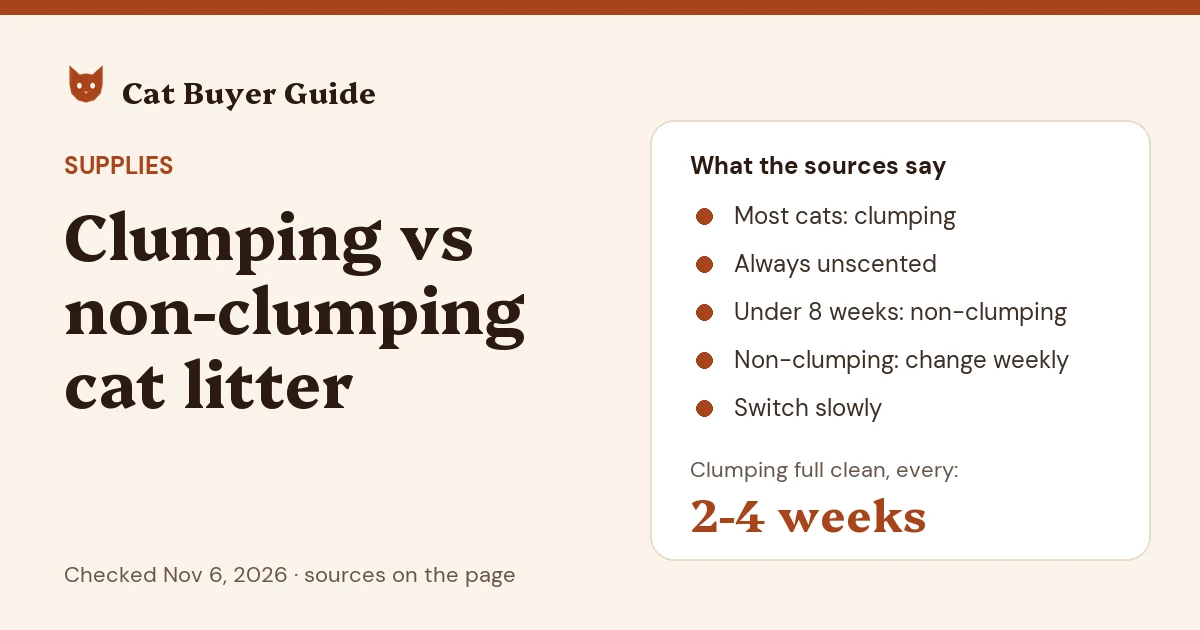
Is clumping or non-clumping cat litter better? For most adult cats, clumping. The ASPCA, the AAHA/AAFP vet guidelines and the Feline Veterinary Medical Association (FelineVMA) all say most cats prefer a soft, unscented clumping litter, and clumps make it easy to scoop out every bit of urine each day. The big exception is young kittens: Best Friends Animal Society says to use only non-clumping litter with kittens under eight weeks, because they taste and play in their litter. And whatever the type, the litter your cat already knows usually beats a “better” one it doesn’t.
We built this comparison from the advice of Cornell’s Feline Health Center, the ASPCA, International Cat Care (iCatCare), the AAHA/AAFP guidelines, the American Association of Feline Practitioners’ Cat Friendly Homes site, FelineVMA and Best Friends, plus one published study, all checked on November 6, 2026. We don’t own a cat and haven’t tested any litter.
The short answer
- Most adult cats: an unscented, soft or fine clumping litter (ASPCA, AAHA/AAFP, FelineVMA).
- Kittens under eight weeks: non-clumping only, such as pine pellets or a non-clumping clay (Best Friends).
- Your cat already uses something? Keep it, or switch slowly (Cornell, iCatCare).
- Non-clumping can work if your cat likes it, but plan to change all of it every week (iCatCare).
- Not sure? Put two boxes side by side with different litters and let your cat choose (ASPCA).
On this page
- Clumping vs non-clumping litter at a glance
- What vets and cat groups say about clumping litter
- Scooping and cleaning: the biggest practical difference
- Clumps tell you how much your cat pees
- Kittens: non-clumping first, then a slow switch
- What one study found
- Types of litter, and which ones clump
- Odor control and homes with more than one cat
- Which should you choose?
- Clumping vs non-clumping litter: FAQ
Clumping vs non-clumping litter at a glance
| Clumping | Non-clumping | |
|---|---|---|
| What most cats prefer | Yes, say the ASPCA, AAHA/AAFP and FelineVMA | Some cats, often those raised on it |
| Daily care | Scoop out the clumps and the poop | Scoop the poop and stir; urine soaks in |
| Full change | Every 2 to 4 weeks (iCatCare) | Every week (iCatCare) |
| Seeing urine changes | Easy: count and size the clumps (AAFP) | Harder: count wet spots before stirring (AAFP) |
| Kittens under 8 weeks | No (Best Friends) | Yes (Best Friends) |
| Common materials | Clay, corn, wheat | Clay, paper pellets, pine pellets |
What vets and cat groups say about clumping litter
Most cats prefer it. “Most cats prefer clumping, unscented litter,” says the ASPCA, with a medium to fine texture. The AAHA/AAFP life stage guidelines say the same of adult cats, and the FelineVMA house-soiling brochure says most cats prefer soft, unscented, clumping litters.
Why cats may like it. Many cats prefer trays with clumping litter, says iCatCare, because litter that clumps when soiled is easy to remove, which keeps the rest of the tray clean and more inviting. iCatCare also says a fine, sand-like litter is likely closest to what cats instinctively favor, and Best Friends notes that clumping litters are usually finer in grain than typical clay litter.
But cats differ. The AAHA/AAFP guidelines note that individual cats’ preferences for litter type have been documented, so if you offer different litters, put them in separate boxes. iCatCare says cats are happy with many materials (paper, wood, silica, corn, clay) as long as the litter is kept clean, especially the one they used as kittens.
Unscented matters too. Every source here favors unscented litter, whichever type. FelineVMA adds that many cats dislike scented or dusty litters and litter deodorizers.
Scooping and cleaning: the biggest practical difference
With clumping litter, urine forms a solid lump that you lift out with the poop. Cornell says to remove the clumps and feces every day, adding clean litter as needed. What’s left in the box stays fairly fresh, so iCatCare says a full clean-out every 2 to 4 weeks is enough.
With non-clumping litter, urine soaks into the litter and stays there. You can scoop the poop, but the wet litter builds up, so iCatCare says to empty and wash the tray every week. FelineVMA’s brochure gives a wider range for washing any box, every 1 to 4 weeks, with soap and hot water only.
Either way, scoop at least once a day, as the ASPCA, Cornell and FelineVMA advise. Our guide to how many litter boxes per cat covers the number of boxes, and our litter box guide for kittens covers sizes.
Clumps tell you how much your cat pees
This is a reason vets like clumping litter that most litter comparisons skip. An average adult cat makes 2 to 3 handful-size urine balls a day, says the AAFP’s Cat Friendly Homes, and with clumping litter it’s easy to see how many times your cat urinates and how much. With an absorbent, non-clumping litter you have to count and size the wet spots before you stir it.
That matters because, as the same page says, noticing changes in your cat’s normal routine, even small ones, can alert you early that something may be wrong. Learn what’s normal for your cat, and talk to your vet when it changes.
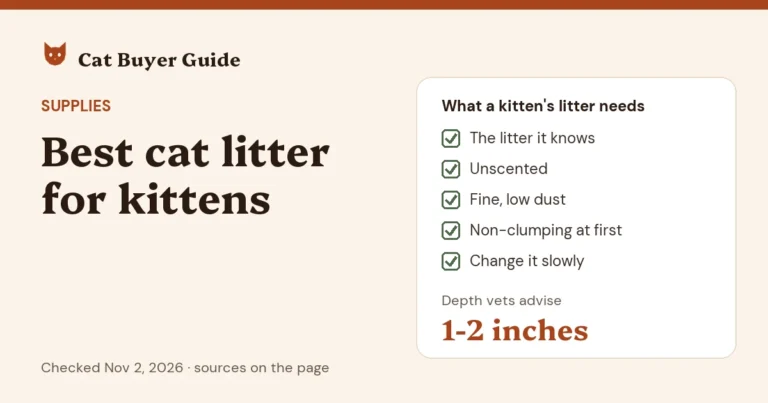
International Cat Care’s 2025 caregiver guide to urinary tract diseases also lists the use of non-clumping litter among factors seen in cats with feline idiopathic cystitis (FIC), a bladder condition, alongside an indoor life, little exercise, obesity, more than one cat and changes in the home. It says FIC comes from a combination of factors, so the list doesn’t show that a litter causes it. The same guide advises unscented, sandy, clumping litter about 1 to 2 inches deep, and the AAHA/AAFP guidelines say unscented clumping litter may be preferred for cats with a history of urinary problems.
Talk to your vet
- If your cat strains to pee, goes often with little coming out, pees outside the box or has blood in the urine, call your vet: iCatCare lists these as signs of lower urinary tract disease.
- A change in how often or how much your cat pees is worth raising too, even a small one (AAFP Cat Friendly Homes).
- A cat that stops using its box may be unwell, not just fussy about litter. Have it checked before you change the litter.
Kittens: non-clumping first, then a slow switch
Best Friends Animal Society’s kitten foster manual says to use only non-clumping litter, such as pine pellets or clay, with kittens younger than eight weeks. Very young kittens taste their litter and play in it, and it says the dust from clumping litter can solidify in their airways or gut.
After that, the AAHA/AAFP guidelines tell vets to have owners start kittens on an unscented clumping sand-type litter or the litter the kitten was already using, and to let kittens show a preference by offering a variety. Ask the breeder or shelter which litter your kitten used, and start there; our guide to the best age to adopt a kitten covers when kittens are ready to go home.
Our litter training guide covers the first days, and our guide to the best cat litter for kittens compares five unscented litters, clumping and non-clumping.
What one study found
Few studies compare litters head to head. A 2025 study in the Journal of Veterinary Medical Science offered 46 cats in four rooms of three cat cafes three clumping litters side by side for three days. The cats used the clumping clay litter 258 times, a clumping wood litter 152 times and a clumping paper litter 66 times. The cats’ usual litters were all non-clumping.
Two cautions: the study compared clumping materials, not clumping against non-clumping, and its lead author works for the company that made all three litters. It fits the vets’ advice, but it isn’t proof on its own.
Types of litter, and which ones clump
iCatCare lists paper, wood, silica, corn, clay and newer materials. Here is how the ones in our kitten litter guide compare, from the makers’ own pages (checked November 2, 2026).
| Material | Clumping? | Notes from our sources |
|---|---|---|
| Clay | Either | Best Friends names non-clumping clay for young kittens; Dr. Elsey’s Ultra is a clumping clay |
| Corn | Yes, in the brand we checked | World’s Best Comfort Care Unscented |
| Wheat | Yes, in the brand we checked | sWheat Scoop Original |
| Paper pellets | No, in the brand we checked | Fresh News Original |
| Pine pellets | Either | Best Friends names pine pellets as non-clumping; Feline Pine sells both kinds |
Read the bag: some makers sell both a clumping and a non-clumping version under one brand name, and a scented one beside the unscented.
Odor control and homes with more than one cat
The best odor control for your cat is clean litter, not perfume. Clumping litter helps because soiled litter is easy to remove, which keeps the rest of the tray clean, says iCatCare, while FelineVMA notes that many cats dislike deodorizers and scented litter. If the box smells, scoop more often and do the full clean-out on time before you reach for a scented litter.
With more than one cat, the AAHA/AAFP guidelines suggest offering different litters in separate boxes, since cats’ preferences differ.
Which should you choose?
- An adult cat, or a kitten past eight weeks, with no history on a litter: an unscented clumping litter. Dr. Elsey’s Ultra Unscented is the clumping clay pick in our kitten litter guide; the maker describes it as unscented and 99% dust-free.
- A kitten under eight weeks, or one that still eats litter: non-clumping pellets, such as Fresh News Original (recycled paper) or Feline Pine Original (pine), the two non-clumping picks in the same guide.
- A cat already happy on non-clumping litter: keep it, and change it all every week.
- A cat with urinary problems: ask your vet; the AAHA/AAFP guidelines say unscented clumping litter may be preferred.
To switch, Cornell says to do it gradually, adding small amounts of the new litter to the old. The ASPCA suggests putting two boxes with different litters side by side and letting your cat choose.
Clumping vs non-clumping litter: FAQ
Is clumping or non-clumping litter better for cats?
For most adult cats, clumping: the ASPCA, AAHA/AAFP and FelineVMA say most cats prefer soft, unscented clumping litter. Non-clumping is the safer start for kittens under eight weeks (Best Friends), and fine for a cat that already likes it.
Is clumping litter safe for kittens?
Not before eight weeks, says Best Friends, because young kittens taste their litter. After that, the AAHA/AAFP guidelines suggest an unscented clumping litter or the one the kitten knows.
Which is better for odor?
Clumping, mostly because soiled litter is easy to remove, which keeps the tray clean (iCatCare). Daily scooping and a full clean every 2 to 4 weeks with clumping litter, or every week with non-clumping, control odor better than a scented litter, which many cats dislike (FelineVMA).
How often should I change non-clumping litter?
Empty and wash the tray every week, says iCatCare, and scoop the poop at least once a day.
Can I mix clumping and non-clumping litter?
Only as a way to switch: Cornell says to change litters gradually, adding small amounts of the new to the old. None of our sources suggests keeping a mix for good.
Sources
- ASPCA: Litter Box Problems, checked Nov 6, 2026
- Cornell Feline Health Center: Feline Behavior Problems: House Soiling, checked Nov 6, 2026
- AAHA/AAFP: 2021 Feline Life Stage Guidelines (full text on PMC), checked Nov 6, 2026
- FelineVMA: House-Soiling (client brochure, updated Feb. 2026, PDF), checked Nov 6, 2026
- International Cat Care: Choosing a litter tray for your cat (updated Dec. 10, 2025), checked Nov 6, 2026
- International Cat Care: Lower urinary tract diseases, a guide for caregivers (2025, PDF), checked Nov 6, 2026
- AAFP Cat Friendly Homes: What is Normal for Your Cat?, checked Nov 6, 2026
- Best Friends Animal Society: Kitten foster manual, checked Nov 6, 2026
- Iwabuchi-Inoue, Hattori and Kikusui (2025): Litter box size and litter type preference and their associated behavioral changes in cats, J Vet Med Sci 87(6), checked Nov 6, 2026