How to Travel with a Cat in a Car: Carrier, Food and Long Trips

A buyer's guide built from specifications, warranties and return policies, not hands-on testing. Facts and prices checked November 7, 2026. We may earn a commission if you buy through links on this page. It never changes what we recommend. As an Amazon Associate we earn from qualifying purchases. How we research
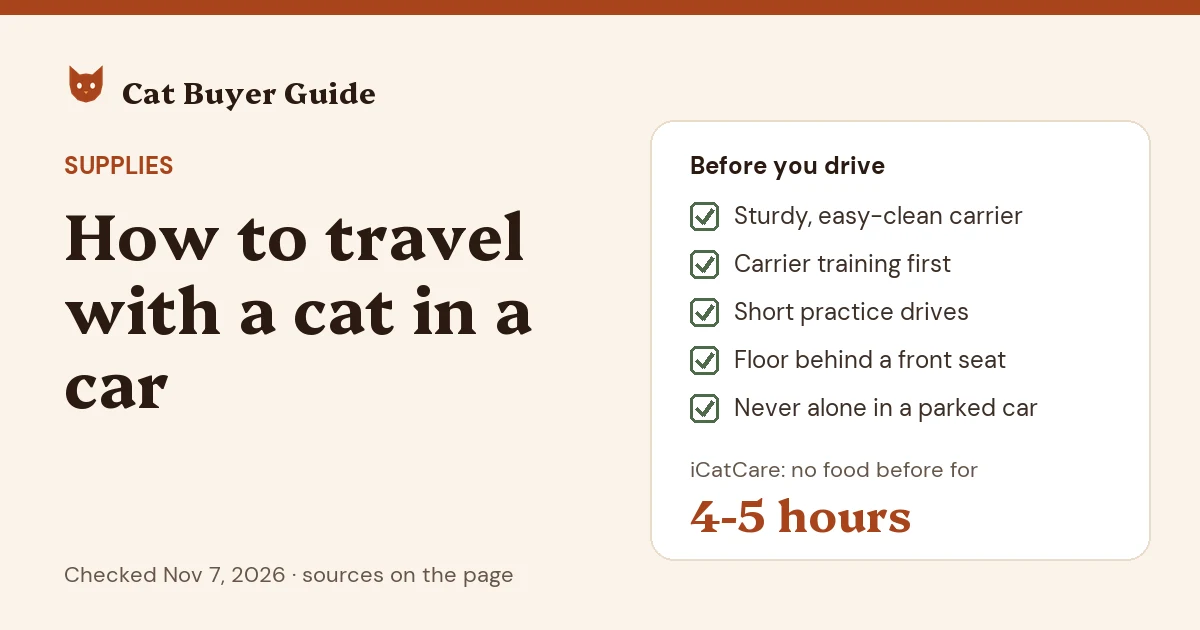
The best way to travel with a cat in a car is in a sturdy, easy-to-clean carrier, secured on the floor behind the driver’s or passenger’s seat, with the cat used to that carrier well before the trip. Don’t let your cat loose in the car, skip the big meal before you leave, and never leave your cat alone in a parked car. That is the shared advice of International Cat Care, the Feline Veterinary Medical Association (FelineVMA) and the ASPCA.
Most cats aren’t happy travelers, iCatCare says: they are bonded to their home territory and feel exposed away from it. So the work starts days or weeks before you drive.
The short answer
- Always in a carrier. A loose cat can distract the driver or escape (iCatCare).
- Carrier on the floor behind a front seat. Use a seat belt only on a crash-test-certified carrier (FelineVMA).
- Train the carrier first, with treats and familiar bedding inside (iCatCare, FelineVMA).
- Short practice drives before a long one (ASPCA).
- No food for a few hours before: about 4 to 5 hours (iCatCare) or a light meal 3 to 4 hours before (ASPCA).
- Never leave your cat in a parked car, even in shade with the windows open (iCatCare, ASPCA).
1. Choose a carrier that suits the car
iCatCare’s advice is a strong carrier that’s easy to clean in case your cat is sick or soils it on the way. It suggests avoiding cardboard and cheap, light plastic boxes except for very short trips, notes that fabric and wicker are hard to clean, and says backpack carriers can be unpleasant for cats that can’t hide. A solid plastic carrier with a secure door, vents and a top half that lifts off ticks its boxes. Our cat carrier guide compares carriers built that way, from the makers’ specifications.
Bigger isn’t better for the trip itself: iCatCare says cats like a small space and move around less in one. Two cats should ride in separate carriers, for air, room and less risk of overheating, and because even close friends can fall out when stressed.
Carriers from our buyer’s guide
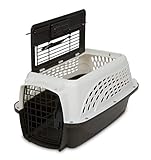
Top and front doors: the Petmate Two Door Top Load Kennel (19-inch), plastic, for pets up to 10 lb, per Petmate. More in our carrier guide.

For a bigger cat: the Petmate Vari Kennel (24-inch), for pets of 10 to 20 lb, with a top that lifts off, per Petmate. More in our carrier guide.
Links to Amazon, chosen from the makers’ specs in our buyer’s guides. We haven’t tested them, and we may earn a commission if you buy.
2. Get your cat used to the carrier
A carrier usually means the vet, so many cats hate it. Make it a pleasant place well before the trip, iCatCare says: the door open, a cozy, familiar-smelling bed inside and treats fed there, so your cat goes in and out and even sleeps in it. FelineVMA’s 2025 statement also advises carrier training, and a towel or blanket over the carrier so the cat can hide. Our guide to getting a cat used to a carrier has the step-by-step version.
iCatCare adds that a synthetic feline pheromone spray on the bedding may help. Wait at least 15 to 20 minutes after spraying before your cat goes in, because the spray smells of alcohol at first.
Then, the ASPCA suggests, take a series of short drives and build up the time in the car.
3. Where to put the carrier in the car
| Spot | What the sources say |
|---|---|
| Floor behind the driver or passenger seat | Recommended by FelineVMA; iCatCare also suggests this footwell |
| Back seat with a seat belt | Only if the carrier is crash-test certified (FelineVMA). A belt around an uncertified carrier may crush it |
| Trunk | Never (iCatCare) |
| Back of a hatchback | Can be poorly ventilated, and the cat may overheat (iCatCare) |
| Loose in the car | No: the cat can tangle with or startle the driver, or escape if a door opens (iCatCare) |
Wherever it goes, it must stay put if you brake hard (iCatCare, ASPCA) and get good airflow. In hot weather choose a carrier that lets air through; in cold, one that keeps drafts off but still breathes (iCatCare).
4. Food, water and the day of the trip
- Food: iCatCare says to withhold food for about four to five hours before the journey in case your cat is sick. The ASPCA, writing for all pets, suggests a light meal three to four hours before you leave and no feeding while the car is moving.
- Water: offer it up to the time you leave and during the trip if you can (iCatCare). Bowls that clip onto the carrier door let you fill them without opening it.
- ID: a microchip plus a collar tag with your phone number, and a temporary tag with your destination number for the trip (ASPCA).
- During the drive: your cat may meow, sometimes all the way. Talk calmly, but don’t let it out; the motion often helps a cat settle (iCatCare).
Traveling with a cat in a car long distance
Everything above applies, plus:
- Breaks: check your cat regularly, especially in hot weather. A car heats up fast, and iCatCare says parking in the shade with the windows open isn’t enough. Someone should stay with the cat, with the doors open, or take it out of the car in its carrier. The ASPCA warns of cold too: a parked car can trap it.
- Pack: food, bowls, water, any medication, a first-aid kit, waste bags, spare absorbent bedding and your cat’s records (ASPCA, iCatCare).
- Crossing state lines: bring the rabies vaccination record, and ask your vet whether you need a health certificate (certificate of veterinary inspection), the ASPCA says.
- When you arrive: settle your cat in one secure, quiet room with water and a little food (iCatCare). After a move, iCatCare advises keeping a cat indoors for at least two to three weeks.
What about a litter box?
iCatCare says a litter tray may fit in a large crate in the back of a car, but your cat probably won’t use it during the journey. Lining the carrier with absorbent pads, and bringing spare familiar-smelling bedding to swap in, is the more practical plan.
Talk to your vet
- If your cat has been sick or very anxious on past trips, iCatCare says it’s worth asking your vet about medication that may help. Only your vet can decide if that’s right.
- Before a long trip or a move across state lines, ask your vet what records or certificates you need (ASPCA).
- Heatstroke can be fatal (iCatCare). If you think your cat has overheated, call a vet at once.
How to travel with a cat in a car: FAQ
Can my cat ride loose in the car?
No. iCatCare says a loose cat can cause an accident by getting tangled up with the driver or startling them, and can escape and get lost if a window or door opens.
Should I belt the carrier into the seat?
Only if it’s crash-test certified. FelineVMA’s 2025 statement recommends the floor behind the driver’s or passenger’s seat, and says belting a carrier that isn’t certified may crush it.
Should I cover the carrier?
FelineVMA suggests giving your cat a chance to hide, for example with a towel or blanket over the carrier. Keep the vents clear so air still flows.
Can two cats share a carrier for the trip?
iCatCare advises one carrier per cat: more room, better airflow, less overheating, and less chance of a falling-out.
How long can a cat travel in a car?
None of our three sources gives a time limit. They focus on what keeps a cat safe on any trip: a secure carrier, regular checks, water when possible, and never leaving it alone in a parked car.
How we wrote this guide
We read International Cat Care’s travel article, FelineVMA’s 2025 position statement on transporting cats in motor vehicles and the ASPCA’s travel safety tips, on November 7, 2026. Where they differ (food before the trip, seat belts), we give both and say which we follow. We don’t own a cat and haven’t driven with one. The carrier picks come from our buyer’s guide, which compares makers’ specifications, not hands-on use.
Sources
- International Cat Care: Travelling with your cat, checked Nov 7, 2026
- FelineVMA: 2025 Transportation of Cats in Motor Vehicles Position Statement, checked Nov 7, 2026
- ASPCA: Travel Safety Tips, checked Nov 7, 2026