How to Cat-Proof a Christmas Tree: 9 Steps from Vets and Charities

Built from dated data and expert sources, not hands-on pet testing. Facts and prices checked November 3, 2026. We may earn a commission if you buy through links on this page. It never changes what we recommend. As an Amazon Associate we earn from qualifying purchases. How we research
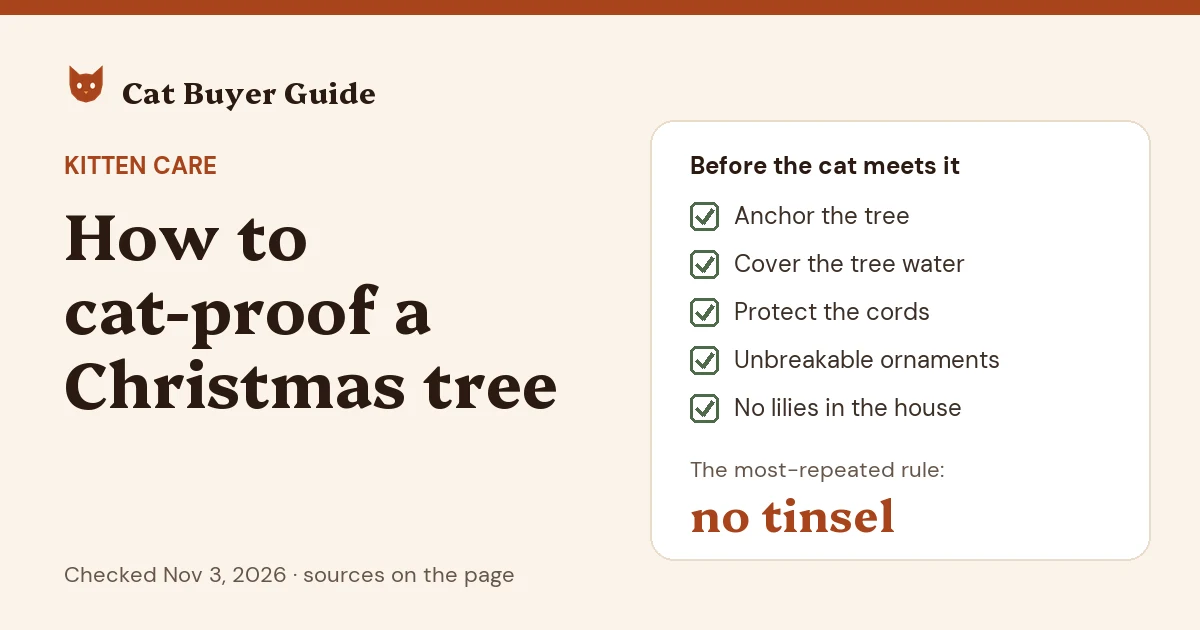
To cat-proof a Christmas tree, make it impossible to tip over, leave off the tinsel, keep the cat away from the tree water and the light cords, and hang only unbreakable ornaments, tied on securely. That is the shared advice of the ASPCA, Cornell’s Feline Health Center, the UK charity Cats Protection and Pet Poison Helpline. No tree is fully cat-proof, so supervise a curious cat near it and keep the dangerous extras, such as lilies and tinsel, out of the house.
A kitten’s first Christmas is the riskiest. Feline vets’ behavior guidelines list vigorous exploring and climbing as normal from about 9 to 16 weeks, and a new tree full of dangling, shiny things is the most tempting thing in the room.
The short answer
- Anchor the tree with a heavy, wide stand, and tie it to the wall or ceiling (Cornell, ASPCA, Cats Protection).
- No tinsel. If a cat swallows it, it can block or tear the intestines and may need surgery (ASPCA, Pet Poison Helpline).
- Cover the tree water, and use plain water with nothing added (ASPCA, Cornell).
- Protect the cords with tubes or cord covers, and switch the lights off when you’re out (Cats Protection, Cornell).
- Unbreakable ornaments on the lower branches, tied on with loops instead of hooks (Cornell).
- No lilies in the house; keep holly and mistletoe out of reach (Pet Poison Helpline, ASPCA).
On this page
- Why cats climb Christmas trees
- 1. Pick a stable spot and a heavy stand
- 2. Tie the tree to the wall or ceiling
- 3. Cover the tree water, and keep it plain
- 4. Skip the tinsel (and the ribbon on presents)
- 5. Choose unbreakable ornaments, and hang them well
- 6. Protect the light cords
- 7. Real or artificial tree?
- 8. Give your cat its own place to climb
- 9. Supervise, and keep holiday plants in check
- Cat-proof Christmas tree ideas: FAQ
- How we wrote this guide
Why cats climb Christmas trees
To a climbing cat, an indoor tree is the outdoors brought inside, as Cornell puts it, and even an undecorated tree can come down if it isn’t anchored. Cats Protection says some cats see a lit tree as a challenge they can’t resist, and others are drawn to the sparkly decorations. The FDA adds that tinsel, ribbon and string look like easy, wiggly prey.
So cat-proofing has two jobs: make the tree safe if your cat does climb or chew it, and make it less tempting in the first place.
1. Pick a stable spot and a heavy stand
A sturdy base, or weights on the stand, keeps the tree from toppling (Cats Protection), and the ASPCA says to secure it tightly so it can’t tip onto a pet.
2. Tie the tree to the wall or ceiling
Cornell’s behavior team suggests anchoring the tree to the ceiling with a cup hook and some wire or string.
3. Cover the tree water, and keep it plain
Tree water is a breeding ground for bacteria that can cause nausea, diarrhea or an upset stomach, the ASPCA says, so cover the stand or make it hard to reach. Cornell’s advice is to use plain water with no chemicals added. Cats Protection warns that fertilizers and plant food can harm cats.
4. Skip the tinsel (and the ribbon on presents)
This is the rule our sources repeat most: the ASPCA and Pet Poison Helpline say to skip tinsel, and Cats Protection says to be careful with it. Tinsel isn’t a poison, but a swallowed strand can cause a “linear foreign body”, Pet Poison Helpline explains: something stringy that catches around the base of the tongue or in the stomach while the rest moves on. Cornell says it can then act like a piano wire and cut through the intestines, which is life-threatening. The ASPCA lists severe vomiting, a blocked digestive tract, dehydration and possible surgery.
The same goes for ribbon, string, yarn and the curling ribbon on presents (FDA, Pet Poison Helpline). After wrapping, put leftover ribbon and string away where your cat can’t find them.
5. Choose unbreakable ornaments, and hang them well
Glass and ceramic ornaments shatter, and the ASPCA warns that the shards can hurt a pet’s mouth and digestive tract. Cornell suggests:
- ornaments of cloth, straw, wood or other unbreakable materials on the lower branches, at a cat’s eye level;
- tying them on with cloth loops rather than metal hooks.
Cats Protection suggests hanging decorations closer to the top, away from paws. The two tips fit together: anything breakable goes high up or stays in the box, and anything within reach should be safe to knock off.
Leave these off the tree, or keep them well out of reach:
| Decoration | Why |
|---|---|
| Tinsel, ribbon, string | Can block or cut the intestines (ASPCA, Pet Poison Helpline, Cornell) |
| Glass or ceramic ornaments | Shatter; shards hurt the mouth and gut (ASPCA, Cornell) |
| Snow globes | Some contain antifreeze (ethylene glycol), which is highly toxic (ASPCA, Pet Poison Helpline) |
| Bubble lights | Contain methylene chloride, a chemical that can make pets ill if chewed (Pet Poison Helpline) |
| Salt-dough ornaments | Even dry, the salt can cause dangerous imbalances (ASPCA, FDA) |
| Wrapped food or candy under the tree | Pets can smell what’s inside (ASPCA) |
6. Protect the light cords
A chewed wire can give a potentially lethal electric shock, and a punctured battery can burn the mouth and throat (ASPCA). Cats Protection suggests covering the wires that lead to the tree with plastic or cardboard tubes, and switching the lights off at the wall when you’re not home. Cornell adds tying cords up or running them through a heavy plastic cord protector from a hardware store.
7. Real or artificial tree?
Neither is cat-proof. Cats Protection notes that with a real tree, some of the oils the tree produces can make a cat that licks or nibbles it very unwell, and fallen needles can hurt paws, so pick them up. An artificial tree has no needles to drop or water to drink, but Cornell says it may not stop a determined chewer.
Cornell also suggests putting something cats dislike on the lower branches. Don’t use essential oils for this: as our guide to things poisonous to cats explains, cats can’t clear them well.
8. Give your cat its own place to climb
A cat that loves to climb will look for somewhere to do it. Feline vets’ guidelines tell owners to give young cats climbing structures, so a cat tree of its own, set up before the holidays, gives a climber somewhere it’s allowed to go. It won’t stop every cat from trying the Christmas tree, but it gives you somewhere to redirect it.
Cats Protection also says many cats find the holidays stressful: give yours space and a quiet place to hide when guests come. Cornell adds that a cat should be shut safely away during a party, so it can’t slip out of the door.
Cat trees from our buyer’s guide
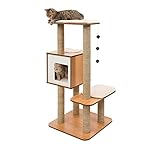
A tall tree with a den: the Catit Vesper High Base, 47.8 inches with 4 levels and a den with two entrances, per Catit. More in our cat tree guide.

For a big cat: the Armarkat B4120, 41 inches on a 24 x 20 inch base, rated for 75 lb by the maker. More in our cat tree guide.
Links to Amazon, chosen from the makers’ specs in our buyer’s guides. We haven’t tested them, and we may earn a commission if you buy.
9. Supervise, and keep holiday plants in check
Cats Protection’s last tip is simple: if your cat is playful, watch it when it’s near the tree, and don’t put cat presents under it, especially catnip.
Holiday plants need their own rules:
- Lilies are the most dangerous plants for cats, Pet Poison Helpline says. A small amount of a leaf, petal or pollen can cause sudden kidney failure. They are common in holiday bouquets, so check the flowers guests bring, and keep lilies out of a home with a cat. More in our lily section.
- Holly and mistletoe can cause stomach upset and, the ASPCA says, heart problems if eaten. Pet Poison Helpline notes American mistletoe is milder than European mistletoe, and the spiny leaves of Christmas or English holly can cause severe stomach upset. Keep both out of reach.
- Poinsettias are only mildly toxic: drooling or vomiting is possible, but serious poisoning is rare (Pet Poison Helpline).
- Amaryllis can also be toxic to cats (Cats Protection), and a Christmas cactus can cause vomiting and diarrhea (Pet Poison Helpline).
If your cat chewed or swallowed something
- Call your vet or an emergency clinic straight away if your cat ate tinsel, ribbon, string, a lily, a broken ornament or a snow globe’s liquid, or chewed a live wire, even if it seems fine.
- Take the packaging or a piece of the plant or decoration with you (Cats Protection).
- In the US, the ASPCA Animal Poison Control Center is at (888) 426-4435 and Pet Poison Helpline at (855) 764-7661. Both answer 24/7 and a fee may apply; our poison guide has more.
Cat-proof Christmas tree ideas: FAQ
How do I keep my cat out of the Christmas tree?
There’s no guaranteed way. Make the tree boring and safe: nothing dangling within reach, no tinsel, cords covered, water covered. Give your cat its own climbing spot, switch the lights off when you’re out (Cats Protection), and supervise. Cornell suggests a deterrent on the lower branches, but don’t use essential oils.
Do Christmas tree guards or fences work?
None of the vet and welfare sources we read mentions tree guards, so we can’t say how well they work. If you use one, it should meet the same rules the sources give for the tree: it can’t tip over, and it keeps your cat away from the water and the cords. A cat that can jump over it isn’t kept out.
Is a real Christmas tree poisonous to cats?
A real tree isn’t one of the main holiday poisons, but Cats Protection says some of its oils can make a cat that chews it ill, fallen needles can hurt paws, and the ASPCA says the tree water can grow bacteria that upset the stomach. Cover the water and sweep up needles.
Is tinsel safe if it’s not made of metal?
No. Pet Poison Helpline says tinsel isn’t a poison in itself (unless it’s made with zinc); the danger is a strand getting stuck and damaging the intestines.
When can I put the tree up with a new kitten?
Any time, as long as it’s anchored and safe before the kitten is left alone with it. If you’re bringing a kitten home close to the holidays, keep it in its own room at first, away from the tree.
How we wrote this guide
We read the holiday safety pages of the ASPCA, Cornell’s Feline Health Center, Cats Protection, Pet Poison Helpline and the FDA, and re-opened each one on November 3, 2026. Where the sources differ (top versus low branches for ornaments), we say so. We don’t own a cat and haven’t tried these steps or the cat trees we link: the picks come from our buyer’s guide, which compares makers’ specifications, not hands-on use. This guide isn’t veterinary advice; if you’re worried about something your cat ate, call your vet.
Sources
- Cats Protection: Keeping your cat safe at Christmas, checked Nov 3, 2026
- ASPCA: Holiday Safety Tips, checked Nov 3, 2026
- Cornell Feline Health Center: Beware Holiday Hazards, checked Nov 3, 2026
- Pet Poison Helpline: Winter Holiday Pet Poison Tips, checked Nov 3, 2026
- Pet Poison Helpline: Are Poinsettias Poisonous to Cats and Dogs?, checked Nov 3, 2026
- Pet Poison Helpline: Holiday Pet Poison Myths, checked Nov 3, 2026
- FDA: Take the “Oh No!” Out of Your and Your Pets’ Holiday (content current as of Feb. 19, 2025), checked Nov 3, 2026
- AAFP and AAHA: Feline Behavior Guidelines (2004, PDF), checked Oct 28, 2026