Kitten Vaccination Schedule: Which Shots, When, and What They Cost

Built from dated data and expert sources, not hands-on pet testing. Facts and prices checked October 7, 2026. No affiliate links on this page. How we research
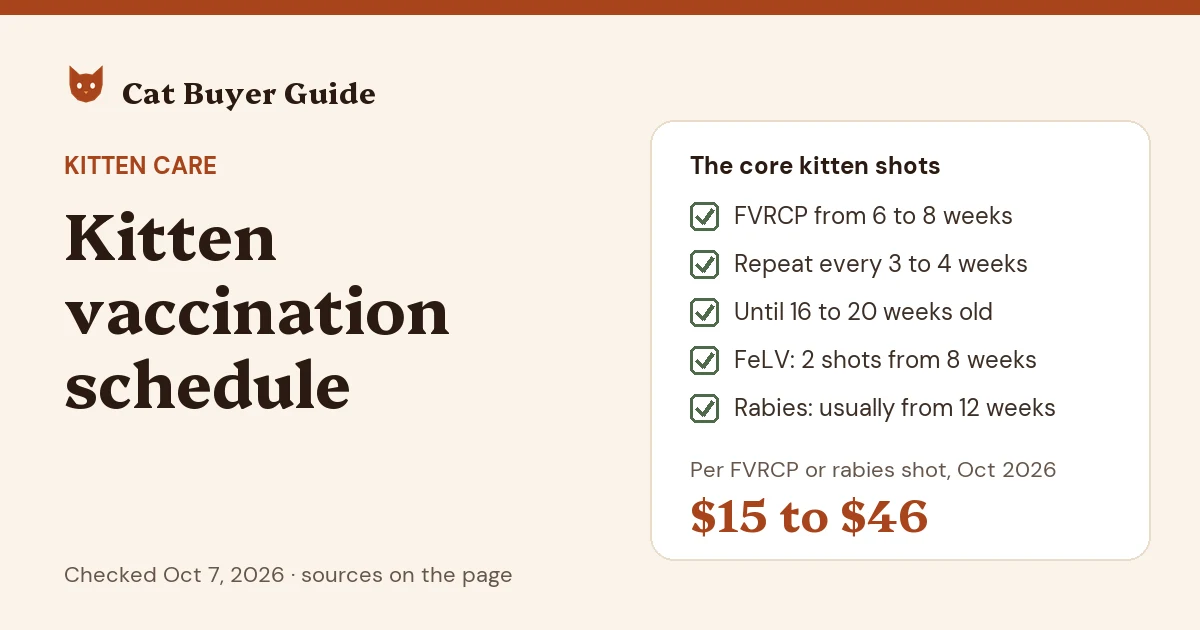
Kittens can get their first core vaccine, the FVRCP combination shot, from 6 weeks of age, then a repeat every 3 to 4 weeks until they’re 16 to 20 weeks old, under the 2020 AAHA/AAFP Feline Vaccination Guidelines. Two feline leukemia (FeLV) shots, 3 to 4 weeks apart, can start at 8 weeks after a negative test, and rabies follows the vaccine label and local law. The guidelines suggest an FVRCP booster at 6 months; FeLV and rabies boosters come about a year after the first round. Your vet sets your kitten’s actual dates.
A task force of feline experts convened by the American Animal Hospital Association (AAHA) and the American Association of Feline Practitioners (AAFP), now the Feline Veterinary Medical Association, wrote them. On Oct 7, 2026, we checked them against the WSAVA’s 2024 guidelines, the national rabies compendium, Cornell, International Cat Care and the ASPCA, and collected vaccine prices from five clinic groups.
The short answer
- FVRCP (feline distemper and two respiratory viruses): from 6 to 8 weeks, every 3 to 4 weeks until 16 to 20 weeks; a booster at 6 months, which the guidelines suggest considering instead of 1 year; then every 3 years.
- FeLV: a test, then 2 shots 3 to 4 weeks apart from 8 weeks; a booster a year later; then by risk.
- Rabies: usually 1 shot from 12 weeks, per the vaccine label and local law; a booster a year later; then every 1 or 3 years.
- Indoor kittens need the core shots too.
- Cost (Oct 7, 2026): $15 to $46 per FVRCP or rabies shot, $17 to $40.86 per FeLV shot.
On this page
Kitten vaccination schedule by age
Here is the AAHA/AAFP schedule for pet kittens (Table 2), with rabies from the national rabies compendium. Print it, or save the page as a PDF, for your vet visits.
| Age | Vaccine or test | Notes |
|---|---|---|
| 6 to 8 weeks | FVRCP, 1st shot | Not before 6 weeks |
| Every 3 to 4 weeks | FVRCP, repeat | Until 16 to 20 weeks old |
| 8 weeks or older | FeLV test, then FeLV 1st shot | Vaccinate only if the test is negative |
| 3 to 4 weeks later | FeLV, 2nd shot | Ends the kitten FeLV series |
| 12 weeks or older | Rabies | At the age on the vaccine label; follow local law |
| 16 to 20 weeks | FVRCP, last kitten shot | Not before 16 weeks |
| 6 months | FVRCP booster | The guidelines say to consider it instead of waiting until 1 year |
| About a year later | FeLV and rabies boosters | FeLV 12 months after the 2nd shot; rabies 1 year after the 1st |
| Adult: FVRCP | Every 3 years | After the 6-month booster |
| Adult: FeLV | Yearly if at high risk | Less often, or not at all, if risk is low |
| Adult: rabies | Every 1 or 3 years | As the vaccine label and local law say |
Also from the AAHA/AAFP FAQ and the WSAVA’s 2024 guidelines. AAHA’s one-page schedule for vet clinics is a PDF.
For example, a kitten that starts at 8 weeks might have shots at about 8, 12 and 16 weeks, the FVRCP booster at 6 months, and FeLV and rabies boosters at about 15 months: five visits. The guidelines note that the 6-month booster adds a visit. Your vet may group the shots differently.
Shelters move faster, starting FVRCP as early as 4 weeks and repeating it every 2 weeks, since disease spreads easily where many cats live together (AAHA/AAFP).
Core and non-core vaccines for kittens
Core vaccines are recommended for every cat; non-core ones depend on a cat’s risk (AAHA/AAFP).
| Vaccine | Protects against | For kittens? |
|---|---|---|
| FVRCP | Panleukopenia (feline distemper), herpesvirus-1 (rhinotracheitis), calicivirus | Core |
| Rabies | Rabies, which is fatal and can spread to people | Core; required by law in many states |
| FeLV | Feline leukemia virus | Core under 1 year (AAHA/AAFP) |
| Chlamydia, Bordetella | Bacterial eye and airway infections | Non-core: for outbreaks in multi-cat homes |
| FIP | Feline infectious peritonitis | Not generally recommended |
| FIV | Feline immunodeficiency virus | No vaccine sold in North America (Cornell) |
Panleukopenia is highly contagious and can kill, and kittens are particularly at risk (Cornell); the vaccine is very effective (International Cat Care). Herpesvirus and calicivirus are the main causes of upper respiratory infections in cats; vaccination doesn’t always prevent infection, but it makes the illness much milder.
FeLV is the leading cause of virus-associated deaths in cats, and about half of cats diagnosed with it die within two and a half years, says Cornell. The AAHA/AAFP guidelines make its vaccine core for kittens, which are much more likely than adults to develop progressive infection if exposed, and whose lifestyle often changes in the first year. The ASPCA and International Cat Care call it non-core, and the WSAVA calls it core for young cats where FeLV is common, so ask your vet about the risk where you live.
Why kittens need a series of shots
Antibodies from the mother’s first milk protect a kitten early on, but they also block vaccines, and they fade at a different rate in every kitten (AAHA/AAFP). So the shot is repeated, to make it likely that one works soon after they fade. In between there can be a “window of susceptibility,” when the antibodies are too low to protect the kitten but high enough to block the vaccine.
That’s why the series runs to 16 weeks or later, and why the 6-month booster exists: up to a third of kittens may not respond to a final shot at 16 weeks, and some may still have blocking antibodies at 20 weeks (AAHA/AAFP). The WSAVA advises a last kitten shot no earlier than 16 weeks, or at 18 to 20 weeks where the risk is high, then another at 26 weeks or older. In the UK, International Cat Care puts the first booster at 12 months.
No vaccine is 100% effective, Cornell notes, so keep a new kitten’s contact with other cats limited until your vet says otherwise.
FeLV: test first, then two shots
Your kitten should be tested before its first FeLV shot, because vaccinating an infected cat does no good (AAHA/AAFP; the AAFP’s 2020 retrovirus guidelines). The test detects part of the virus itself, not antibodies, so the mother’s antibodies and FeLV vaccines don’t affect it. The AAFP advises testing every newly acquired cat for FeLV and FIV; a kitten can test FIV-positive until about 6 months of age because of its mother’s antibodies, so a positive kitten can be retested.
A negative test on the mother doesn’t clear her kittens: the retrovirus guidelines call testing a queen but not her kittens unreliable. And shelters don’t always test: the Humane Society of Sonoma County, for one, no longer tests healthy kittens under 6 months and recommends doing it with your own vet.
The series is two shots, 3 to 4 weeks apart, from as early as 8 weeks, then a booster 12 months after the second. After that, the AAHA/AAFP guidelines tie boosters to risk:
- High risk (for example, living with a cat that spends most of the day outdoors unsupervised, or in a multi-cat home where not every cat’s status is known): yearly.
- Lower risk (a few cats all known to be negative, or limited, supervised or no outdoor access): every 2 to 3 years with vaccines licensed for it, or none once there’s no further risk (retrovirus guidelines).
Rabies: the label and the law
The AAHA/AAFP guidelines leave rabies to the vaccine label and local law.
The label sets the youngest age. In the list of US rabies vaccines in the 2016 Compendium of Animal Rabies Prevention and Control, from the National Association of State Public Health Veterinarians (a new edition is being written), every rabies-only vaccine licensed for cats was labeled for kittens 3 months (12 weeks) or older. A kitten can be considered immunized within 28 days of its first rabies shot. Whatever its age then, it needs a booster 1 year later; after that, boosters follow the label, every 1 or 3 years.
Your state, county or city sets the rules: whether cats must be vaccinated, from what age and how often. Some areas require a rabies shot every year and others every three years, and in almost all states proof of rabies vaccination is mandatory, says the ASPCA. The AAHA/AAFP FAQ adds that cats in every state except Hawaii should be vaccinated against rabies even where the law doesn’t require it.
More rabid cats than dogs are reported in the US (247 cats and 89 dogs in 2013), which is why the compendium says cat vaccination should be required. If a cat that’s up to date is exposed to rabies, it calls for a booster and 45 days of observation at home. For a cat that was never vaccinated, it calls for euthanasia or, if the owner is unwilling, 4 months of strict quarantine.
Do indoor kittens need vaccines?
Yes. International Cat Care calls core vaccines essential for all cats, indoor-only cats included, and the FelineVMA’s guide for owners says “even cats living totally indoors require regular vaccination.” Germs can still reach indoor cats through vet visits, other cats in the home, and owners’ clothes and shoes (AAHA/AAFP). Rabies is a risk indoors too: bats can get into homes through small cracks, and indoor cats sometimes escape, notes Cornell.
Side effects and where the shots go
What’s normal
Most kittens have no reaction, or a mild one: tiredness, poor appetite or fever for a few days, or soreness and swelling where the shot went in (AAHA/AAFP). In the largest survey the guidelines cite, of nearly 500,000 cats vaccinated at Banfield Pet Hospitals from 2002 to 2005, 0.52% had a reaction recorded within 30 days, about 5 in 1,000.
When to call the vet
- If mild signs last more than a day or two (FelineVMA).
- Right away for vomiting, diarrhea, a swollen or itchy face, trouble breathing or collapse: signs of a rare allergic reaction (about 1 to 5 per 10,000 vaccinations, AAHA/AAFP) that appear within minutes or hours of the shot (FelineVMA).
- If a lump where the shot went in lasts more than 2 to 3 weeks or seems to be growing (International Cat Care).
A rare cancer, and why the leg
Rarely, a cancer called a feline injection-site sarcoma grows where a shot was given, months or years later (FelineVMA; International Cat Care). International Cat Care puts it at fewer than about 1 in 20,000 vaccines. Cornell, the FelineVMA, the WSAVA and the ASPCA all say the benefits outweigh the risks.
The guidelines recommend vaccinating low on a leg, or sometimes in the tail, and not between the shoulder blades, the traditional spot. A tumor low on a leg can be removed with wide margins, by amputating the leg if necessary; one between the shoulder blades may not be noticed until it’s large, and surgery there often fails (AAHA/AAFP; WSAVA).
The guidelines give vets and owners a “3-2-1” rule: a lump that’s still there 3 months after the shot, is wider than 2 cm (about three-quarters of an inch) or is still growing a month after the shot should be biopsied.
Talk to your vet
- Your vet sets the schedule for your kitten’s age, health, history and lifestyle. Bring every record from the shelter or breeder.
- Tell your vet if your kitten seems unwell on vaccine day or has reacted to a shot before; both can change the plan (AAHA/AAFP).
- Ask whether your kitten will need FeLV boosters as an adult, what your area’s rabies rules are, where each shot will go, and when to spay or neuter.
- Get veterinary care right away for vomiting, diarrhea, facial swelling, trouble breathing or collapse after a shot.
- Keep the rabies certificate and the full vaccine record.
What kitten shots cost
Published prices of five clinic groups in eight states, collected on Oct 7, 2026 (our own data):
| Service | Price range | Cheapest to dearest |
|---|---|---|
| FVRCP shot | $15 to $46 | Humane Society of Sonoma County to Skaer Veterinary Clinic |
| Rabies shot | $15 to $46 | Humane Society of Sonoma County to Skaer Veterinary Clinic |
| FeLV shot | $17 to $40.86 | Emancipet to Banfield Pet Hospital, San Diego |
| FeLV/FIV test | $20 to $55 | Emancipet to Animal Welfare Society |
The lows come from nonprofit clinics: the Humane Society of Sonoma County in Santa Rosa, Calif., and Emancipet, in Texas and Philadelphia. The highs: Skaer Veterinary Clinic, an independently owned clinic in Wichita, Kan.; Banfield (pages last updated May 14, 2025); and the nonprofit Animal Welfare Society in West Kennebunk, Maine.
Add the visit fee: Banfield requires an office visit for every vaccine ($67.95 to $95.95 at the five hospitals we checked), and Emancipet charges $20 a visit. The Animal Welfare Society requires a $75 wellness exam before a pet’s first vaccines, but not for later boosters, and charges $30 or $45 for rabies, depending on the vaccine. Only three of the lists priced the FeLV/FIV test, and seven the FeLV shot.
For first-year totals, with exams, deworming, a microchip and spay or neuter, see our new kitten checklist. A standard accident-and-illness insurance policy won’t pay for shots; only a wellness add-on does (what cat insurance covers).
Shelter and breeder kittens
Adopting? First shots are often in the fee: at 27 of the 30 shelters and rescues in our adoption fee comparison, the fee included vaccines. Best Friends Animal Society says every animal it adopts out is vaccinated, microchipped and spayed or neutered ($150 for a kitten 6 months or younger). The Humane Society of Sonoma County’s kitten fee ($220) includes FVRCP vaccinations, and the Animal Welfare Society‘s cat fee includes a distemper vaccine and, for cats over 12 weeks, rabies. An 8-week-old adoptee still needs the rest of its series, so take the record to your first vet visit (what age to adopt a kitten).
Buying from a breeder? Ask which shots the kitten has had, and get the record with dates and vaccine names (how to choose a cat breeder).
Watch out for: an ad that calls an 8-week-old kitten “fully vaccinated.” Under the guidelines, no kitten finishes its core series before 16 weeks. Be wary, too, of demands for extra money for “shots” before a kitten ships: IPATA, the trade group for pet shippers, lists them among the tricks of pet-shipping scams. See how to spot a kitten scam.
FAQ
What if my kitten misses a shot?
Book it soon. The AAHA/AAFP FAQ keeps kitten shots 2 to 4 weeks apart; closer together, they can interfere with each other. A kitten seen 6 weeks or more after its last dose should get at least two more, 3 to 4 weeks apart, and the series still runs until at least 16 weeks.
My kitten has no vaccine records. What now?
Expect your vet to start as if it had none. Core vaccines are for all cats with an unknown vaccination history, say the AAHA/AAFP guidelines, and Cornell advises treating adult cats of unknown status as unvaccinated.
Can a kitten get several vaccines at one visit?
Yes, in different places on the body (AAHA/AAFP FAQ). The risk of a reaction rises with the number given at once, so if your kitten has reacted before, ask your vet whether to split them.
Can I give my kitten its shots myself?
The guidelines advise against it: the AAHA/AAFP task force recommends that a vet vaccinate, since vaccines from other sources may not protect unless properly stored, handled and given, and the rabies compendium says rabies vaccines should be given only by or under the direct supervision of a licensed vet. Nonprofit clinics are the cheaper route: shots started at $15 in our price check.
Sources
- AAHA and AAFP: 2020 Feline Vaccination Guidelines (Stone et al., JFMS 2020;22:813-830), checked Oct 7, 2026
- AAHA: 2020 AAHA/AAFP Feline Vaccination Guidelines, Core Vaccines for Pet Cats, checked Oct 23, 2026
- AAHA: 2020 AAHA/AAFP Feline Vaccination Guidelines, Frequently Asked Questions, checked Oct 7, 2026
- AAHA: Feline Vaccination Schedule for General Practice (one-page table, PDF), checked Oct 7, 2026
- WSAVA: 2024 Guidelines for the Vaccination of Dogs and Cats (Squires et al., J Small Anim Pract 2024;65:277-316), checked Oct 7, 2026
- AAFP: 2020 Feline Retrovirus Testing and Management Guidelines (Little et al., JFMS 2020;22:5-30), checked Oct 7, 2026
- NASPHV: Compendium of Animal Rabies Prevention and Control, 2016 (JAVMA 2016;248:505-517), checked Oct 7, 2026
- NASPHV: Rabies Prevention and Control (the 2016 compendium is current and under revision), checked Oct 7, 2026
- FelineVMA: Vaccinations for Your Cat (client brochure, 2024), checked Oct 7, 2026
- Feline Veterinary Medical Association: Introducing the FelineVMA (the AAFP’s new name, Sept. 2024), checked Oct 7, 2026
- Cornell Feline Health Center: Feline Vaccines: Benefits and Risks, checked Oct 7, 2026
- Cornell Feline Health Center: Ask Elizabeth: Need for Rabies Vaccination for Indoor Cats, checked Oct 7, 2026
- International Cat Care: Vaccinating your cat, checked Oct 7, 2026
- ASPCA: Vaccinations for Your Pet, checked Oct 7, 2026
- IPATA: Current Pet Scams, checked Oct 7, 2026
- Best Friends Animal Society: Adopt (adoption fees), checked Oct 23, 2026
- Humane Society of Sonoma County: How to Adopt (adoption fees), checked Oct 23, 2026
- Animal Welfare Society (Maine): How to Adopt (adoption fees), checked Oct 7, 2026
- Our price data (published vaccine and test prices of five clinic groups in eight states, collected Oct 7, 2026)
- Humane Society of Sonoma County: Spay/Neuter Clinic pricing (effective July 1, 2026), checked Oct 23, 2026
- Emancipet: Healthy Pet Services prices, checked Oct 23, 2026
- Skaer Veterinary Clinic (Wichita, Kan.): Our Fees, checked Oct 23, 2026
- Animal Welfare Society (Maine): Wellness & Preventative Care prices, checked Oct 7, 2026
- Banfield Pet Hospital, San Diego: estimate prices (page updated May 14, 2025), checked Oct 23, 2026
- Banfield Pet Hospital, Gainesville, Fla.: estimate prices (page updated May 14, 2025), checked Oct 7, 2026
- Banfield Pet Hospital, Houston: estimate prices (page updated May 14, 2025), checked Oct 7, 2026
- Banfield Pet Hospital, Apache Junction, Ariz.: estimate prices (page updated May 14, 2025), checked Oct 7, 2026
- Banfield Pet Hospital, Brooklyn: estimate prices (page updated May 14, 2025), checked Oct 7, 2026