What Is a Backyard Cat Breeder? Signs, Risks and Better Options

Built from dated data and expert sources, not hands-on pet testing. Facts and prices checked October 18, 2026. No affiliate links on this page. How we research
A backyard cat breeder is someone who breeds cats without the care, planning and knowledge that responsible breeding takes. It can be a pet owner whose unspayed cat had a litter, someone who lets a cat have kittens “for the experience,” or a home seller breeding kittens for quick sales. On a large scale, the same thing is called kitten farming. The kittens are real, unlike in a scam, but they’re more likely to be sick, sold too young or poorly socialized.
The short answer
- What it is: breeding in poor conditions with too little care, often by people with little experience, and whether or not anyone wants the kittens (RSPCA Australia).
- Why it matters: poor nutrition, infections, parasites, behavior problems and inherited disease are common results, and the surplus kittens add to shelter numbers.
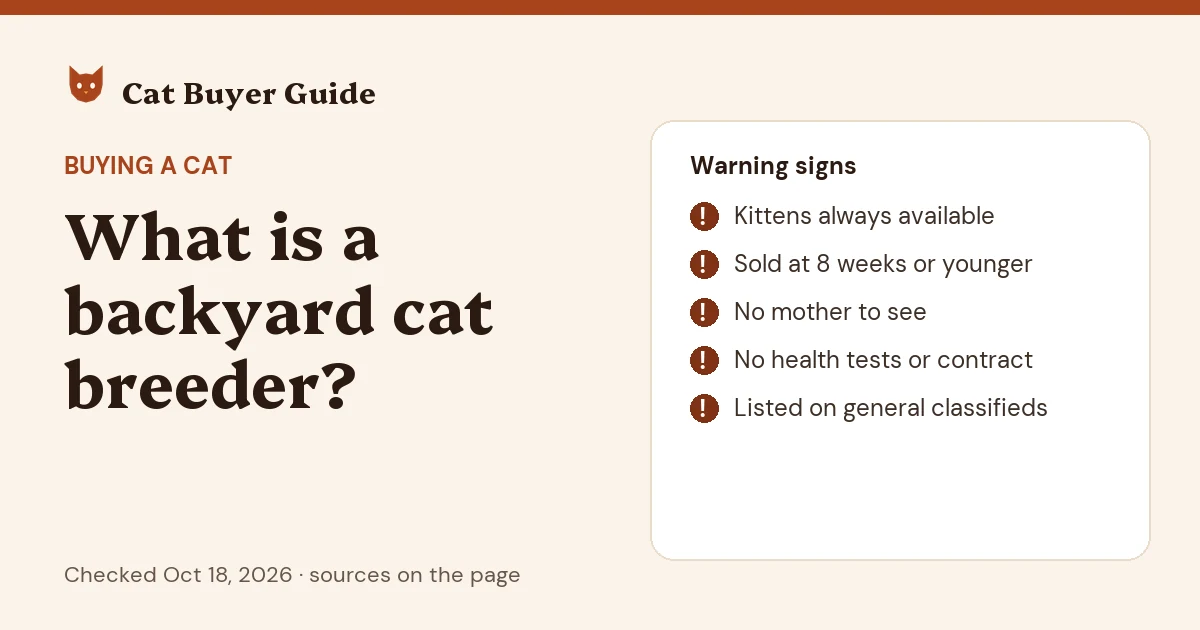
- How to tell: kittens always available, no health tests or contract, kittens sold young, no chance to see the mother.
- What to do instead: adopt, or buy from a breeder who tests the parents, keeps kittens to 12 to 16 weeks and gives you a written contract.
We checked each point below against welfare, registry, veterinary and federal sources on Oct 18, 2026. We don’t breed or own cats; this is a research guide.
On this page
- What is a backyard cat breeder?
- Backyard breeder vs responsible breeder
- Why buying from a backyard breeder is risky
- Are backyard cat breeders legal?
- How to spot a backyard cat breeder
- What about an accidental litter or a free kitten?
- Better options than a backyard breeder
- If you already bought from a backyard breeder
- Backyard cat breeder FAQ
What is a backyard cat breeder?
The clearest definition comes from RSPCA Australia: backyard breeding is irresponsible breeding in inadequate conditions with insufficient care, often by people with little experience or knowledge. What sets these breeders apart from responsible ones, the RSPCA says, is that they don’t meet acceptable standards of care and breed whether or not there’s a known demand for the kittens.
It happens in three main ways, according to the RSPCA:
- By accident. An owner didn’t have a cat spayed or neutered, and she got pregnant.
- On purpose, for the “experience.” Some people let a pet have a litter because they think it’s good for the cat or for their children to see. The RSPCA calls these not valid reasons.
- On purpose, for sale. Cats are bred to sell the kittens, without the health testing and care a good breeder gives.
When this is done at scale it’s called kitten farming, or a kitten mill. The ASPCA uses “commercial breeders” for facilities that produce animals in high numbers, generally to sell through a broker, a pet store or another third party, and doesn’t support buying from them.
A backyard breeder isn’t the same as a scammer. A kitten scam sells a kitten that may not exist. A backyard breeder has real kittens; the problem is how they were bred and raised.
Backyard breeder vs responsible breeder
| Backyard breeder | Responsible breeder | |
|---|---|---|
| Why kittens are born | Accident, or to sell | Planned, often with a waiting list |
| Parents’ health | Often untested | Breed-specific tests, results shown |
| Age kittens leave | Can be under 8 weeks | Usually 12 to 16 weeks |
| Where kittens grow up | Anywhere, little handling | In a home, handled daily |
| Paperwork | Little or none | Contract, health and vaccine records |
| After the sale | No follow-up | Advice, and takes the cat back |
| Spay or neuter | Not required | Done, or required by contract |
This table is our summary of the ASPCA’s criteria for responsible breeding (written mainly about dogs, though the ASPCA says they apply in part to cats), CFA, International Cat Care and the Kitten Checklist. Under the ASPCA’s criteria, a responsible breeder screens the parents for inherited problems, doesn’t mate parents with offspring or brothers with sisters, lets buyers see where the kittens are raised and meet the litter and preferably both parents, gives accurate health and pedigree records, sells directly to owners rather than through a broker, and will take a cat back at any time.
Why buying from a backyard breeder is risky
Health problems
Inadequate nutrition, infectious diseases, parasites such as fleas and worms, and genetic abnormalities are common where breeding is careless, the RSPCA says. A seller who puts money before welfare may skip vet care, warns the UK charity Cats Protection, and a buyer can be left with big vet bills, or a kitten that doesn’t survive. If a place is dirty, smelly and full of cats and kittens, be wary: good hygiene is essential to keep kittens healthy, International Cat Care says.
Kittens sold too young
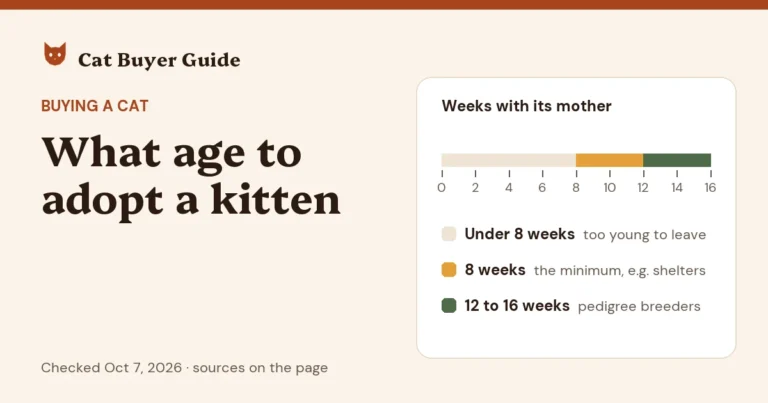
Kittens shouldn’t leave their mothers before 8 weeks: in that time they get nutrients and antibodies from her milk and learn grooming, toileting and play, Cats Protection explains. It warns that some sellers advertise kittens as older than 8 weeks and sell them younger. Pedigree breeders usually keep kittens longer: most let them go at 12 to 16 weeks depending on the breed, CFA says, and calls kittens that leave very young a red flag. Federal rules also bar shipping a kitten under 8 weeks old (9 CFR 2.130). See what age to bring a kitten home.
A fearful adult cat
Kittens learn to be comfortable with people from about 3 to 8 weeks old, International Cat Care says, and a kitten that misses those experiences is likely to grow into a fearful cat. The Kitten Checklist, from a group of UK vet and welfare organizations, puts the sensitive window at 2 to 9 weeks and says the person who bred the cat, “on purpose or accidentally,” carries a large responsibility for those early experiences. Kittens raised in outside pens, with too many litters for each to get enough handling, can miss them, International Cat Care notes.
Inherited disease and false pedigree claims
Many breeds carry inherited diseases that DNA tests can screen for, and responsible breeders test the parents; our red flags guide has examples. A backyard breeder rarely does. Some buyers have also paid pedigree prices for a kitten that turned out to be a regular non-pedigree cat, Cats Protection notes: only a cat with official papers from a breed registry is a pedigree.
More cats in shelters
Backyard breeding adds to the number of unwanted animals and to shelter numbers, the RSPCA says. In the US, about 3 million cats entered shelters and rescues in 2025, and about 2.2 million were adopted, according to the ASPCA.
Are backyard cat breeders legal?
Usually, yes. In the US, federal Animal Welfare Act rules require dealers to hold a license, but most small home breeders don’t need one:
- Four or fewer breeding females. Someone who keeps four or fewer breeding female pet animals in total, and sells only kittens born and raised at home, is exempt from federal licensing (9 CFR 2.1). The limit counts the whole household.
- Face-to-face sales. Sellers count as “retail pet stores,” which are also exempt, when the buyer and the animal are physically present so the buyer can see the kitten before buying or taking it (9 CFR 1.1).
- Age. Shipping or handing a kitten to a carrier under 8 weeks old, or before it’s weaned, breaks federal rules (9 CFR 2.130).
So a home breeder without a federal license isn’t breaking the law, and isn’t inspected either. A license wouldn’t prove good care anyway: it’s required of dealers, and the ASPCA advises against buying from commercial breeders, brokers and pet stores. State and local rules vary, so check your state’s laws on breeders and pet sales.
How to spot a backyard cat breeder
The signs overlap with our full list of cat breeder red flags. The ones that point most to a backyard breeder:
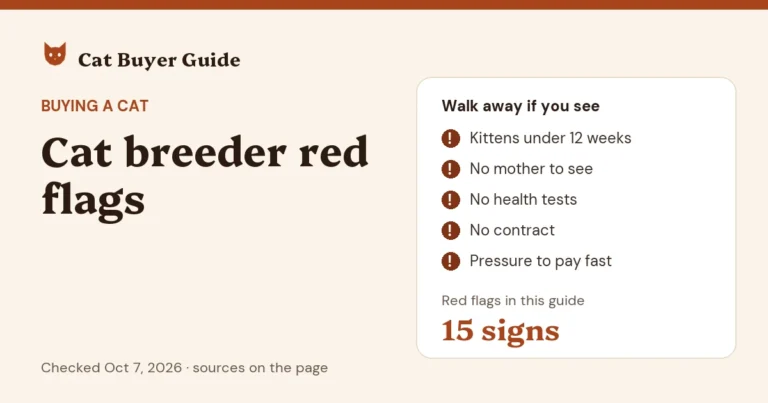
- Kittens are always available. Most breeders don’t have many kittens at once, and with most good breeders you’ll have to wait (CFA).
- Kittens are sold at 8 weeks or younger, or the seller is vague about their age.
- You can’t see the kitten with its mother. The Kitten Checklist calls this vital: it shows the kitten was bred there, not “farmed” or imported illegally.
- No health tests, no records, no contract. Ask about breed-specific health testing, vaccines, worming and a vet check, and expect a contract and paperwork (CFA).
- The listing is on a general classifieds site. CFA says you won’t find reliable breeders on Craigslist or other sites that aren’t just for cats.
- The place is dirty, smelly and crowded with cats (International Cat Care).
- The seller asks you nothing about your home and plans. A good breeder wants to make a good match (ASPCA).
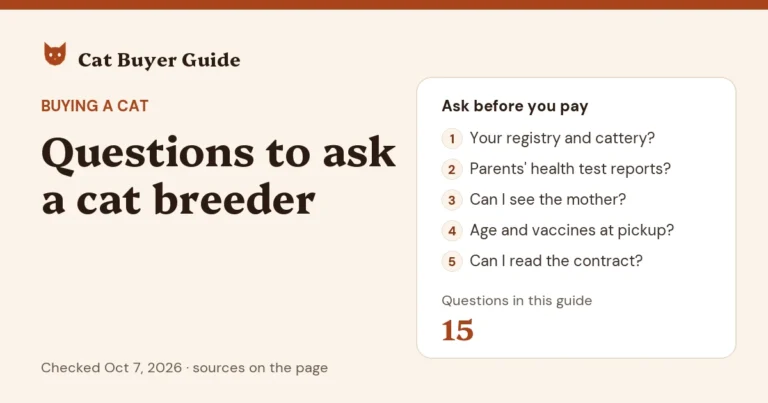
Our list of questions to ask a cat breeder helps you check these before you visit.
What about an accidental litter or a free kitten?
Not every kitten from a home litter is a bad start. The Kitten Checklist says the same checks apply whether the kitten is free or paid for, pedigree or not, from a charity, a private home or a breeder. A kitten born in a pet home should be with its mother until 8 weeks old, and ideally has grown up among people and everyday home life. Ask to see it with its mother, check it looks healthy, ask what vet care it has had, and plan a vet visit, vaccines and a spay or neuter.
The fix for accidental litters is simple. The Feline Veterinary Medical Association supports spaying or neutering cats not meant for breeding by 5 months of age, because a cat can be able to breed as early as 4 to 5 months, without obvious signs. See when to spay or neuter a kitten and what it costs.
Better options than a backyard breeder
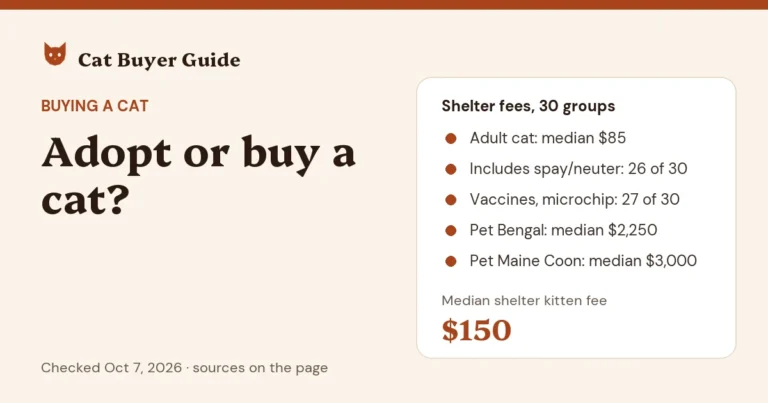
- Adopt. The ASPCA’s advice is to consider a shelter or rescue first. Shelters often spay or neuter kittens before adoption, many rescue kittens have had at least one vaccination (International Cat Care), and many shelters have older cats that may suit you better than a kitten, the Kitten Checklist notes. Our guide to whether to adopt or buy a cat compares the costs.
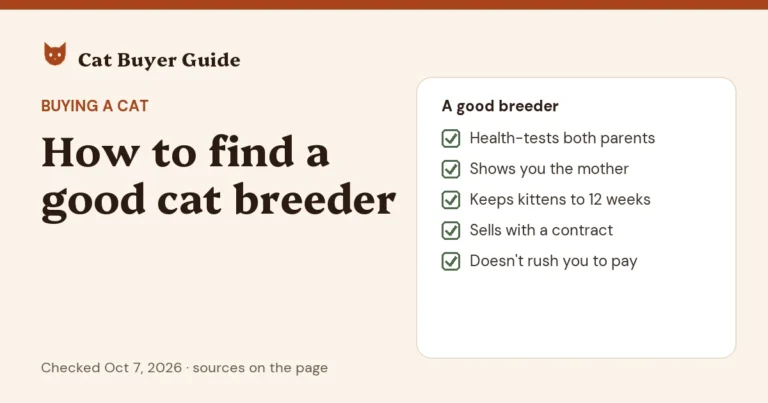
- Buy from a responsible breeder. Look for one who tests the parents, raises kittens in the home, keeps them until 12 to 16 weeks and gives you a contract. Our guide to choosing a cat breeder explains how to find and check one.
- Be ready to wait, and to walk away. International Cat Care advises against buying a sick or scared kitten out of pity to “save” it.
If you already bought from a backyard breeder
- Book a vet visit in the first few days, and take any records you were given.
- Ask about FeLV and FIV testing. The AAFP’s retrovirus guidelines say cats should be tested as soon as possible after they’re acquired, and that one test doesn’t always settle it.
- Catch up on vaccines, worming and a spay or neuter on your vet’s schedule (see our kitten vaccination schedule).
- Give a shy kitten time. Kittens keep learning after 8 weeks, International Cat Care says, but if the early basics are missing there may be little to build on, so a kitten that missed them may stay wary.
- Suspect a scam or neglect? See the reporting steps in our red flags guide and kitten scam guide.
Talk to your vet
A kitten from an unknown background should see a vet soon after it comes home, and sooner if it stops eating, has diarrhea, or has discharge from its eyes or nose. Your vet will decide which tests, vaccines and parasite treatments it needs, and when to spay or neuter.
Backyard cat breeder FAQ
Is a backyard breeder the same as a kitten mill?
They’re close relatives. The RSPCA uses “kitten farming” for irresponsible breeding on a large scale; a backyard breeder is usually smaller, often one home. The ASPCA’s “commercial breeders” produce kittens in high numbers to sell through brokers, pet stores or websites.
Is every home-based cat breeder a backyard breeder?
No. The Kitten Checklist says the ideal start for a pet kitten is to be born into a home among people, and a reputable breeder’s kittens stay with their mother until about 12 or 13 weeks. What matters is how the cats are cared for: tested parents, clean conditions, daily handling, kittens kept to the right age, and a written contract.
Does a USDA license mean a breeder is good?
No. A small home breeder with four or fewer breeding females, or one who sells face to face, doesn’t need a federal license (9 CFR 2.1). Licenses are for dealers, and the ASPCA advises against buying from commercial breeders. Check the breeder against the signs above instead.
Are backyard bred kittens cheaper?
Not always, and the price isn’t the whole cost. Cats Protection reports buyers paying pedigree prices for kittens that turned out not to be pedigrees, and warns that kittens from irresponsible sellers can bring high vet bills. For what pedigree kittens cost from catteries, see our breed guides, such as the Bengal, Maine Coon and Ragdoll cost guides.
Sources
- RSPCA Australia: What is a ‘backyard breeder’? (2024), checked Oct 18, 2026
- ASPCA: Position Statement on Criteria for Responsible Breeding, checked Oct 18, 2026
- ASPCA: US Animal Shelter Statistics (2025 data), checked Oct 18, 2026
- CFA Cat Talk: Could This Kitten Be A Scam? (Hoos, 2025), checked Oct 18, 2026
- International Cat Care: Choosing a kitten (2025), checked Oct 18, 2026
- The Cat Group: The Kitten Checklist (via International Cat Care), checked Oct 18, 2026
- Cats Protection: 5 reasons why buying a kitten online may not be cute, checked Oct 18, 2026
- 9 CFR 2.1, Animal Welfare Act licensing and exemptions, via Cornell LII, checked Oct 18, 2026
- 9 CFR 1.1, Definitions (retail pet store), via Cornell LII, checked Oct 18, 2026
- 9 CFR 2.130, Minimum age requirements, via Cornell LII, checked Oct 18, 2026
- Feline Veterinary Medical Association (AAFP): Pediatric sterilization in cats, position statement, checked Oct 18, 2026
- AAFP: 2020 Feline Retrovirus Testing and Management Guidelines (Little et al., JFMS), checked Oct 18, 2026