How to Buy a Kitten (or a Cat): 8 Steps, Real Prices and Safe Payment

Built from dated data and expert sources, not hands-on pet testing. Facts and prices checked October 27, 2026. No affiliate links on this page. How we research
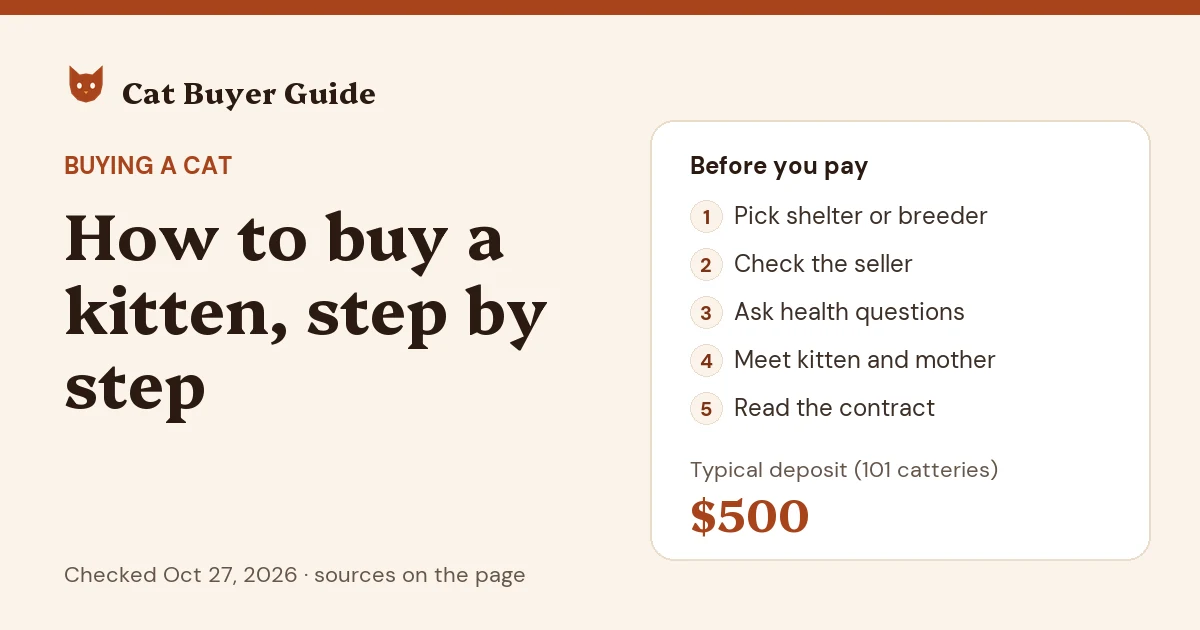
How do you buy a kitten? Decide what kind of cat you want and what you can spend, then get it from a shelter, a rescue or a registered breeder you have checked yourself. Talk to the seller by phone or video, see the kitten and its mother, read the contract, and pay a deposit only after all that, ideally by credit card. Then book a vet visit for the first days at home.
Buying a cat isn’t hard, but the order matters. Most of what goes wrong (a sick kitten, a lost deposit, a scam) happens when someone pays first and checks later. The steps below follow veterinary and official advice from International Cat Care, the Cat Fanciers’ Association (CFA), Cornell’s Feline Health Center and the FTC. The deposit and payment numbers are our own, from the websites of 132 US catteries.
How to buy a kitten in 8 steps
- Decide: kitten or adult, pedigree or mixed breed.
- Set a budget: the cat, then the first year.
- Choose where to get it: shelter, rescue or a registered breeder.
- Check the seller before you pay anything.
- Ask the questions that matter: health, vaccines, guarantee, returns.
- Meet the kitten and its mother, in person or on video.
- Read the contract, then pay the deposit the safe way.
- Bring it home to a ready house, and see a vet within days.
On this page
- Step 1: Decide what kind of cat you want
- Step 2: Set a budget (how much to buy a kitten)
- Step 3: Choose where to get your cat
- Step 4: Check the seller before you pay
- Step 5: Ask the questions that matter
- Step 6: Meet the kitten and its mother
- Step 7: Read the contract, then pay the deposit safely
- Step 8: Bring your cat home and see a vet
- How we got the deposit and payment numbers
- How to buy a kitten: FAQ
Step 1: Decide what kind of cat you want
Start with the cat, not the listing. A cat is a long commitment: International Cat Care talks of 14 to 15 years or longer, and CFA says cats often live 15 years or more with good care.
- Kitten or adult? Cornell’s Feline Health Center says kittens are playful and energetic, and you can shape how they grow up. An adult’s personality is already set, so you know better how it will fit your home.
- Pedigree or mixed breed? Both make excellent companions, Cornell says. A pedigree’s size, looks and, to some extent, personality follow its breed. A mixed-breed kitten’s adult size and looks are harder to predict.
- Coat and care. Longhaired cats need daily combing or brushing, CFA says. Some breeds need extra care, like the flat-faced Persian’s eyes.
If you’re unsure, our adopt or buy guide compares the two routes on price and what’s included. If you’re set on a breed, buying a pedigree cat covers papers, contracts and health tests.
Step 2: Set a budget (how much to buy a kitten)
There are two costs: the cat, and everything after. Here is what the cat itself cost in our own data.
| Where you get it | Typical price | Our data |
|---|---|---|
| Shelter or rescue, adult | $85 (median) | 30 US shelters and rescues, Oct 7, 2026 |
| Shelter or rescue, kitten | $150 (median) | same 30 |
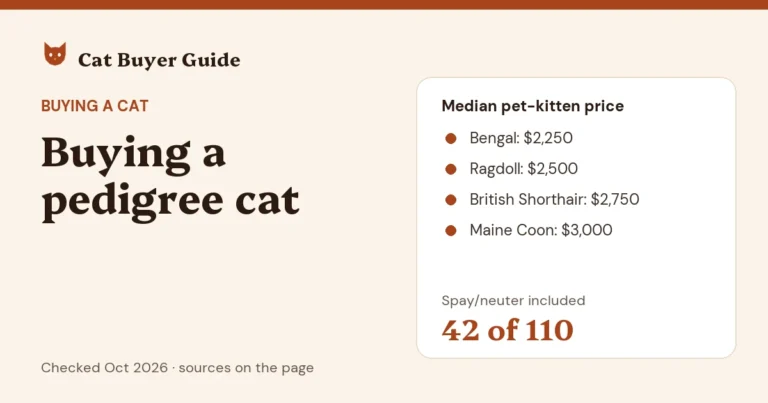
| Bengal from a breeder | $2,250 (median) | 30 catteries, Oct 7, 2026 |
| Ragdoll from a breeder | $2,500 (median) | 31 catteries, Oct 17, 2026 |
| Sphynx from a breeder | $2,675 (median) | 22 catteries, Oct 24, 2026 |
| British Shorthair from a breeder | $2,750 (median) | 24 catteries, Oct 20, 2026 |
| Maine Coon from a breeder | $3,000 (median) | 25 catteries, Oct 7, 2026 |
Adoption fees usually include more than breeder prices do. Most of the shelter fees we checked already cover the spay or neuter and first vaccines; at breeders, it varies. The breed guides (Bengal, Ragdoll, Sphynx, British Shorthair, Maine Coon) show what each cattery includes.
Then add the start-up costs. Our new kitten checklist puts the must-have supplies at $131 to $349 and the first vet care at $308 to $1,158 (checked October 7, 2026). The full first year is in our guide to how much a cat costs. CFA’s advice is blunt: if you can’t afford vet care or the basics right now, you may want to wait.
Step 3: Choose where to get your cat
International Cat Care names three good routes: a good breeder, a good rehoming or rescue center, or a friend or family member whose cat had a litter. Wherever you go, it says to be ready to walk away if you don’t like what you see or hear.
- Shelters and rescues. The FTC suggests starting with a local rescue or shelter, and notes there are rescues for specific breeds. That’s also how to buy a rescue kitten: you pay an adoption fee and usually sign an agreement, often to spay or neuter. International Cat Care adds that not every rescue does well by its cats. A good one takes in only as many cats as it can care for, gives them vet care, and keeps the risk of disease down.
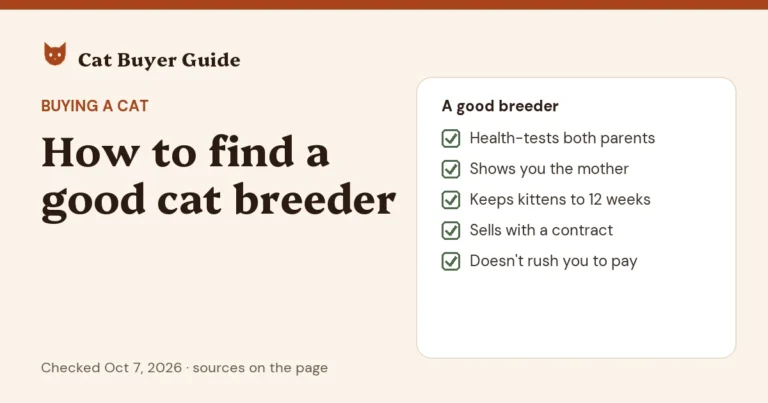
- Registered breeders. For a pedigree, look in the breeder lists of CFA or TICA, or meet breeders at a cat show, as CFA suggests. A listing tells you where to start, not that the breeder is good, so you still check them (step 4). Our guide to how to choose a cat breeder shows what to look for.
- Pet stores, dealers and ads. CFA says reputable breeders don’t sell their kittens through pet stores, and that pet-store kittens sometimes come from “kitten mills”. International Cat Care says to avoid kittens advertised through dealers, and to vet an ad’s seller as carefully as anyone else. Our guide to backyard cat breeders explains the risk.
Watch out for: a breeder with many litters of different ages and breeds, or rooms full of cats. International Cat Care says to look elsewhere. What you want is a home like your own, clean, with a healthy, confident mother cat and lively kittens.
Step 4: Check the seller before you pay
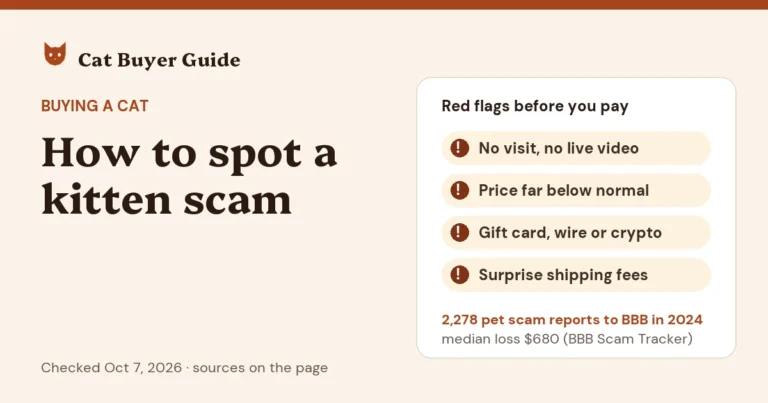
Kitten scams are common, and they work by getting money first. The FTC’s checks are quick:
- Search the seller’s name with words like “complaint” or “scam”.
- Run the photos through a reverse image search. Stock photos or pictures copied from elsewhere mean move on.
- Ask for a visit or a video call. Real shelters, rescues and breeders want to know you and the cat are a good match. If a seller won’t meet, video chat or even talk by phone, the FTC says to move on.
- Find the contact details yourself, from a registry listing or the breeder’s own site, not from an ad.
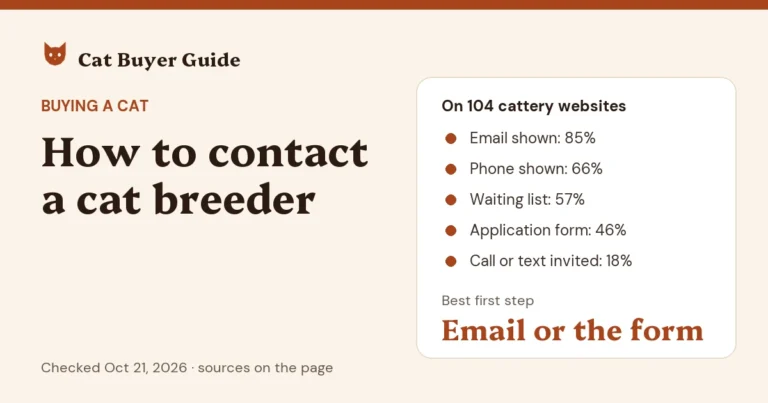
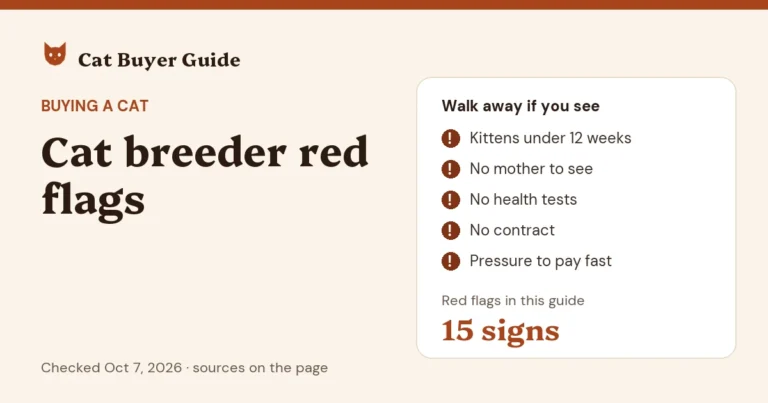
Our guides to kitten scams and cat breeder red flags go through the warning signs in detail, and how to contact a cat breeder shows what a good first message looks like.
Step 5: Ask the questions that matter
International Cat Care suggests asking questions before you even view a litter, and looking elsewhere if the answers don’t satisfy you. These come from its kitten advice and CFA’s list of questions for breeders:
- How old is the kitten, and when can it come home?
- Has it been raised in a home, around people, noises and visitors?
- Which vaccinations has it had, when, and when is the next one due? (Ask for the certificate.)
- Has it been treated for worms and fleas, and with what?
- Has the litter been healthy, and is the mother healthy? Have the parents been tested for feline leukemia (FeLV)?
- For a pedigree: which inherited diseases are the parents tested for?
- Is there a health guarantee? How long, and what does it cover?
- What happens if it doesn’t work out? Will you take the cat back?
- What food and litter is it used to?
Our full list, with what a good answer sounds like, is in questions to ask a cat breeder.
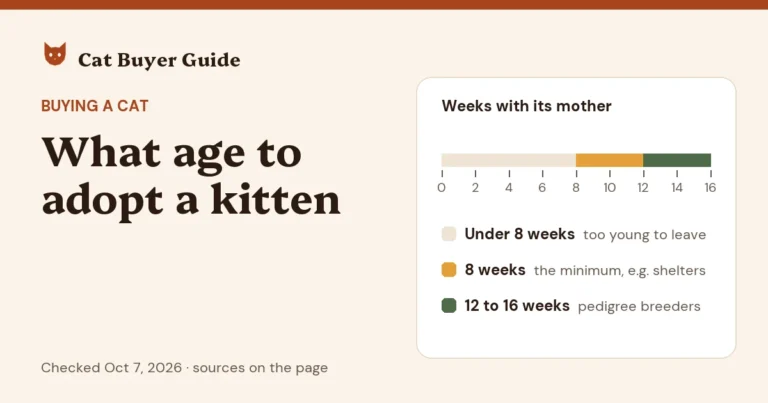
Age matters. CFA says to steer away from kittens younger than 8 weeks. International Cat Care says pedigree kittens usually go home at over 12 weeks, and other kittens at around 8 weeks. Our guide to what age to adopt a kitten explains why.
Step 6: Meet the kitten and its mother
See the kitten in person if you can, or on a live video call if the breeder is far away. Ask to see the mother and the rest of the litter too, International Cat Care says, to check they’re healthy.
What a healthy kitten looks like, from Cornell and International Cat Care:
| Look at | Good sign | Ask about it if you see |
|---|---|---|
| Eyes and nose | Bright, clean | Runny eyes, sneezing, discharge |
| Ears | Clean inside | Dark, tar-like dirt or discharge |
| Coat | Glossy, full | Bare spots, dandruff, fleas |
| Body | Neither thin nor pot-bellied | A very thin or swollen belly |
| Under the tail | Clean | Dirty or sore (diarrhea) |
| Behavior | Friendly, playful, curious | Hiding all the time, or very sleepy |
Signs like these are a reason to ask questions and to involve a vet, not a diagnosis. International Cat Care also warns against buying a sick or scared kitten out of pity, just to get it out of a bad place: you may take on health or behavior problems you’re not ready for.
Step 7: Read the contract, then pay the deposit safely
Most breeders ask for a deposit to hold a kitten. Before you pay one, read the contract or purchase agreement. CFA says nearly every pedigree breeder will ask you to sign one about spaying or neutering. Check the price, what it includes, the health guarantee, the return policy and what happens to the deposit if either side backs out.
Here is what 132 US catteries in our five breed studies posted about deposits and payment.
| Deposits and payment | What we found |
|---|---|
| Catteries that state a deposit amount | 101 of 132 |
| Typical deposit | $500 (median), from $100 to $1,500 |
| Deposit of exactly $500 | 49 of the 101 |
| Deposit as a share of the kitten’s price | 18% (median), from 3% to 50% |
| Use the word “non-refundable” in their terms | 61 of the 101 |
| Accept a payment app (Zelle, Venmo, PayPal, Cash App, Apple Pay) | 30 of the 34 that list how to pay |
| Mention a credit or debit card | 6 of the 34 |
So paying a real breeder by payment app is common. That doesn’t make it safe if the seller turns out not to be real. The FTC says payment services like Venmo make it hard to get your money back, and that a credit card, if you have one, gives you the most protection. It also says nobody legit will require a gift card, a wire transfer (such as MoneyGram or Western Union) or cryptocurrency.
The safe order: check the seller (step 4), talk by phone or video (step 6), read the contract, then pay. If a breeder only takes a payment app, you rely entirely on your own checks, so do them first. Keep the contract, receipts and messages.
Step 8: Bring your cat home and see a vet
Before the cat arrives, Cornell says to have the basics ready: a litter box, food and, ideally, a scratching post. Our new kitten checklist has the full list with prices, and our litter box, carrier and scratching post guides compare models. Ask the seller what food and litter the kitten is used to, and switch slowly if you change them.
See a vet in the first days
Cornell says any new cat should be checked by a veterinarian as soon as possible after it comes home. If you have other cats, keep the newcomer apart until the vet has examined it, especially if its health history isn’t known. Bring the vaccination certificate and any records from the seller. Your vet will check for parasites and plan the rest of the kitten vaccination schedule and the spay or neuter. Talk to your vet about anything you noticed at the visit.
The first days are about settling in. Our guide to the first week with a new kitten walks through them.
How we got the deposit and payment numbers
How we got these numbers
- Where: the 132 US catteries in our five breed-price studies: Bengal (30 catteries) and Maine Coon (25), checked October 7, 2026; Ragdoll (31), October 17; British Shorthair (24), October 20; Sphynx (22), October 24. Each study read the catteries’ own websites; the method is on each breed’s page.
- Deposits: the deposit amount each cattery posted, one per cattery. “Share of price” divides it by that cattery’s lowest posted pet-kitten price.
- “Non-refundable”: a count of catteries whose recorded deposit terms use the word. It can refer to the deposit itself or to a waiting-list fee.
- Payment methods: recorded only in the three newer studies (Ragdoll, British Shorthair, Sphynx: 77 catteries), of which 34 said how they take payment.
- Raw data: one row per cattery, recomputed from the five study files on October 27, 2026.
Limits: these are what catteries posted, not what every breeder does; the catteries claim CFA, TICA or other registration, which we didn’t check in the registries; and some sites have changed since the dates above.
How to buy a kitten: FAQ
How much does it cost to buy a kitten?
At the 30 US shelters and rescues we checked, a kitten’s adoption fee had a median of $150 (October 7, 2026). From a registered breeder, a pet kitten’s median price ran from $2,250 (Bengal) to $3,000 (Maine Coon) in our five breed studies. Start-up supplies and first vet care add hundreds of dollars more.
Is it safe to buy a kitten online?
It can be, if “online” only means you found the seller online. Check the name for complaints, reverse-search the photos, insist on a phone or video call, and pay by credit card where you can. Never pay by gift card, wire transfer or cryptocurrency: the FTC says no legitimate seller will require those.
Can I buy a kitten at 8 weeks?
CFA says to avoid kittens under 8 weeks. Many breeders keep pedigree kittens until about 12 weeks or more, International Cat Care says, and CFA says kittens offered at cat shows are usually at least 4 months old. See what age to adopt a kitten.
Should I pay a deposit by Zelle or Venmo?
Many real breeders take them: 30 of the 34 catteries in our data that list how they take payment accept a payment app. But the FTC warns that money sent that way is hard to get back. Pay only after you’ve checked the breeder, talked by phone or video, and read the contract, and use a credit card if the breeder takes one.
What paperwork should I get?
The signed contract or adoption agreement, receipts for every payment, the vaccination certificate, and records of worming, flea treatment and any tests. For a pedigree, ask how and when the registration papers come: some breeders send them only after proof of spay or neuter.
Sources
- Our data: deposits and payment terms at 132 US catteries from our five breed-price studies (Bengal and Maine Coon checked Oct 7, Ragdoll Oct 17, British Shorthair Oct 20, Sphynx Oct 24, 2026)
- International Cat Care: Where to get a cat or kitten (updated Sept 26, 2025), checked Oct 27, 2026
- International Cat Care: Choosing a kitten (updated Sept 26, 2025), checked Nov 2, 2026
- CFA: Finding the Purr-fect Pedigreed Kitten, checked Nov 2, 2026
- Cornell Feline Health Center: Choosing and Caring for Your New Cat, checked Oct 27, 2026
- FTC: Get the dog or cat instead of the scam (consumer alert), checked Nov 2, 2026